Saturday, May 17, 2014

Scapegoating the Body

This post links to RAnn's Sunday Snippets and Convert Journal

that's a relief

(This post is a bit of a sequel to the prior post.)

On April 30 I completed what I think is my 10th year of catechizing 6th-graders in Wednesday Night Sunday School. I love teaching, but I like to also sit down and have someone else be the teacher, especially if they really have something to teach. My classes are on Wednesday nights at the same time RCIA; and on Thursdays the parish offers lectures on assorted topics of interest to Catholics such as the Reformation, the Divine Comedy, and Islam. Both RCIA and the Thursday night series are led by our Director of Christian Formation T.J. Nielsen, who, like Goldilocks' porridge, is just right: brisk, informed, funny, comment-and-question oriented, and not too Powerpointy. But during the Catechetical year, having taught on Wednesday I don't wanna go back out on Thursday; so I attended only one of TJ's presentations before May, and two more since then. My loss. I may try harder next year.

When I hear anyone speak live about religion-philosophy-culture-society, it's usually from the pulpit on Sunday or a lectern during the week. I'm always catechetically assessing the moment-by-moment content of what I hear: do I cover that in class? If so, is this new content I can merge with what I already do? If I don't cover it, should I? How much time would it take? How would I teach it to kids? That sort of thing. It's affirming that most of what I hear from pulpit or lectern overlaps and harmonizes with lots of class content and thought-process, although the pitch is different. And even if there's no direct lesson-plan application of some memorable bit, inevitably some child will ask an off-the-wall question; and pow, I deliver an answer I mooched from someone else years ago.

So refining kids' content through exposure to adult thinking is second nature. But over the last couple of weeks being in TJ's class, I heard questions and comments coming from adults that I had already heard at least once from kids. And of course my 6th-grade answers were different from adult-type answers. So I felt constrained to strip the kiddie-approach out of anything I said before I commented. But still: meaningful adult content lay within children's catechesis, content that wasn't likely to emerge in an adult-only learning environment.

Last night's parish lecture on the Catholic Worldview included discussion of a human being comprising a unity of a body and a soul. TJ mentioned Manicheans and Gnostics, who align the Soul with light and the good; and the Body with darkness and evil.  A woman asked why Christian heretics such as the Cathars would reinvent those old ideas- after all, Genesis observes that everything was good. Now, kids don't ask questions about Cathars or Gnostics. But kids ask questions about how our bodies and souls go together; and discuss why people don't like to apologize or accept blame; why sin is bad; its effects; why bad things happen. In class, Body and Soul is a theme that runs all the way from Genesis through the Mass. There was a good, kid-type answer to that woman's question, but I had to think about it. After the lecture was over and people were chatting, I asked her if I could respond to her question especially with reference to the Genesis bit. She said sure.

I crouched down so I could touch the floor. "You're right that Genesis says everything God made was good. That means even stuff like rocks. It was all good 'cause everything that comes from God is good unless something messes it up. But Adam and Eve sinned, and God said to Adam, "Because you have listened to the voice of your wife, and have eaten of the tree of which I commanded you, 'You shall not eat of it,' cursed is the ground because of you." You may already know adama is Hebrew for earth, ground, dirt. So Adam was made from Adama and God's breath (I pretend to scoop up dirt, breathe into it, and mold it), and he was good. Now Mr. Dirt has sinned. But Adam's sin doesn't just affect Adam the man; Mr. Dirt's sin also curses the dirt, the adama (I angrily smack the floor), because they are connected. Adam sins, and all Creation pays for it. Now nobody wants to think their sins have such repercussions; but I think when I sin, it may have some bad effect centuries or light years from here, like throwing a sin-rock into clean, calm water. I don't know how far the bad ripples will go, but I expect to be appalled when I find out. If God showed me right now all the bad I've caused, it'd probably kill me or at least drive me insane. And being prideful, I look for an easy way around that Matterhorn of guilt- you know, I'm not as bad as Hitler, or my prodigal brother, or Judas. Or my sins are just on me, so no biggie to get God's pro-forma forgiveness.

I expect everybody looks for that sort of out: one that lets us keep most of our pride intact. So people take advantage of a major consequence of sin: death. See, death separates the body and soul, and the body belongs to the visible, physical world, which we already know is a mess: famine, plague, tornadoes, tigers, yuck! It was a mess before I got here! So that must be the problem: our souls, our invisible real selves are good and pure, and not morally responsible for being stuck in these lousy sin-prone bodies. This heresy simply scapegoats the Body, in order that the Soul may get a pass. A convenient construct, but a false one. A human being is singular, even if we can imperfectly perceive different aspects of that singularity. We're a bit like Jesus in that respect: Jesus comprises God/Man/Body/Soul all at once. But Jesus is singular; prying him apart is heretical. Likewise the Trinity: the three-ness is singular. Prying them apart is heretical.

The whole person sins. There's no Gnostic spiritual better-half with an eternal get-out-jail-free card. That's why there will be a Resurrection of the Dead before the Final Judgement: the whole person is good or bad, so the whole person will be judged. Ouch.

That's why that heresy remains popular. And it's why the Catholic Church is always clear about why it truly is heretical: the only out is true repentance, and the sacrifice of one's pride."

And that's also why we have, you know, Confession. Ouch again.

(Audio version here.)

Thursday, May 8, 2014

Sin and Weltanschauung

This post links to New Evangelizers and RAnn's Sunday Snippets

I think it's in that one

Last Thursday night I attended the first of two lectures at my parish on the topic of worldview. One thread ran like this:

The ultimate reality is God, who is all good. Therefore the worldview most attuned to reality is most likely to lead to holiness. I like that. Anyway, amid discussion, someone asked about Beauty- is it objective or subjective? And I was compelled to pontificate briefly.

When I was about 14 years old I began to notice that occasional smells, handwriting, tunes, color combinations, foreign word sounds, images, or voices had a druglike effect on me which was both very personal but also very transcendent. It had been true since I was a little kid. I still recall being mesmerized by the colors on a toy seaplane; and even until today, I can de-stress if I look at something purple (usually a necktie) and repeat the word "purple" a few times...mmm...purple. Go figure. Anyway, at 14 I began to wonder about the beauty within these bewitching bits of Creation: was it just my reaction to them, or were they beautiful on their own? That is, was Beauty objective or subjective? Did beauty exist, the way a rock exists? Or was it but a therapeutic figment of my imagination? If no-one sees beauty, is it still beautiful?

This was also when I was having to make my own mind up about God & All That without much success. Now that I think about it, this may be why I didn't have a girlfriend or a social life back then. Am I digressing?

So last night I commented that it took me about 20 years to realize that Beauty did indeed exist independently of my perception of it. And that once I got that settled, all the Godstuff fell into place in a way that tied into the worldview discussion. Put simply, God is Good/ Everything he made is Good/ Beauty is a manifestation of that intrinsic Goodness. As a wooden spoon reveals the beauty of the wood from which it's made, so does all Creation manifest the Beauty of God's Goodness. Easy, right? That took me 20 years. Thank ya Jesus for letting me live long enough to suss it out.

But further discussion led to how people often disagree about what's beautiful. Yes, that's so, people don't agree on all sorts of stuff. When I bump into problems like this, first I think about Eden- you know, before sin. Did Adam and Eve disagree? I doubt it. Their worldview was as aligned with reality as a human being's worldview can possibly be. What's to disagree about? They lived a holy life 24/7, hanging out with God in the shade of the Garden. Did they have God's worldview? Well, no. But their small, human worldview was in perfect harmony with God's...ya can't ask for more than that.

Then Sin entered the World, and messed up not just us, but Creation: hurricanes, carnivores, plagues, you name it. Not only does Sin cloud our view of beauty and everything else, but also degrades Creation itself. There's less Beauty to see, and it's harder to see it. Our whole existence is a grinding struggle against the continual physical and metaphysical consequences of our sins; speaking as an architect, I tell my wife that it's a wonder that we can stack one stone on top of another one. And all of us, isolated in our unique, mean little sin boxes, peek out at adulterated fragments of God's wonder, and inevitably argue about what we are looking at. It's impossible to underestimate the effects of Sin- indeed, Sin makes it so. Sin stunts us so that except for God's revelation, we have little choice but to grasp at mere batches of reality: always the snake, the tree trunk, the fan; but never the elephant.

Which is frustrating. As someone commented later on last night: there are so many conflicting ways of imagining God, so many ways to put God in a box, yet he remains unboxable. Yes again- but we can't be discouraged. Looking again at Eden, did Adam and Eve have to box little wads of data? Again, I doubt it. But we're stuck with boxes, we can't fix that. Yet we can always aspire to bigger boxes, and fewer boxes, which I think leads to a better understanding of God; and by extension, of reality. For example, the more I understand the Bible as a single box, the more it points to Catholicism, which unsurprisingly is the biggest box of Christian thinking; well, the biggest box of thinking, period.

Which gets us back to one's Weltanschauung, one's world-at-look-ing. I want the biggest one I can manage in a sin-wracked World; and the one most aligned with Reality. I want what Prof. Romano Guardini called Die Katholische Weltanschauung, the Catholic Worldview.

That's the topic of tonight's lecture.

photo by Skrewtape
     

Wednesday, April 9, 2014

Book & Blood

This post links to RAnn's Sunday Snippets and Convert Journal


Tonight we finished Revelations: Alpha & Omega, New Jerusalem, Wedding Feast of the Lamb; and jumped into the Mass. I start by drawing the Synagogue and the Temple. We review what happens in each place, their history, and who is in charge. In prior years, I'd say the Synagogue is for Reading, the Temple is for Offering, and a Catholic church is for Both. It's a good intro to the Mass, but hardly memorable.

But tonight after drawing the Temple, I impulsively added red-marker-blood out front to emphasize its sacrificial raison d'être. In doing so I careened into a pithier, catchier way of putting things:

Synagogue for Book.
Temple for Blood.
Church for Both.

Or as we'd say once the concepts were learned:

One for Book.
One for Blood.
One for Both.

I like that.

Saturday, March 29, 2014

Babies & Metaphysics

This post links to Convert Journal


not appreciating the cosmicness of it all

I was at lunch with my father earlier this week, we were discussing a favorite subject: God. Somehow we got around to contraception, and that in neither of our marriages was there any contraception, natural or artificial. We reflected on how much less our marriages would be if we had contracepted, and why that was so. This led to me pinpointing when in my life I embraced the idea that God was completely interested in, and aware of, every hair on my head. That God loved me personally, infinitely and uniquely. Such that now, decades later, I accept it like I accept gravity: a done deal.

I was in my early 30s when my understanding of God-stuff and Science-stuff merged into just Stuff, my own Grand Unified Theory. That is, it seemed to me as though all knowledge pointed toward God, and that lumping it all together worked better than keeping it in separate boxes. On the science-side I was especially prodded by Einstein's wonderful equation E = mc². It essentially says that Energy and Mass are interchangeable. Einstein said Energy and Mass are "manifestations of the same thing," sort of like 1 gallon = 4 quarts; or 1 kilo of ice = 1 kilo of water. That fit in well with something I read (I think it was in Hawking's A Brief history of Time) about the first moments of the Big Bang, when the universe was a small, hot, dense, churning continuum of matter and energy, both and neither at the same time. What is colloquially referred to as massergy.

So matter is a manifestation of energy; and I believe the source of that energy is God. And that God created the physical universe through some energy manifesting the characteristics of matter. That's why there was Light before there was the Sun or the Moon: first the Energy, then the Matter. Which reminds me on the religion side that Dante described the energy of the Universe as "L'amor che move il sole e l'altre stelle/ the love that moves the sun and the other stars."

You may also recall that at every step of Creation, God saw that it was good, at least until He noticed Adam lacked a wife. Why was it all good? Like Dante, I believe it's because the energy of the Universe is Love. That is, the Universe is 100% composed of God's love. Not love as how one feels, but love as a force; the generative force that sustains the Universe; the force that we may also understand as gravity or magnetism or light. Or as a rock. Or a drop of water. Or a hair on my head.

God is typically described as omniscient, omnipresent, omnipotent, and omnibenevolent; and in that order. I'm more inclined to put all-benevolent/ all-good/ all-loving first. Why? Because God could have the first 3 qualities and not be moved to create a single thing. God's all-loving nature manifested itself as Creation; that is, God "thought" love, and Creation resulted. Why, I bet Einstein would agree with me that Love and Creation are "manifestations of the same thing."  Put in Catechism class terms, Love Creates. Where there is Love, there is Creation. And where there isn't, there isn't. Think of Satan. He hates being made of, and sustained by, God's love. And he doesn't create a single good thing.

We also know from Genesis, and from simply being alive, that God shares with us humans the ability to love, so we create too. He gave Eve to Adam, and our quintessential creativity channels through married love: babies. So for us to contracept is to profoundly push against the entire loving-creative raison d'être of the Universe, its very fabric; and our own loving-creative natures, which we among all creatures uniquely share with God.

Friday, March 21, 2014

Kids Wanna Know

The next few posts link to RAnn's Sunday Snippets

Too Catechetical for Words

We had 28 class meetings on this year's Wednesday Night Sunday School schedule. Since New Year's we've lost two days to snow, plus about another 1/2 class to other events. The later in the year I lose classtime, the harder it is to compensate. I don't talk faster because we already move at the Speed of Comprehension. What I do instead is prioritize and eliminate, like Frederick the Great.

Two evenings ago we covered the Resurrection through the Ascension.  We use a handout showing an image of the Anastasis, and a Supper at Emmaus by Rembrandt. In covering the Anastasis, for reasons of time I didn't translate a couple of Greek abbreviations in the picture, although I did explain the Greek word Anastasis, and show the kids how to pronounce the letters. Then we moved on.

After class one of the kids asks, what do these two things mean, i.e., the IC and XC.


See, what I leave out is exactly what someone wants to know. I go over the squiggies and the letters. In moments like this when a child wants to know something particular, I always want to answer the question directly, but than add a bit that points to the bigger picture. So I say a bit about words on ikons, and also write on the board similar squiggied-letters that often appear in Mary-ikons: MP and ThY, which abbreviate Μητηρ Θεού MITIR ThEOU, Mother [of] God. It was a nice little lesson.

Now, this isn't just a chance to for a child to take away something extra; it's also a chance to involve the parents. Next week I'll give her a prayer card like this one:


Is has MR-ThY and also IC-XC. Thanks to reader Moonshadow, I understand that to the left and right are the Archangels Michael and Gabriel. The Greek says O AP M  (The ARchangel Michael) and O AP G (The ARchangel Gabriel). I'll write the translations on the back. I'll also get her to tell me what the angels are holding, and why they matter (they're a few of the Instruments of the Passion). I'm confident she'll know the cross and the spear. But what's that other thing? I blew it up for a closer look, and I think it's the sponge on the hyssop stick. She already knows what it is, it's just not easy to recognize. I expect to give her hints, e.g. "I thirst." I'll conclude by saying she oughta show her parents what she's learned and impress the heck out of them.

In this business you never know when or where stuff will grow. Just throw the seeds, you won't run out.

If I had all the time in the world, a whole class could be spent on this single image: its visual catechesis, Queen of Heaven, King of Heaven, Mother of God, Fully God, Fully Man, Immaculate Conception, Crucifixion, angels, the Greek words, all of which allude to Scripture and of course the Big Catholic Picture.

For those who want to know more about cryptic Greek on ikons, here's an old post about John the Baptist.

Book Review 8: Fr. Ryland's Memoir


I wrote this review about 6 weeks ago, then kind of forgot about it. Fr. Ryland died yesterday.

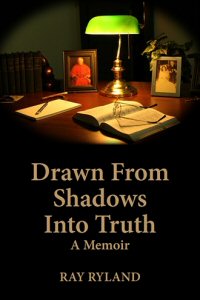
As usual I made a mistake by judging this book by its cover: Drawn from Shadows into Truth, A Memoir by Ray Ryland. I expected something nebulously reflective; I didn't get it. Instead, Father Ryland has recounted both his vivid and peripatetic life story, and his journey of faith, from his Disciples of Christ roots in Depression-era Oklahoma, to coming home to the Catholic Church. It is indeed a memoir in the conventional sense, but it also takes the reader through a lifetime of spiritual inquisitiveness, growth, change and maturation. The pace is measured, and we share in Fr. Ryland's gentle, decades-long philosophical development as a Christian, and ultimate fulfillment as a Catholic priest. I've read many conversions stories, but don't recall another that played out over such a long time, and with so many stops along the way.

Fr. Ryland remembers each person who influenced his faith, and takes careful time to show how their ideas and added to or altered his Christian worldview. Some were authors long dead; others were contemporaries. Among the authors he admires is Cardinal John Henry Newman, in whose own faith journey Fr. Ryland found encouragement. A few years ago I tackled Newman's Apologia pro sua Vita, but never finished it. The Cardinal's prose was just too difficult. But Fr. Ryland does a fine job of explaining Newman's thinking in a writing style that's clear, but not condescending.

What I most appreciate about Drawn from Shadows is its wide angle. Fr. Ryland became Catholic by thinking holistically for decades about the nature of Christ's Church, and where one might find it. If that sounds nebulously reflective, trust me, it's not. It was refreshing and exciting.

The last third of Drawn from Shadows comprises essays which treat aspects of Fr. Ryland's conversion one at a time, rather than following them as assorted threads through 50 years of faith-formation.

Recommended.


Monday, March 17, 2014

Outbrother


I suppose y'all periodically run into the "Jesus had brothers so Mary and Joseph were sexually intimate" idea. This is partly based on how Hebrew was translated into Greek; and how both Hebrew and Greek were/are translated into English, which IMNSHO is a terrible language in which to translate the Bible. English is a cataclysmic collision of Romance and Germanic tongues; an oil-and-water jumble of vocabulary, spelling, grammar, syntax, culture, worldview, history, and religion. A glorious language. In my opinion, the most glorious; but still, not an ideal language in which to translate other languages.

Anyway, the Brothers of Jesus Thing hinges on the Greek word αδελφός-adelphos-brother; and whether its meaning extends to relationships for which English has other, specific words...such as cousin. Or nephew. Or relative. 

In the Gospels we read:

"While he yet talked to the people, behold, his mother and his brethren stood without, desiring to speak with him."

"Then one said unto him, Behold, thy mother and thy brethren stand without, desiring to speak with thee.

"Jesus saith unto her, Touch me not; for I am not yet ascended to my Father: but go to my brethren, and say unto them, I ascend unto my Father, and your Father; and to my God, and your God."

So... are those brethren Jesus' brothers in the strict genetic sense of being male children of Mary? Or at least sons of Joseph from a previous marriage? I believe the Church is correct, that Mary is ever-virgin; and that Jesus was her only child. So the arguments don't much interest me. But I'm keen on the language aspects. I was curious: how often do languages have one word for brother; and a completely different word to express what we mean by cousin? Well....not often, and most of them use the same French word that we "English" speakers use.

I have Maronite Rite friends from the Levant who refer in English to their cousins as "brothers" unless they are being careful when making an introduction. Their first language is Arabic. In Arabic, cousin is expressed as uncle-son; but informally they are brothers.

In Hebrew, cousin is uncle-son.

In Hungarian, cousin is unoka-testvére, uncle-son.

In modern Greek, cousin is εξάδελφος, ex-adelphos, out-brother.

In Russian, cousin is двоюродный брат, dvayu-rodniy brat, second-born brother.

In Serbian, cousin is either bratranec or sestrična, based on the words for brother/ brat; and sister/ sestra.

In Hindi and Bengali, cousin is a two-part noun ?-brother, I can't figure out the prefixes.

So it's typical in most other languages for the English concept of "cousin" to be understood in terms of brother or son; especially in non-formal, traditional contexts, and where extended families are the norm.

And some languages have no native phrasing for cousin at all:

Turkish borrows from French: kuzen.

German borrows from French: Cousin

Polish borrows from French: kuzyn.

Swedish borrows from French: kusin.

And French imposed itself on English: cousin.

So- does "brother" in an English Bible necessarily mean "a male offspring having both parents in common with another offspring"? Not at all. And if English expressed "cousin" with phrasing that involved the word "brother" or "son" as many languages do, I doubt we'd even be having this discussion.