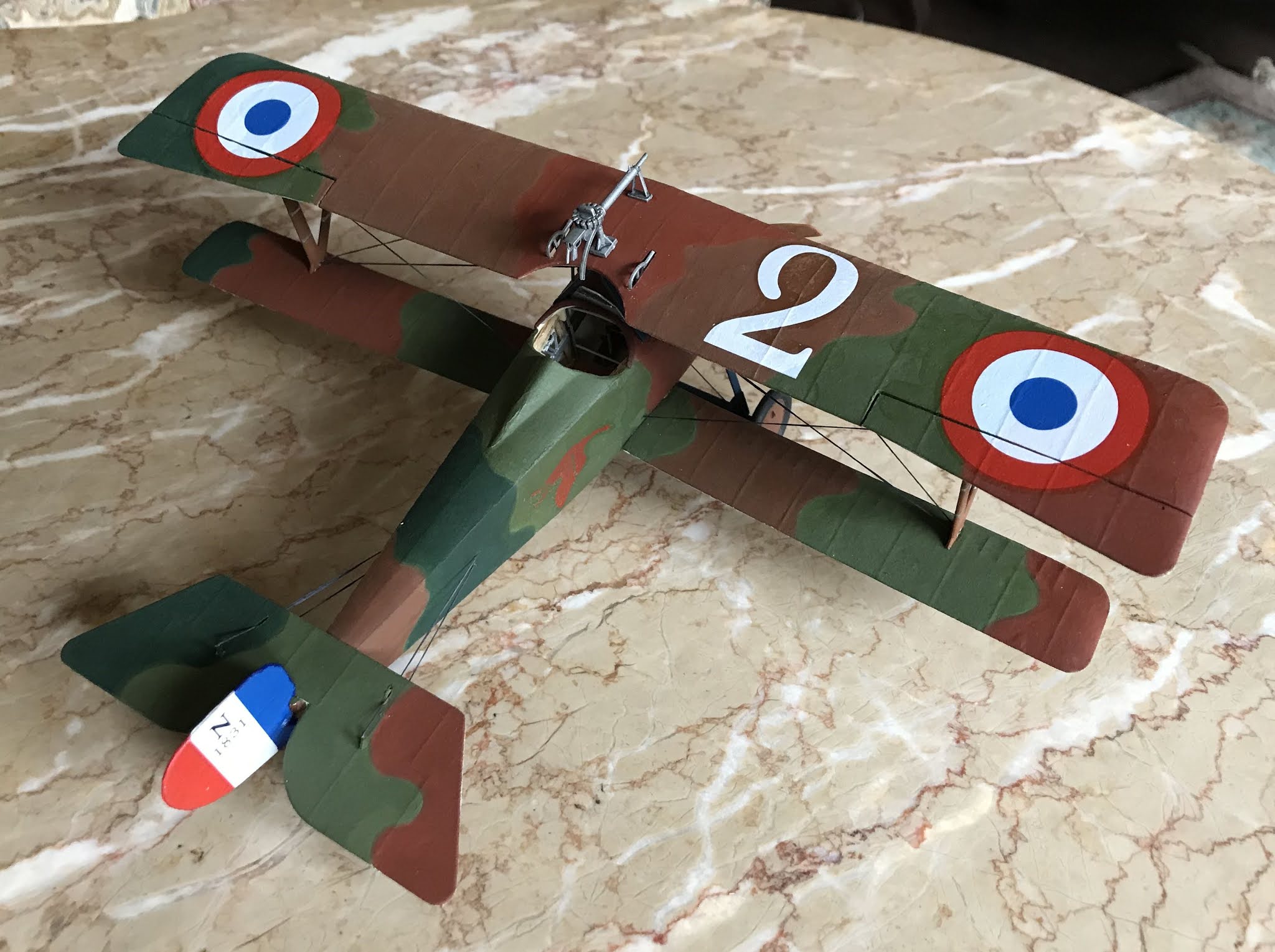
Showing posts with label French. Show all posts

Tuesday, November 2, 2021

Avion Français

 Pleasant little 2-weeker, 1/32 Nieuport 17. Lissome as a mosquito hawk. Handpainted with craftstore acrylics over balsa-plane tissue.


Tuesday, December 30, 2014

Le Mot Juste 3

This post links to RAnn's Sunday Snippets

A couple of days ago I couldn't think of a word, you know how it is. I described it to my wife, she drew a blank too. I looked at a couple of online Thesauruses, no luck. After 30 minutes it popped into my head; it was something like enervating or disinterested. That sort of word.

Then at dinner tonight we were discussing the flu going around. A daughter was drawing a blank on the word she wanted. She was saying the flu "passes on, it's easy to get sick." Oh yeah- flu is contagious.

New topic: English isn't all that English anymore, not since the 11th century when Guillaume le Bâtard, William the Conqueror, became King of England, and brought all that Latinate Norman French with him. About 45% of modern English is French-sourced: words such as impartial, attorney, celestial, venison, verity and velocity; but not words such as fair, lawyer, heavenly, deer, truth, and speed. And yes, words such as disinterested and contagious are also French-Latin.

So I have a little two-part hypothesis:

1. When an Anglophone can't remember a word, it's most likely to be a Latinate word like velocity, not a West Germanic word like speed.

2. The Anglophone will try to describe that forgotten word using mostly West Germanic words.

Considering that almost nobody speaks English with any awareness of where any word might have come from a thousand or more years ago, isn't it remarkable that this fundamental split in the language still exists subconsciously after so long? Is it merely syllable count? I doubt it. This must get at some inherent difference in how Romance and Germanic languages work at the most primal level. And do German speakers therefore think differently than we do, not having a French-soaked vocabulary and grammar? And likewise the French- what do they miss from not having West Germanic nuts and bolts in their tongue? Does English confer benefits on the speaker's brain from being dual-sourced? And when Germans or Frenchmen forget words and try to describe them- are there any patterns to the words sometimes forgotten or always remembered?

As we say in English: I. Don't. Know. But I do wonder.

Wednesday, June 29, 2011

Alice Meat

Really; indeed

This post is linked to RAnn's Sunday Snippets

There's a whole lotta John 6 on the Internet about this time every year. There's a whole lotta John 6 in Wednesday Night Sunday School, too. One of the key John 6 classroom verses reads:

"For my flesh is meat indeed: and my blood is drink indeed."  in the Douai-Rheims & KJV;

"For my flesh is food indeed, and my blood is drink indeed." in the RSV;

"For my flesh is real food and my blood is real drink." in the NIV;

and my preferred translation in the NAB, "For my flesh is true food, and my blood is true drink."

I find the word "true" a bit more compelling than "real," and way more compelling than "indeed". Truth is simply a more moral, profound and comprehensive concept than the other two. I don't see how real or indeed add anything to true; but they do take something away. St. Jerome must have agreed: his Vulgate reads, "Caro enim mea vere est cibus; et sanguis meus, vere est potus." You know: truly. English uses that Latin-French -ver- root in veracity, aver, very, and of course, Jesus' favorite, verily.

Uh-oh; now I'm curious about verse 55 in French...here we go:

"Car ma chair est vraiment une nourriture, et mon sang est vraiment un breuvage."  Yep, truly again.

And in Greek, the passage reads, "η γαρ σαρξ μου αληθως εστιν βρωσις και το αιμα μου αληθως εστιν ποσις," which is Greek to me, but the keyword ἀληθῶς/ alithos also means truly. You know, like in My Big Fat Greek Wedding when they give the Easter greeting: "Χριστός ἀνέστη! Xristos anesti! Christ is risen!" followed by the response, "Ἀληθῶς ἀνέστη/ Alithos anesti/ Truly risen!"

Ἀληθῶς-alithos is the adverb form of ἀλήθεια-alitheia-truth. So for example, when Pilate spoke to Jesus, he asked him, "What is alitheia?" And Jesus said of Himself, "I am the way, the alitheia, and the life." 

By the way, Alitheia is close to how Spaniards would pronounce Alicia, i.e., they softly lisp the s sound. Would Alicia/ Alice come from alitheia and mean Truth? Why, yes, it would.* Now I wonder about Martha-Marcia...why yes, Martha is Greek from Aramaic (mistress, the feminine of master). See, languages ain't so tough.

 I know this doesn't have to be the big deal for everyone else that it is to me. But in Catechism class, it's good to be able to draw parallels among: Pharisees saying Jesus is true; St. John writing that God is true; Jesus saying he's the Truth; Pilate looking right at the Truth and asking Him what is Truth; and Jesus flatly stating that his flesh is true food, his blood true drink.

Saying real or indeed in the last case takes the simple & straightforward and makes it complicated.

Is that fussy? Well, if your name were Alice, and you were to tell me what your name meant, what would you say?

Uh-huh.

*Some sources say Alice is Celtic; I think it's possible that in English the name could be conflated from both Greek and Celtic, but Alitheia seems closer than Adalhaidis.

Saturday, June 11, 2011

The Reticent Circumflex


 little hat- geddit?

French is just the greatest; who doesn't like French? And the Anglophone can step easily into French, because our English vocabulary has been enriched (that's right: enriched) with thousands and thousands of French words since 1066, when Francophone Vikings conquered England.

Or something.

Anyway, by recognizing some patterns in French, it's easy to know what the English sibling or cousin of a French word is likely to be. Of course any Anglophone can recognize train, couleur, honneur, fleur, raison, raisin, appetit, detour, porter, direct, and example. In these cases the English siblings are identical, or virtually so, and we don't need to know any patterns.

But here's a pattern in French that isn't so obvious: maître, fête, côte, bête, forêt.

The pattern is the little hat on the vowels; it's a circumflex; or le petit chapeau, the...little...hat. Often, but not always, the circumflex indicates the loss of the letter s from a word, per the examples above. If we add the s back we create (or at least approximate) the English cognates: master, feast, coast, beast, forest.

The circumflex indicates the lost s so often that it always pays to try the s in a circumflexed word just to see if it helps with the meaning. For example prêtre gives us prester, which is an older version of priest in English, as in Prester John. A favorite of mine is huître. Huister...is that English? Yes, but we spell it oyster. 

Don't worry if the s trick doesn't always work. For example, in rôle and diplôme it's a comment on the vowel sound. And I think sometimes the French use a circumflex just because they like how it looks.

Now you ask, if we got those words from the French, why do we say them with an s when they don't? Well, because the French still said them with an s in 1066. But the French language in England stopped changing, unlike the French in France, which kept getting more French. As Chaucer said of the Prioress around 1370:

And French she spoke full fair and fetisly
After the school of Stratford at-te Bow-e,
For French of Paris was to her unknow-e.

So the English kept the s (but sometimes in a French way: aisle, isle) as the French were letting it go. But if the French increasingly dropped the s in speech, the s didn't erase itself from French books. And I expect that Frenchmen who could write were not fond of spelling forest without its s even if nobody made the sound anymore. Does that seem unduly fussy? It's not- do you want to spell knight as it sounds? Me neither. So the French compromised: drop the s, but add the chapeau where it used to be.

But the circumflex doesn't indicate every case that an s has been dropped; see if you can figure these out: écorcher, école, étude, écrire, étonne. In these examples, adding the s gives us scorch, school, study, scribe, stun. The accent mark takes priority over the circumflex, which is implied though it's not there. So another lost-s pattern is French words which begin with an e followed by a consonant.

There's something else these lost-s-words have in common: they all are part of French's Latin patrimony. That is, école comes from schola; fête from festa; and maître from magister. And this next example is less obvious, but still solvable: château from castellum (fort, castle). But a caution is in order: not every lost-s-word comes from Latin. For example, étiquette lost its s, but its origin is Germanic. 

But sticking with the likelihood that a French lost-s-word is Roman in origin, consider how many words that makes available to you, the discerning pattern sleuth, in all the Latin-sourced tongues, the Romance languages. Remember, Latin originally was simply the language of Latium, the area of central Italy inhabited by the Latini tribe. As the Latin city-state of Rome extended its empire, so spread the Latin language. But the people in Hispania, for example, already spoke their own languages. So when Latin was imposed on them, they didn't speak it as Romans did, but altered it through their existing sensibilities of pronunciation and rhythm. As the Empire later receded, Latin persisted; but only as a local language. The Latin of Hispania wasn't the Latin of Gaul or Dacia, and these local versions would eventually be recognized by their speakers as languages separate from, other than, Latin. Of course Latin herself was also the child of older tongues, but in this post Latin is the only source we'll look at.

Consider the Latin word schola. In French it's école; in Italian, scuola; in Spanish, escuela; in Romanian, şcoală (shkoala). Each version of schola reveals a pattern of each language's rhythm and sound habits; and those patterns can apply to other words. Since this post is about French, let's try étudiant. It starts with an accented e followed by a consonant; assume it's a lost-s-word with an implied circumflex. So we add the s back to get éstudiant. Allowing for our English vowel preferences, we drop the e to get student. Judging from scuola, Italian doesn't add an e in the first place, but it does want to end with a vowel for reasons of rhythm: studiante, maybe? Close, it's studente. Spanish escuela suggests we keep the French e and add a vowel at the end for rhythm...estudiante? Yes indeed. And while in Romanian the word is student, it's worth remembering from şcoală Romanian's tendency to turn an initial s into sh, as we may do with strike and stranger. Thus when English says scholar, Romanian says şcolar (shkolar). 

Now this circumflex pattern is a small one; but it gives the English-speaker easy access through French to dozens of Romance words, and allows a student to jumpstart his foreign language vocabulary with just a bit of practice.  

Tuesday, February 1, 2011

Language and the Egyptian Revolution

While reading accounts of the developing events in Egypt, I notice repeated references to the Qasr Al-Nil Bridge, a popular meeting-place in Cairo. I like the word 'Qasr' because it shows up with the Arabic definite article al  in Spanish as Alcazar, meaning castle, fort. Many, if not most words in Spanish starting with al-, such as alcalde (judge, now mayor) are of Arabic origin, dating back to the Muslim conquest of the Iberian peninsula. And likewise many of the al- words in English also come from Arabic: algorithm, almanac, etc. ( Qasr Al-Nil = Fort on the Nile.)

 Anyway, seeing qasr this time reminded me that in Turkey they use another Arabic word for fort, hisar (mountain, fort), and I don't think they ever say qasr. By the way, German also conflates forts and mountains in the word burg/ berg; I suppose that's fairly common, forts tending to be sited on high ground.

Where was I? Oh, yeah, qasr. So I was wondering why Egyptians say qasr and not hisar. I think they must be the same word, and the Turks softened the k-sound to the h-sound. Just guessing (e.g., my Russian-born son used to pronounce house as chouse, like loch). But assuming they are the same word, there are still other words in Arabic & Turkish for castle and fort; why is qasr in use around the Mediterranean?

My guess is that in the 11th century the crusading Franks brought the Latin word castrum with them to the Holy Land, and the Arabs picked up the word there. Then the Turks got it from the Arabs. But, you say, French doesn't have the word castrum, they would've said castellum.  Yes, French retains the Latin word castellum (a fort smaller than a castrum, which strictly refers to a Roman legion's fortified encampment) first as chasteau, then château. But as late as the 13th century, the French in France were still using the old term castrum, which was applied to château-forts built by the French themselves, and which had no connection to any prior Roman work.

Notice how the Arabs dropped the t out of castr- as the French dropped the s from chasteau. Happens all the time.

So I'm amused to see castrum carried from Latium to Gaul; from France to the Levant; and from the Levant to Spain, where al-cazar now bumps against its old relation across the Pyrenees, château.

Tuesday, May 5, 2009

Naissance de Français

It'd be hard to overestimate the influence Latin has had on me. This post isn't about Latin, though, except indirectly. But if my mind hadn't been trained by Latin, this post wouldn't exist. Specifically because Latin was my entree to French; but generally because Latin gave me an intellectual framework, a cadre, on which to hang practically everything I've learned. Latin provided a Grand Unified Theory of Everything such that no information is of value only in its own category, but incrementally adds to a coherent whole, the Biggest Possible Picture. And in the past 15 years or so, I've come around to the idea that all knowledge points to God...because it seems like more and more that's what my life points to, and everything I know reinforces that....as if by accident.

Didn't I say this post isn't about Latin? That's right: it isn't. It's about...French? No....it's about people, and how God's creative energy infuses everything they do, especially when they speak.
In A.D. 842 a couple of Charlemagne's grandsons, brothers Ludwig and Charles, swore loyalty to each other and against third brother Lothar. The oaths they swore, and other information about the alliance, were recorded. What makes this otherwise mundane event fascinating is that while the clerks wrote their account of the event in Latin, they wrote Ludwig's oath in a kind of proto-French, the precursor to Old French, because that was the 'language' he was speaking when he took the oath; or to paraphrase Chris Tucker, because those were the words that were coming out of his mouth.

Why wouldn't Ludwig just speak Latin? Well, my guess is that he and the rustic Franks he was addressing thought he was speaking (vulgar) Latin, the Roman tongue. The clerks however, being familiar with written Latin, considered it something else. The Franks' vernacular Latin had diverged so far from written Latin that it was treated as another language.

Here's Ludwig's oath in English:

For love of God and for Christian people, and our common safety, of this day forth, as much as God gives me to know and to be able, I will protect this my brother Charles, and will aid him in each thing, as one in justice must protect his brother, in which he would do the same for me; and I will make with Lothar no pact, which of my will can injure this my brother Charles.

Here's what Ludwig said in the Rustic Roman of the day:

Pro Deo amur et pro Christian poblo et nostro commun salvament, d'ist di in avant, in quant Deus savir et podir me dunat, si salvarai eo cist meon fradre Karlo et in ajudha et in cadhuna cosa, si cum om per dreit son fradra salvar dift, in o quid il me altresi fazet, et ab Ludher nul plaid numquam prindrai, qui, meon vol, cist meon fradre Karle in damno sit.

Here it is in modern French:

Pour l'amour de Dieu et pour le chrétien peuple et notre commun salut, de ce jour en avant, en tant que Dieu savoir et pouvoir me donne, ainsi secourrai-je ce mien frère Charles, et en aide en chacune chose si comme homme par droit son frère sauver doit, en ce (à condition) qu'il me fasse autant; et de Lothair nul accord jamais ne prendrai, qui par ma volonté, à ce mien frère Charles à dam soit.

If you're familiar at all with Latin, you'll see right away that Ludwig's oath just isn't very Latin-y; my first impression was that it was some primitive type of Spanish or Italian (Deo, poblo, nostro, podir, fradre); then looking at other words, it seemed a bit French as well (dreit, plaid, prindrai).

So even though it's not very Latin, it's not especially French...yet. Like a newborn baby it's distinct and separate from its mother, but not fully formed. So I think of the Oath of Strasbourg as marking the birth of French. But regardless of how we might name it, ('Rustic Roman,' for example; thus books written in the new Frankish common tongue were Romances) it shows how rapidly people will change a language. Practical changes; and aesthetic changes, which interest me more. Changes of rhythm, lilt, vowel and consonant shifts, stress, eliminating or adding sounds to existing words, I assume are made collectively over generations to make language more beautiful. People just can't leave well-enough alone.

Funny: growing up, the only speaking I thought was beautiful were some Southern U.S. accents, not often heard in South Louisiana. In high school, I had 2 years of Spanish; I decided Spanish was lovely too. Then 2 years of Latin, plus a pre-Vatican 2 Catholic childhood: discovered Latin was elegant. Over the next couple of decades, using my Latin cadre, I've learned other languages, some fairly well, others just at a tourist level...or less....and surprise, they are all beautiful. My preferred way to learn them is by memorizing poetry or better yet, songs. Beauty and affection first, then vocabulary and grammar.

Decades ago I was struck by Jesus' admonition in Matt 25:
'Inasmuch as ye have done it unto one of the least of these my brethren, ye have done it unto me.' Could this be taken at face value? As many would put it: can you see God in other people? I decided to try. It was very artificial for the first few years, but I'm used to it now, though with room for improvement. Now virtually every good thing anyone does looks like God bursting out of them, like in Alien....bang! right out of their breastbones.

And that's how all language looks to me. Nameless, insignificant people in their millions create these beautiful systems, no two alike. A language contains not mere information, but also a way of thinking, a way of interacting with the world. People are created, born, little bits of God, but their creation continues under the influence of language. The power of language to shape our humanity is clear in this 1908 critique of the Polish-born polyglot author Joseph Conrad: "A writer who ceases to see the world coloured by his own language‑‑for language gives colour to thoughts and things in a way that few people understand‑‑is apt to lose the concentration and intensity of vision without which the greatest literature cannot be made." Yet Conrad said of himself: "...I have a strange and overpowering feeling that [English] had always been an inherent part of myself. English was for me neither a matter of choice nor adoption. The merest idea of choice had never entered my head. And as to adoption‑‑well, yes, there was adoption; but it was I who was adopted by the genius of the language..."

(As Peter Schramm's Hungarian father told his son in '56: we were born Americans, but in the wrong place.)

Both Conrad and his critic understood the power of language to affect who you are as a human being. The critic maintains Conrad can't be true to himself in English, Conrad responds that he can be true to himself only in English.

This gets to the point of the post....at last....part of the value of speaking another language even a little bit offers a glimpse of who you might've become, what culture you might've belonged to, who your fellow citizens might've been, but for the accident of birth. And through another language you make a human connection to strangers, even if it's no more than 'gracias/ de nada.'

It helps us see we're all children of God; and reminds us, as the clerks in 842 may have noticed to their annoyance, that those children continue His creation in every good thing they do.