Showing posts with label Mary. Show all posts

Saturday, November 30, 2013

Fine Art 11: Die Maria Schützt Euch

This post links to RAnn's Sunday Snippets

Let's jump right in: I read Die Weise von Liebe und Tod des Cornets Christoph Rilke for the first time in 1982. Here's the backstory, but you don't have to look at it. All you need to know is that the Cornet is a prose poem in German, and an elegant introduction to the language.

Yesterday I was admiring Hans Holbein's portrait of St. Thomas More:

So much of who I think More is comes from this painting. And the same is true for Holbein's portrait of Henry VIII. And Erasmus. And Anne of Cleves. So I started aimlessly browsing all the Holbeins I could find, because you can often see a lot just by looking. By and by I came across this one:

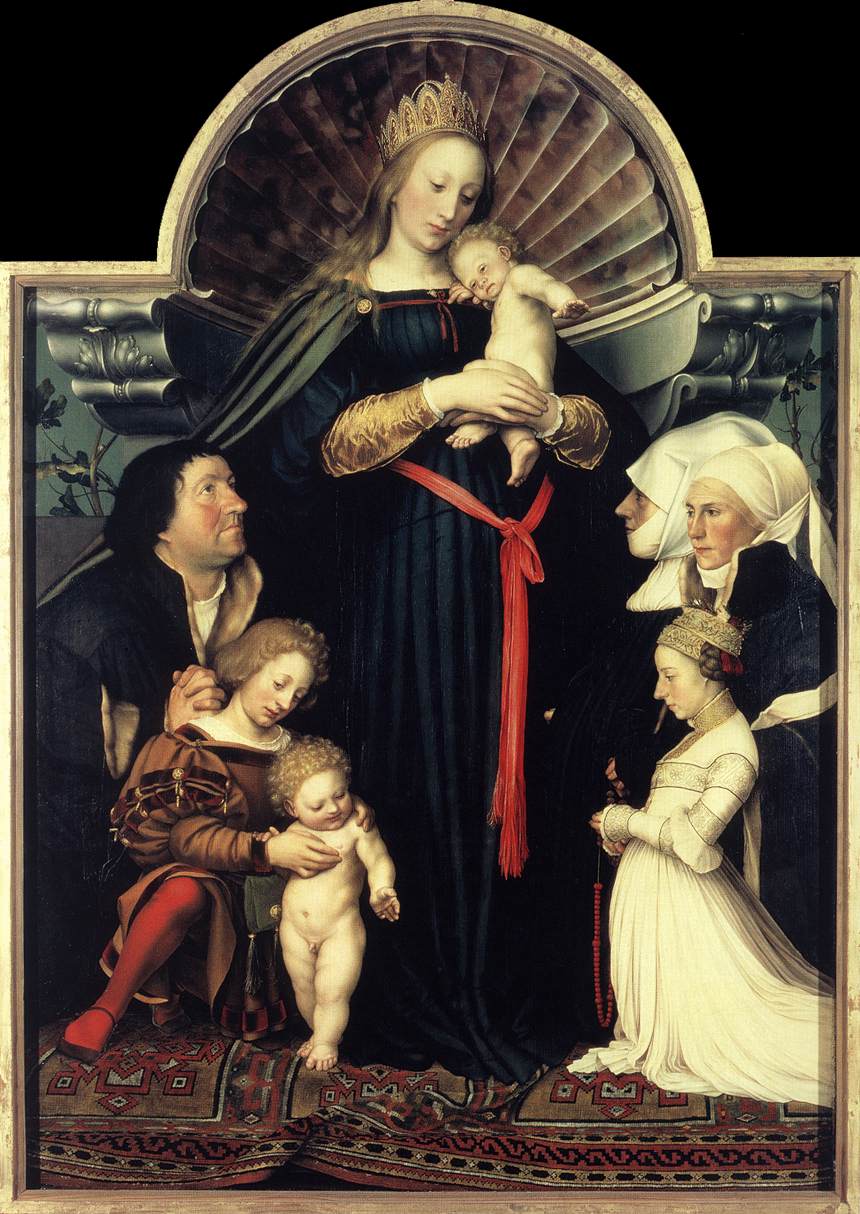
It's called the Darmstadt Madonna. It follows a standard formula in which the patron (in this case, Jakob Meyer, mayor of Basel, Switzerland) is at the right hand of Jesus, the Trinity, or a saint; and other members of the family, both dead and alive, are distributed starting at the central character's left hand. Notice in this case that although Mary is physically dominant, nobody looks at her: the patron focuses his gaze on baby Jesus, as does Mary herself. That's a little Catholic digression about a content-packed painting which is not the subject of this post.

But what struck me is Mary's cloak resting on Jakob's shoulder...a type of overshadowing I hadn't ever noticed before. Mary is protecting Jakob by 'spreading her wing' over him, recalling numerous Bible and liturgical examples of protective overshadowing. I assume that Jakob will extend this protection over his family, and that's why Mary's cloak doesn't overshadow to her left. This image of Mary's protection reminded me of a line from the Cornet, when two soldiers go their separate ways:

"Kehrt glücklich heim, Herr Marquis. > Return happily home, Herr Marquis."
"Die Maria schützt Euch, Herr Junker. > The Mary protects you, Herr Junker."

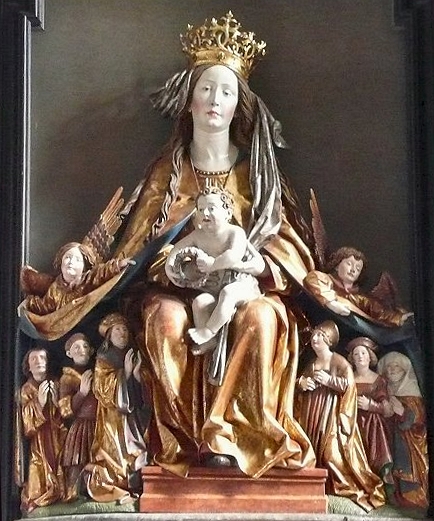
So then I wondered if that was a standard German idea, to seek or enjoy Mary's protection. A quick search on "schutz maria" turned up a town called Maria Schutz in Austria, but I was looking for piety, not places. Tried "schutz madonna", got Schutzmantel Madonna right away, which simply means Protection-cloak Madonna. It's a very common Catholic image in German-speaking cultures:

Looks just like his Momma.


Is the Son's swaddling cloth overshadowing his Mom?

Both the Queen Mother and her Son the King wear crowns


Even popes and bishops want in.

The Schutzmantel Madonna is such a vivid image that I want to get a statue like these for catechism class. It'll fit right in with our recurring theme of overshadowing. Yeah, I could print off a nice lettersize handout of one of these photos (and I may do so regardless) but a 3D teaching tool works better than its 2D version.

And the Schutzmantel isn't just a religious concept. The traditional way a German man would legally demonstrate his adoption (or legitimization) of a child was to publically extend his mantel over the child; so Mary isn't simply protecting a bunch of people- she's adopting them as her children. There's just something about a statue that'll make that point better than a picture. But for class we'll first do a quick skit of Mary extending her beach towel mantel over a couple of her peers. Once the kids figure out its significance, then I'll pull out the statue, we'll discuss some of the German history behind it, and connect it to the Bible examples we've already covered. Then right before class is over I'll distribute a Schutzmantel Madonna handout, and have the kids explain to me how they are going to explain it to their parents for homework.

Figure no more than 5 minutes on the skit and statue; no more than 2 minutes on the handout and quick review.

This material is also covered in this short audio file.

Saturday, January 12, 2013

The Umbrella of the LORD


The Holy Spirit will come upon you, and the power of the Most High will overshadow you; therefore the child to be born will be called holy, the Son of God. 

Living in the modern, woodsy, and temperate South Carolina Upstate, the kids in Wednesday Night Sunday School don't grasp the Biblical concept of overshadowing right away. To them, overshadowing sounds dark and threatening, like a thundercloud. In prior years, I'd explain that people living in a hot, arid land would regard being overshadowed as a good thing, as in "made in the shade." I might use this example from my Yucatan honeymoon: at Chichen Itza, the sun was so brutal that I hid under a tree at every opportunity. I moved from shade-to-shade as much as possible.

But this year I got a volunteer to come stand in front of me. He acted out my description of being uncovered in the desert, and the sun burning him to a crisp: "Your lips are blistered and cracked, your head feels like it's on fire, you can barely open your eyes, you're cooking to death...what do you need? Water! No, you have water. Class, will water keep him alive 'til sundown? No! What does he need? Shade! Yes! He needs...(I reach into my canvas bag)...an umbrella! Yes!" I open it over the wilting child. "How's that? Good! Well don't just stand there, show us...there ya go, so cool, so nice...think you'll live now? Yes! Y'all tell me what people want at the beach. A beach umbrella! Yes. When it's hot and sunny, being overshadowed is gooood- got it? Yes! OK. Now volunteer, would you like to shade yourself with my umbrella? Yes! Well, you can't have it, it's mine. I can decide to overshadow you or not; and you can decide if you're going to stay in my shade or not. So if I start to move...I move too! Yes. But I don't force you, because you have...free will! Yes- we both agree that you'll be protected by my umbrella."

This year I thought of the umbrella only in time for the Annunciation. Next year I'll use it as soon as we cover Exodus, and discuss the Shekhinah overshadowing the Meeting Tent.

Speaking of Exodus, the Hebrew Old Testament does not have a directly-equivalent word for episkiazo, ἐπισκιάζω  the Greek verb we translate as overshadow. Hebrew instead has a few basic verbs such as sakak and kasah, which fundamentally mean "to cover."  Context often suggests specific meanings such as block, screen, protect, defend, enclose, and overshadow.

Centuries after Exodus was written down, the Hellenic Jewish scholars of Alexandria translated the Hebrew scriptures into Greek: the Septuagint. When they translated verbs such as sakak סָכַךְ and kasah כָּסָה into the word-rich Greek language, they didn't say "to cover" every time. So to understand the Biblical idea of overshadowing involves looking at how the concept of covering is used in a spiritual sense in the Old Testament, regardless of the particular verb used in each case. What follows is a representative, but hardly exhaustive list of examples.

Ex 24:15:  Then Moses went up on the mountain, and the cloud covered the mountain. The glory of the LORD settled on Mount Sinai, and the cloud covered it six days; and on the seventh day he called to Moses out of the midst of the cloud.

Num 16:42 And when the congregation had assembled against Moses and against Aaron, they turned toward the tent of meeting; and behold, the cloud covered it, and the glory of the LORD appeared.

Ex 40:3 And you shall put in it the ark of the testimony, and you shall screen the ark with the veil.

Ex 25:20 The cherubim shall spread out their wings above, overshadowing the mercy seat with their wings, their faces one to another; toward the mercy seat shall the faces of the cherubim be.

That is, the LORD's cloud covers the Meeting Tent; the Meeting Tent covers the Sanctuary; the veil screens off the Holy of Holies; the cherubim overshadow the Mercy Seat. Four degrees of covering which define increasingly-exclusive access. Ultimately only one person, the High Priest, is allowed access to the Mercy Seat.

Some charming and affectionate expressions of being protected by the LORD's overshadowing wings:

Ps 17:8 Keep me as the apple of the eye; hide me in the shadow of thy wings

Ps 36:7 The children of men take refuge in the shadow of thy wings.

Ps 91:4  ...he will cover you with his feathers, and under his wings you will find refuge.


The tree overshadows the mother; the mother overshadows her children

 A few more coverings:

1Kings 19:19 So [Elijah] departed from there, and found Elisha the son of Shaphat, who was plowing, with twelve yoke of oxen before him, and he was with the twelfth. Elijah passed by him and cast his mantle upon him. (Elijah selects Elisha to be his protege and successor.)

Nahum 2:5 The officers are summoned, they stumble as they go, they hasten to the wall, the mantlet (cover) is set up. (A mantlet, literally a small mantle or cloak, is a military term for a protective screen or shield. For example, a tank typically has an armored mantlet, which covers the opening through which its gun protrudes.)

Ruth 3:9 I am Ruth, your maidservant; spread your wing (i.e., cloak) over your maidservant, for you are next of kin. (Ruth wants Boaz to marry her.)

Those should be enough examples to give you a spiritual sense of covering: selection, separation, protection, dedication. The umbrella does a good job of physically showing kids these characteristics, especially separation. That is, let's say that as a husband I will put one woman, my wife, under my umbrella. She does not get rained on; and I shelter no-one else. My overshadowing is not inclusive, it's exclusive. And if I collapse the umbrella, she'll get wet. There's no spiritual dimension to it- but suppose there were?

Let's focus a bit on the matrimonial aspects of covering. We'll start with Elijah cloaking Elisha. True, they aren't getting married, but this is going to be a covenantal relationship regardless. Elijah physically and symbolically shows that he has selected Elisha; he will protect Elisha; Elisha is separated from his family; Elisha is dedicated to a new purpose. Why is this so? Because by covering Elisha with his mantle, and Elisha 'accepting the mantle,' Elijah echoes aspects of the Jewish marriage rite.

Y'all are probably familiar with the Jewish prayer shawl, the tallit:


You can see how this man covers himself, using his tallit to create his own private, separate, exclusive Meeting Tent. Suppose he were to admit someone else under his tent, could that matter? Indeed it could.

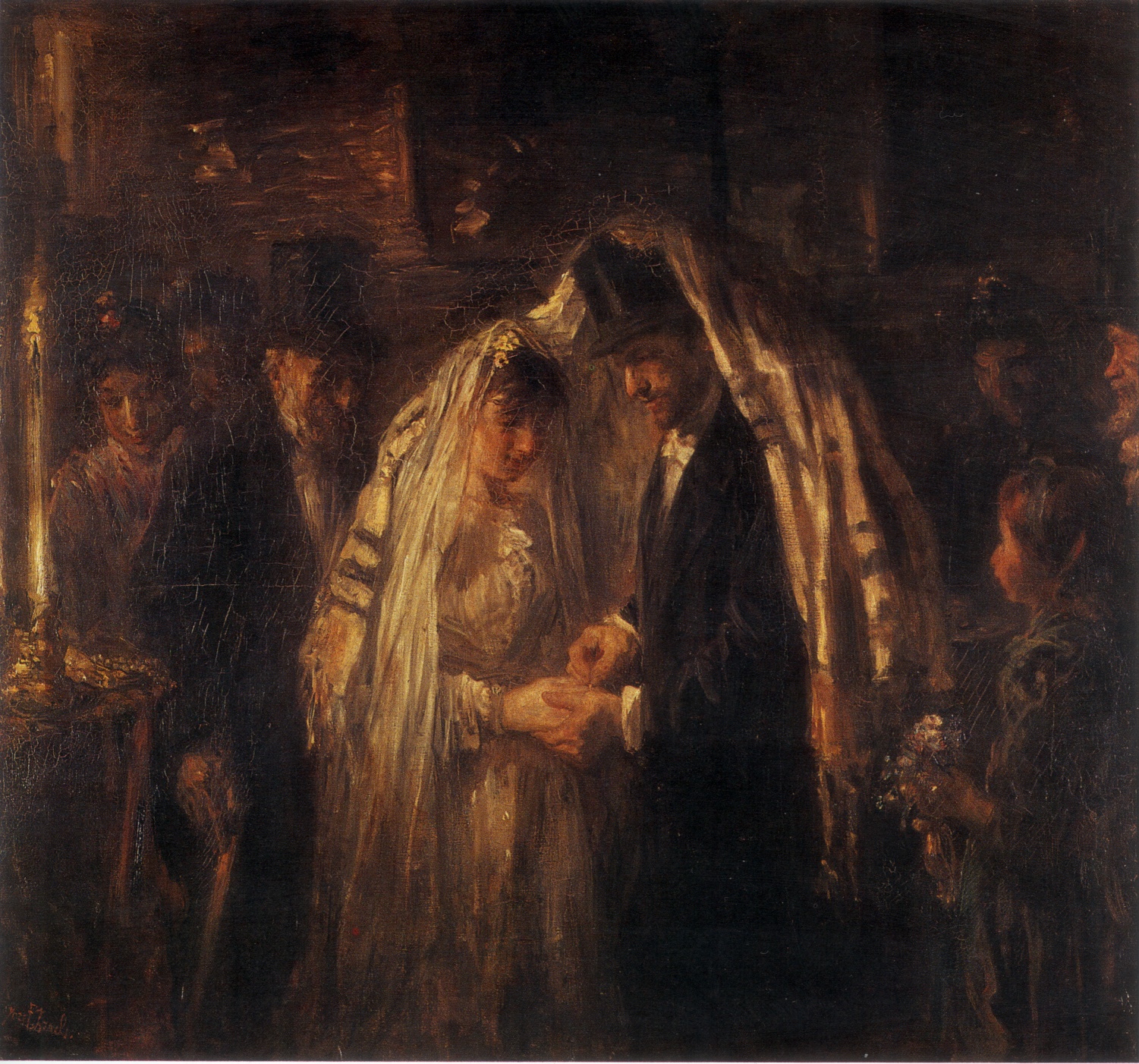
Here's a Jewish man admitting someone else into his tent, spreading his wings over her:


Of course they are getting married. The husband shows that his wife is, that's right, selected, separated, protected, and dedicated by covering her with his tallit. And she shows her acceptance by freely choosing to abide under his wing. By the way, the tallit may also be used to cover the wedding couple, as a tent once covered Abraham and Sarah. The tent covers the couple, the husband covers the wife; once again, a hierarchy of access:

 Yes, those are hockey sticks supporting the chuppah, the canopy.

Boaz understood that Ruth wanted him to marry her; and while spreading his wing over Ruth on a threshing floor would not make a marriage, it would most definitely indicate a commitment to wed. Did Boaz spread his wing over Ruth? Go find out on your own.

And likewise anyone who saw Elijah cover Elisha understood it was no ephemeral gesture.

Here's one more covering verse for you:

Acts 5:15 [T]hey brought forth the sick into the streets, and laid them on beds and couches, that at the least the shadow of Peter passing by might overshadow some of them.

We understand from context that Peter's shadow would heal those upon whom it fell. But after Peter had passed, and the afflicted were no longer overshadowed, would they become blind, lame, leprosy-ravaged again? Of course not: the consequences of Peter's overshadowing were permanent.

Suppose the Meeting Tent veils were pulled back; or the Shekhinah, the Glory Cloud, had shifted overhead; or the Tent wasn't pitched yet; or the cherubim weren't poised over the Ark; would any of that have allowed access to the Mercy Seat by anyone less than the High Priest? Of course not: access to the Ark was permanently exclusive, and the Ark itself was permanently reserved for God's Stuff, as we say in Catechism class.

And when Elijah put his mantle back on his own shoulders- was Elisha free to go back to his family and farm, get married, have kids? Again, of course not. The consequence of being covered by Elijah's mantle was permanent.

How about at a wedding? The husband must eventually put away his tallit, remove it from his wife's shoulders. Is his wife still selected, protected, separated, dedicated? Yes. Her status is permanent.

And the chuppah, the canopy- does God cease to cover the marriage when the tent comes down? Of course not.

Now back to the opening verse from Luke 1: "The Holy Spirit will come upon you, and the power of the Most High will overshadow you; therefore the child to be born will be called holy, the Son of God." That is, Mary was selected, protected, separated, and dedicated by God Himself, and Mary agreed to it. After the child was born, was Mary's overshadowed status canceled? Was Mary free to enjoy a life of marital intimacy with Joseph, having more children? The New Ark, once containing not merely God's Stuff, but God Himself, now suitable for holding...regular stuff?

Of course not: as a consequence of being overshadowed by God, Mary's virginal status was permanent.  More permanent than even a marriage vow, or the healings worked through Peter's passing shadow: ever-virgin.

My umbrella eventually has to close; God's doesn't.


Credit to the San Miguel News for the chuppah; and Henry Owassa Tanner for his Annunciation. 

Saturday, January 7, 2012

Fine Art 6: More Spacious than a Tea Party

This post links to RAnn's Sunday Snippets 


The January 4 class included a review of the Hail Mary prayer via the Annunciation, the Visitation, and the Solemnity of Mary, Mother of God. We had already treated the Annunciation and Visitation in the December 14 class, but without a couple of instructive artworks. [The class calendar is deliberately scheduled to finish the Old Testament in time to coordinate Mary Stuff with the Church feasts of Dec 8, Dec 25, and Jan 1.]

First I showed the kids this miniature of the Isenheim Altarpiece, explained how big it really is (about 9' x 16') how the panels work, etc. My sister got this for me as a Christmas gift when she was in Colmar, France last summer. Which was way before my wife told me a few weeks ago that the Annunciation I liked so much but couldn't name was the Isenheim Annunciation. More than coincidence?


We then focused on the Annuciation panel, which isn't visible in the photo above, using this color handout:


 Our discussion was very close to what I anticipated in an earlier post. The kids recalled Gabriel's greeting to Mary, and saw that it was directly quoted in the Hail Mary. The kids then recounted the Visitation, and recognized Elizabeth's greeting in next bit of the prayer.

I then asked the kids to guess the Catholic significance of January 1. None could, but that was OK. I told them it was the Solemnity of Mary, Mother of God. To add dimension to this feastday, we reviewed a handout of this ikon:

The common name for this ikon type is Platytera, Πλατυτέρα, meaning more ample, broader. That's short for "more ample than heaven." [Plat- is related to English flat, German platt, and French platte, as in the Platte (broad) River] It means that Mary, by containing the Creator of the Universe in her womb, was figuratively larger than infinity. Or as an old Greek hymn puts it, "He whom the entire universe could not contain was contained within your womb, O Theotokos (God-birther).” It's a terrific teaching tool that illustrates an aspect of Jesus' humility, and that Mary was the mother of not only Jesus' human nature, but of his entire person, comprising both his human and divine natures. That is, Mary is the Mother of God- just as the Hail Mary says. That literal womb makes this a very unusual Platytera, which was completed in January 2011 by the ikonographer Tom Athanasios Clark in the apse of St. George's Orthodox Church in Shreveport, La.

Most Platyteras look like this one:

Which is fine as far as it goes...whose lap is Jesus sitting on- his babysitter's? Just kidding, but sitting on a lap isn't what I'd call compelling visual testimony to the intimate prenatal relationship between God the Son and his momma. By the way, the Greek is Πλατυτέρα των Ουρανών, Platytera ton Ouranon, Wider than Heaven.

Or they're like this one:


This Platytera's better because it's a bit more expressive (although in an abstract sense) of Jesus being physically inside Mary. But neither of these is as effective as that cutaway pink uterus in the first example. The kids get that one right away: Mary's tummy, her womb.

We may as well learn some more Greek while we're at it:  those letters in the above ikon are M-R and Th-U. The squiggies above the letters mean those are abbreviations. They're short for Μητηρ Θεού/ Mitir Theou/ Mother of God. I always wonder: if you're going to spend a couple thousand hours or so on a mosaic, why cut corners with abbreviations?

To finish our Marian train of thought, I bring out a chair that my kids sat on when they were practically toddlers- a chair like one of these...


...and demonstrate how Mary was more spacious than a tea party.

Thursday, December 16, 2010

XmaSnaX

We do not have games or crafts or movies or parties of any kind in Wednesday Sunday School. All classtime is...classtime. Whatta concept. These children will be graduating from highschool in 6 more years; babydays are slap out the window. But during the Christmas class the kids can eat snacks and drink pop; that's called an unparty. I lose about 10 minutes of productive time to unparty inefficiency, but even Scrooge let Bob Cratchit take the afternoon off on Christmas Day. And most of the class material is Christmas-related, and they are good kids, and well...I'm weak.

"Hey, it's almost Christmas; what season is it? Winter? Not yet. Fall? No, I mean what Church season? Advent. Yes, which means Arrival. I was thinking this week about the first Advent, when Mary was waddling around [I do so] with a huge stomach, saying, "Joseph, I am so ready to have this baby." I always considered Advent being a time of expectation, like "O come, O come, Em-ma-a-an-u-el," but never really thought about Mary being tired of waiting and wanting to get it done. That's how my wife and daughter-in-law are; I think all mothers have their own personal Advent season every time they are pregnant.

Y'all remember last class we were talking about Mary, and the Immaculate Conception came up? Yes. It's related to Baby Jesus and Christmas. Which reminds me I didn't see any of you at Mass last Wednesday, but I know you young'uns can't drive yourselves to church. Anyway, let's think about the Immaculate Conception a bit. Who was immaculately conceived? Jesus! Well, yes, he was. Let me ask it this way: who is honored by the feast of the Immaculate Conception? Mary. Yes. It's not about when Jesus was conceived without sin, but about...when Mary was conceived without sin.  Yes. It's about Mary growing in her momma, not Jesus growing in Mary. OK, let's review some [on the board goes the Ark of the Covenant & pregnant Mary to the right]: here's the Ark of the Old Covenant and ...the Ark of the New Covenant.  Yes. The old Ark contains God's stuff; the New Ark contains...God!  Yes. What's more precious and holy: God's stuff, or God Himself? God Himself. Yes. Now let's look at the Old Ark for a second. It wasn't just some old box the Israelites kept pots in. It was made of expensive wood and the inside was lined with gold. It was the finest, purest, most precious container they could make. And how did they move the Ark around? They carried it on poles. Yes, so they wouldn't touch it. Why would they not want to touch the Ark? Cause it was important? Yeah, sort of. People felt unworthy to touch the Ark because of their sins; the Ark was set apart from sinful things. Y'all know the nuns we have in our parish? Yes. Well, suppose some young man thought one of them was cute, and asked her to go on a date, go out dancing. That'd be weird! Yes, why...she's not married. Nuns don't do that after they're nuns! Right, they are set apart, like the Ark. They're reserved for God by their own choice. And Mary freely chose to be set apart, too, and be the Mother of God.

Now, the Ark never contained anything but the jar of manna, Aaron's staff, and the Commandments. Can you imagine if the Ark was empty, and I came along and wanted to store my shoes in it? That'd be wrong! Suppose they were brand-new shoes? No! Suppose they were golden shoes? Umm...no! Why not? Cause it's for God's stuff, not regular stuff. Right. The Ark is permanently set apart for God's stuff. Now here's Mary, the...New Ark!  Yes. What's in her? Jesus. Yes, who is...God. Yes. Now we know that God is more valuable than his Stuff. And we know how much respect the Israelites had for the Ark. So how much respect might we have for Mary? More! Yes, way more. Now was that stuff in the Ark perfect? Perfect? Yeah...would you expect anyone to worship the pot of manna? I don't think so. Me neither...even if it's God's Stuff it's still just stuff. Was the stuff in Mary perfect? It wasn't stuff, it was Jesus! Right, who is perfect. So do we worship what was in the New Ark? Yes. So which Ark should get more respect? The New one!  Yes.

Now tell me, are we born in sin? Yes. Why? Cause Adam and Eve sinned! Yes, we inherit that original sin from our parents...what's it called? Umm...Original Sin? Yes. I thought I'd trick you on that, y'all're too smart. Do our parents create us? Yes? Yes, with God's help. We inherit sin though our parents because we're made from them. Tell me, who was Jesus' Father? God the Father? Yes. Does he have a body?. No. Is God a sinner? Well, isn't God perfect? Yes, just checking. And Jesus' mom? Mary! Who had...a...body'n'soul!  Yes. So if she was sinful...Jesus would get it from her?  Yes.

OK what's this? [I pull up my shirt enough to see my belly-button] Ha, that's your belly-button! Uh-huh...what's it for? Nothing. Well, what was it for before I was born? It was the thing....the umbilical cord!  Yes, like so. [I draw a fetal Jesus and connect him to Mary's tummy with an umbilical cord] Let's imagine I'm baby Jesus. Do I breathe while I'm in Mary? No. Do I eat? No. Drink? No. Right. Everything I get comes from Mary. We are as close to being one thing as you can get. Mary breathes, eats, & drinks for both of us, and she shares all that with me while I'm growing inside her, just like all mothers do. Now imagine perfect baby Jesus so completely joined to his mom...how could that work if she were a sinner like me? That'd be weird. Yes; we're made of a...body'n'soul!  Yes, so if our souls are messed up by sin...our bodies are too. Yes. And if Mary's soul was stained by sin...her body was too. Yes. And she would not have been a very good Ark for Jesus. Imagine I'm a good Israelite back when they were making that beautiful Ark. I come up with a nice box. I say, hey y'all don't need to make a special box, my new washing machine came in this one, it's very sturdy. They didn't have washing machines! Pretend they did! What would they say? They'd say no! Right, a regular container won't do for holding something special. And remember, Jesus floating in Mary's tummy was much closer to her than the jar of manna was to the Old Ark, just sitting there for centuries. If Mary was sinful, body'n'soul, how would Jesus get oxygen and nutrition from her without also getting sin? He couldn't. Right. That's why the Church teaches that Mary was conceived in her mom without sin, and never sinned, so she'd be a good Ark for God to live in for 9 months. And look, one last thing. [I put a dot on Mary's tummy] This is Mary's egg, the one that's going to become Jesus. If she's a sinner, body'n'soul, then...the egg has sin in it? Yes, it's part of her body. So how are you gonna get that sin out before Jesus is conceived? Well, God could do it. Yes, but what's better: to take a sinful egg and clean it off before Jesus' conception, or just have it always have been clean from the get-go? From the get-go! Right. So those are the two main ways I think about Mary being sinless from the first moment she existed in her momma: Mary's sinless tummy for God to grow in, and a sinless bit of her to make Jesus from.

Now, we know Mary's the New Ark. But There's Something Else About Mary...do y'all get that? Get what? Never mind. [I draw a sad Eve beside Mary] Who is this sad woman? She's in the Bible. Elizabeth? Ooh, good guess, but no. Mary? No...she's maybe the saddest woman in the whole universe...look, she's wearing some kind of animal skin...Eve! Yes, it's Eve. Eve feels terrible because when the devil tempted her with the apple, she could've said no, right? Yes! 'Cause she had...free will!  Yes. But she said yeah, sure, ok I guess; ate the apple and then got her dimwit husband to have a bite, too. So now we're all miserable living in a sinful world. Anyway, I saw a terrific picture a couple of days ago... I need a Mary! No, I used you last week! You daughter, get up here. And an Eve, yes, c'mon. Y'all face each other. OK, Mary you are way pregnant...put your left hand in your hoodie pocket, poke it out so we can see that baby...good. Now Eve, you look sad because...I ate the apple. Yes, and wouldn't you love to be able to fix that? Yes. Now Mary, take Eve's hand...and put it on your tummy so Eve can feel your baby...who...is...Jesus! Yes. Class, would this make Eve feel better, to know Jesus is going to be born? Yes. Why? 'Cause Jesus will fix our sins? Umm, sort of; Jesus will undo the damage of that first sin in the Garden. Eve, are you feeling better? Yes. OK, remember Mary is the New Ark; we also call her...? No guesses. Who's this? Eve. What Testament is she in? The Old Testament. Yes, and Mary is in..theNewTestamentMaryistheNewEve!  Mega-genius, yes! Mary is called the New Eve. Eve, what bad thing did you freely agree to do? Eat the apple! Yes; and Mary, what good thing did you freely agree to do? Have Jesus? Yes. Mary & Eve, sit down. Through Eve we got a mess; through Mary...the mess got fixed! Yes. Trick question: could Mary have chosen not to have Jesus? No, she had to. Why? So He could die and all. So Mary didn't have any free will? God forced her? No, but if she said no then Jesus wouldn't have been born. Right. That's scary to imagine. But God did leave it up to Mary, just like he left it up to Eve. This shows how much God loves us: he leaves us free to make incredibly important choices that don't just affect us, but the whole world, the whole universe, even."

Readers, here is the image the girls portrayed:

It's a good handout the kids can take home. And here is the winsome backstory: The Anchoress

this class will continue in the next post