Showing posts with label Deutsch. Show all posts

Tuesday, December 30, 2014

Le Mot Juste 3

This post links to RAnn's Sunday Snippets

A couple of days ago I couldn't think of a word, you know how it is. I described it to my wife, she drew a blank too. I looked at a couple of online Thesauruses, no luck. After 30 minutes it popped into my head; it was something like enervating or disinterested. That sort of word.

Then at dinner tonight we were discussing the flu going around. A daughter was drawing a blank on the word she wanted. She was saying the flu "passes on, it's easy to get sick." Oh yeah- flu is contagious.

New topic: English isn't all that English anymore, not since the 11th century when Guillaume le Bâtard, William the Conqueror, became King of England, and brought all that Latinate Norman French with him. About 45% of modern English is French-sourced: words such as impartial, attorney, celestial, venison, verity and velocity; but not words such as fair, lawyer, heavenly, deer, truth, and speed. And yes, words such as disinterested and contagious are also French-Latin.

So I have a little two-part hypothesis:

1. When an Anglophone can't remember a word, it's most likely to be a Latinate word like velocity, not a West Germanic word like speed.

2. The Anglophone will try to describe that forgotten word using mostly West Germanic words.

Considering that almost nobody speaks English with any awareness of where any word might have come from a thousand or more years ago, isn't it remarkable that this fundamental split in the language still exists subconsciously after so long? Is it merely syllable count? I doubt it. This must get at some inherent difference in how Romance and Germanic languages work at the most primal level. And do German speakers therefore think differently than we do, not having a French-soaked vocabulary and grammar? And likewise the French- what do they miss from not having West Germanic nuts and bolts in their tongue? Does English confer benefits on the speaker's brain from being dual-sourced? And when Germans or Frenchmen forget words and try to describe them- are there any patterns to the words sometimes forgotten or always remembered?

As we say in English: I. Don't. Know. But I do wonder.

Saturday, November 30, 2013

Fine Art 11: Die Maria Schützt Euch

This post links to RAnn's Sunday Snippets

Let's jump right in: I read Die Weise von Liebe und Tod des Cornets Christoph Rilke for the first time in 1982. Here's the backstory, but you don't have to look at it. All you need to know is that the Cornet is a prose poem in German, and an elegant introduction to the language.

Yesterday I was admiring Hans Holbein's portrait of St. Thomas More:

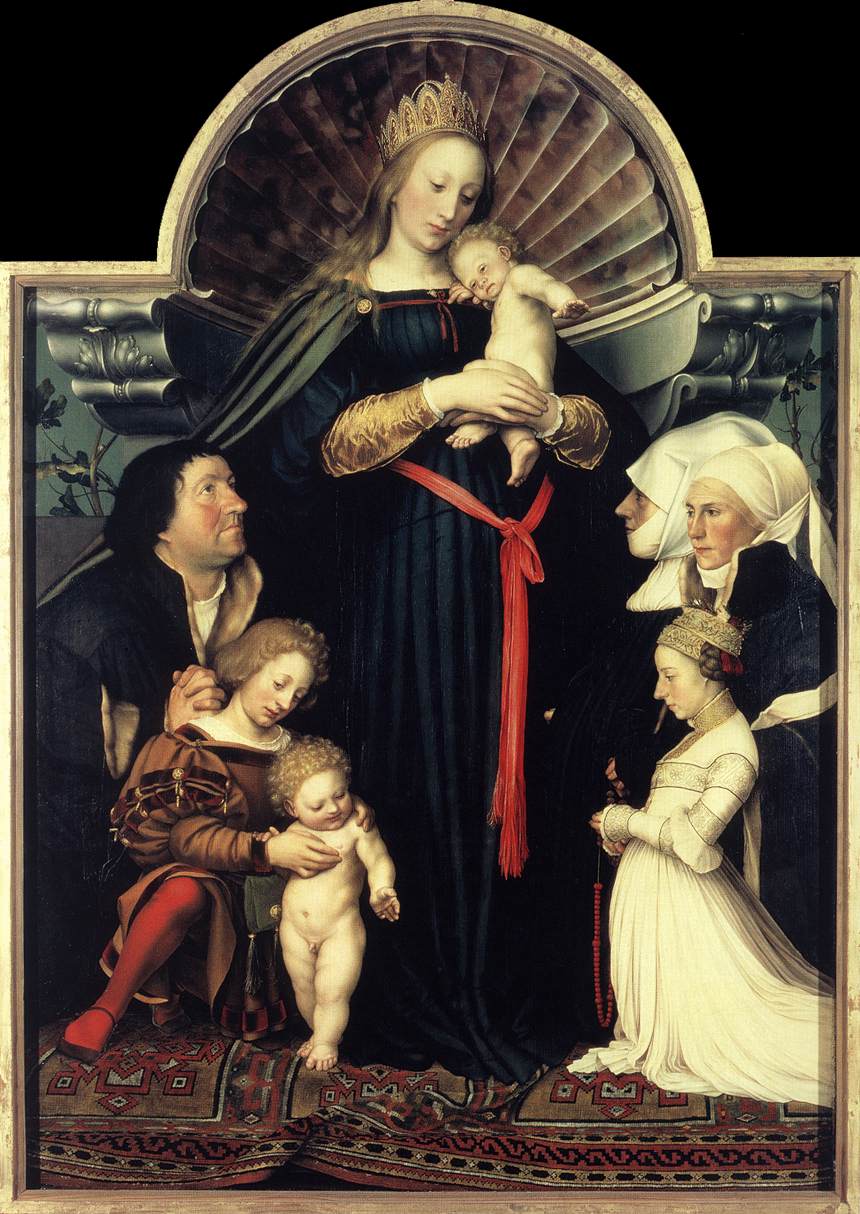
So much of who I think More is comes from this painting. And the same is true for Holbein's portrait of Henry VIII. And Erasmus. And Anne of Cleves. So I started aimlessly browsing all the Holbeins I could find, because you can often see a lot just by looking. By and by I came across this one:

It's called the Darmstadt Madonna. It follows a standard formula in which the patron (in this case, Jakob Meyer, mayor of Basel, Switzerland) is at the right hand of Jesus, the Trinity, or a saint; and other members of the family, both dead and alive, are distributed starting at the central character's left hand. Notice in this case that although Mary is physically dominant, nobody looks at her: the patron focuses his gaze on baby Jesus, as does Mary herself. That's a little Catholic digression about a content-packed painting which is not the subject of this post.

But what struck me is Mary's cloak resting on Jakob's shoulder...a type of overshadowing I hadn't ever noticed before. Mary is protecting Jakob by 'spreading her wing' over him, recalling numerous Bible and liturgical examples of protective overshadowing. I assume that Jakob will extend this protection over his family, and that's why Mary's cloak doesn't overshadow to her left. This image of Mary's protection reminded me of a line from the Cornet, when two soldiers go their separate ways:

"Kehrt glücklich heim, Herr Marquis. > Return happily home, Herr Marquis."
"Die Maria schützt Euch, Herr Junker. > The Mary protects you, Herr Junker."

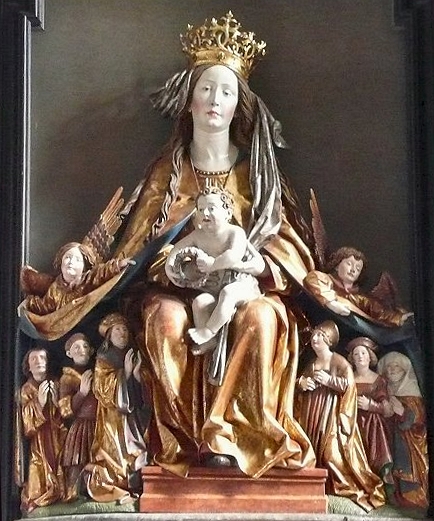
So then I wondered if that was a standard German idea, to seek or enjoy Mary's protection. A quick search on "schutz maria" turned up a town called Maria Schutz in Austria, but I was looking for piety, not places. Tried "schutz madonna", got Schutzmantel Madonna right away, which simply means Protection-cloak Madonna. It's a very common Catholic image in German-speaking cultures:

Looks just like his Momma.


Is the Son's swaddling cloth overshadowing his Mom?

Both the Queen Mother and her Son the King wear crowns


Even popes and bishops want in.

The Schutzmantel Madonna is such a vivid image that I want to get a statue like these for catechism class. It'll fit right in with our recurring theme of overshadowing. Yeah, I could print off a nice lettersize handout of one of these photos (and I may do so regardless) but a 3D teaching tool works better than its 2D version.

And the Schutzmantel isn't just a religious concept. The traditional way a German man would legally demonstrate his adoption (or legitimization) of a child was to publically extend his mantel over the child; so Mary isn't simply protecting a bunch of people- she's adopting them as her children. There's just something about a statue that'll make that point better than a picture. But for class we'll first do a quick skit of Mary extending her beach towel mantel over a couple of her peers. Once the kids figure out its significance, then I'll pull out the statue, we'll discuss some of the German history behind it, and connect it to the Bible examples we've already covered. Then right before class is over I'll distribute a Schutzmantel Madonna handout, and have the kids explain to me how they are going to explain it to their parents for homework.

Figure no more than 5 minutes on the skit and statue; no more than 2 minutes on the handout and quick review.

This material is also covered in this short audio file.

Friday, August 24, 2012

Der Großartige

This post links to RAnn's Sunday Snippets

That je-ne-sais-quoi Upper-Rhine look

I like to guess where German-language surnames come from. Living in America, I bump into unfamiliar German names regularly; based on a surname's look and sound I sometimes can suss out where someone's ancestors came from in Germany (or Austria), where they settled in America, and at about what time.

Germany didn't exist as a unified political entity before 1871. By that late date, its agglomeration of kingdoms, marches, duchies, baronies, counties, free-states, and free-cities had for centuries possessed their own identities, dialects, literature, architecture, and last names. I expect it's no mystery to Germans whence their surnames originate, but for me it can be tough.

nobody could stuff all that into one sausage

So today at the bank, my deposit was handled by a Mrs. Deiwert. Never heard of Deiwert before. Didn't sound Colonial, e.g., from Pennsylvania; not from Louisiana's German Coast; didn't sound postwar; maybe it's an Ohio River valley name, 1850-ish. Yep, her husband is from south Indiana. Then I supposed the name came from the Upper Rhine, which was a reach.

But this afternoon while searching online for Deiwert I bumped into this terrific site: Karte zum Namen, i.e., Map of Names. You just type in a surname, and using Germany's telephone data, you're shown a map of the name's distribution. Turns out Deiwert is a very uncommon name, found in one small district, Schwäbisch Hall.

 3 phone numbers in the whole country for Deiwert

Schwäbisch Hall lies on the Kocher River; which flows into the Neckar; which flows into...the Upper Rhine. So there.

The net can be such a blessing: I love having the data at my fingertips.
The net can be such a curse: I'll miss the thrill of guessing.

* Der Großartige: the greatest, the most terrific.

Saturday, June 30, 2012

Who What When Where Whow


  Lascaux? Uh-uh. Altamira? Uh-huh.

Who would disagree with the idea that the more cars you can drive, the easier it will be to drive yet another one? Bueller? Bueller? OK, nobody.

The same is true for languages, especially within language families, such as the Indo-European family (IE). IE languages have so much in common that like cars, the more of them you drive, the easier it is to drive another one. Here's a quick (not the only by any means) example:

Check these basic English interrogative particles: who, what, when, where, why, whow. I add a w to how to clarify that "how" belongs to the family of wh- interrogatives.

I had two profitable years of highschool Spanish, followed by two explosive years of Latin. Latin was the first foreign language where I noticed that like English, the interrogative particles shared a common initial sound, kw: Qui, Quod, Quando, Quo, Quid, etc. Not the same sound as in English, but still nice to know the pattern.

Over the next few decades, due to education, travel, and adoption, I learned some more languages; not fluently, but enough to not need English or gestures to communicate. Because the main benefit of speaking a language is to be able to ask questions, a good learning shortcut (among many) was that any language's interrogatives were all likely to start with the same sound, and it's usually true:

Wer, Was, Wenn, Wo, Warum, Wie, in English's lovely and creative cousin, German.

Qui, Que, Quand, Quoi, Comment, Où, in Latin's daughter, French. Note that comment starts with the same k sound as the q- words. And is short for Latin ubi, which I suppose is itself contracted from an older proto-Latin word starting with q, something like "quobi".

And in Russian: кто/ Kto, что/ Chto, когда/ Kogda, где/ Gdye, куда/ Kuda, как/ Kak. The exceptions in Russian are worth some digression: Kto means who; Chto means what. I'm guessing that distinguishing between people and things created Chto- simply altering the k-sound enough to make a new word. By the way, it's pronounced shto, not chto due to the speed at which the word is said.

Gdye (gd-YEH), where, may be a newer, voiced version of the unvoiced Ktye, an imagined word I'm backfiguring to fit the k- pattern.

These, and many more, Indo-European languages are assumed to spring from a common tongue which left no written record; what Germans call an Ursprache (ur- primeval, original + Sprache, language) My guess is that all of these interrogative particles originate in a single interrogative proto-particle, khuh. Khuh would sound like huh, but with a kh sound like the ch in loch. Here's how over time we get from khuh to the other words:

For some peoples, kh would sharpen to k or kw. Depending on their own aesthetic sense, others would soften kh or kw to wh. From wh, speakers may further soften to h (as in who), or w (even as we do today in saying wite instead of white). W could shift to v as it has done in German. You may think I assume too much, but listen to my Russian-adopted son Michael. When he was first learning English, he could not say 'house'. He said khouse. But 'hospital' was gospital. Why not khospital? Dunno...Russian has its reasons. And 'dinosaur' (dinosawr) was dinosavr.

Now a little digression. You know the intonation for "I don't know" when the note rises on don't and is lower for both I and know: iDUNno. Sometimes we will hum mmmMMMmmm and be understood. Of course without already knowing the English words, the humming won't communicate a thing.

Now you also know what this means: huh?

And huh...they aren't the same.

And this: uh-uh.

And: uh-huh.

Unlike mmmMMMmmm, none of them is based on English; but they can also be hummed or grunted because we know the "words" already. Those sounds aren't words from any language, any Sprache. They don't enjoy the status of "word;" but they're language, and we understand them. My guess is that those sounds are vestiges, living fossils of the oldest human oral communication which predates Proto Indo European. What the Germans might call a Vorursprache, before an original language. Communication so old and basic it's simply nuanced grunting. And huh? would be the root sound from which the word khuh developed.

Maybe the the first word. It'd be just like humans to make their first word a question.


Wednesday, October 26, 2011

Deutsche Romanische Kirchen


I like church architecture. While I admire the technical daring and spectacle of Gothic architecture, I prefer Romanesque churches. And among the churches built in the Romanesque manner, I like the German ones best.

One of German Romanesque's strong points is its design flexibility: that is, its visual vocabulary and structural system allow each church to be very different from the others while recognizably belonging to the same family. If Gothic churches tend to all be sisters, the German Romanesque family would include aunts and nieces. The German churches may have a front main entry, side main entries, or main entries at both ends along with altars at both ends. There may any number of towers in an assortment of shapes and sizes. Within the vocabulary almost anything goes. And if they don't compare well against Gothic's glamor, they more than compensate by their charm and individuality.

A very few of my favorites:

Maria Laach Abbey, so small it needs 2 photos.


Limburg

Bamberg


Speyer (the town is named after the spires)


Tournai, Belgium (it's not in Germany)

Late in the last century our architectural office (Greene & Associates) designed a 2400-seat Baptist church. For assorted reasons the project borrowed heavily from German Romanesque sources, including the above examples. A few drawings follow.

East Elevation


                      Ground Floor Plan
 South Elevation


A recent photo of the church taken by local photographer Jerry Spain

We do a lot of churches, but rarely have a budget and a client that allows for this kind of project.

Saturday, June 4, 2011

The Wily Umlaut

 Warning: this is not a catechetical post.

 English is just the best; it's so rich in words. Not only do we have oodles of  'regular' English words such as chicken, deer, lawyer, pig, and cow, but also thousands of French words such as poultry, venison, attorney, pork, and beef. And words from India such as shampoo, bungalow, ketchup, punch, khaki, and jungle. Not to mention several thousand more loanwords from all over the planet. I will not mention them. But English isn't just a mix of vocabularies: it's also a mix of grammars.

One of the many charms (or aggravations) of English is its plurals. The easiest don't even require a change: deer, fish, moose.  Other easy ones all end in s: cats, dogs. Fussier ones take an s but have a consonant change: leaf/leaves; house/houses; mouth/mouths. The oddest (and oldest) require a vowel change to make the plural: geese, men, mice, lice, brethren, cistern (kidding), and my favorite, women. Women is my favorite because both vowels change to make the plural. German, one of English's cousins, requires vowel changes even more than English does. How nice that in German the change may be indicated by an umlaut, those two dots that occasionally appear over its vowels. Like so: Mötley Crüe. Just kidding. I mean like so: ä,  ö,  ü. Thus in German there is one Buch/ book, and two Büche; one Hand, two Hände. The umlauted vowels sound different. If we used such marks, we might spell particular plurals like this: man/ män; woman/ wömän; and goose/ göse. English umlauts all sorts of words, not just nouns (e.g., sink/sank/sunk); but doesn't ever use the marks.

Now Anglophones learning German often don't want to worry about the umlauts; they're content to show the plain vowels. After all, English don't need no stinkin' umlauts to indicate vowel change...but failure to use the umlaut can radically change a word's meaning.

Here's a little Anglo-Deutsch example which visually makes the point.


With an Umlaut:


Without an Umlaut:


Which example is your favorite? Well, probably neither one...but you get the, uh, point.


Saturday, May 8, 2010

Terrebonne Weltanschauung

My formative years were lived in South Louisiana: Terrebonne (like Pearl S. Buck) Parish, to be more specific. I didn't realize until my family moved to South Carolina that the whole world was not flat, humid, fecund, familial, tasty, and Catholic. But ya gotta get away from ya culcha ta really appreciate its sensibilities.

Many years later I was in school in Italy, far from the Carolina Piedmont, farther still from the Louisiana of my childhood. The first day on the ground in labyrinthine Genova, I constantly had to ask for directions. I was a bit nonplussed by how people stood so near to me while speaking, and how they might also hold me by the bicep. Yet it was also familiar and agreeable. I thought, Good Lord, this reminds me of...Louisiana, who'd a thunk it? That first day in Genova marked when I began to think about the particulars of the South Louisiana worldview, if that's not too elevated a term for it. So forget all that Zydeco/ blackened-whatever/ MardiGras pap; I have seen the soul of the real Louisiana.

A few months after arriving in Genova, I found myself on a train, speaking with a German. I asked him to suggest something in German that'd be good for me to read. He recommended Die Weise von Liebe und Tod des Cornets Christoph Rilke/  The Song of the Love and Death of Cornet Christopher Rilke, by Rainer Maria Rilke. I read it then, and  re-read it every couple of years. It's a sort of poem which contributes to my understanding of German-ness. The line I most remember, which colors my view of Germans and Germany, is this one:

Aus dunklem Wein und tausend Rosen rinnt die Stunde rauschend in den Traum der Nacht.

Out of dark wine and a thousand roses runs the hour rushing into the dream of night.

Oh man...that will always be Germany.

During my childhood in Terrebonne Parish, I was surrounded by a vast extended family. One day I walked into Grandma's house, where she sat talking with some lady about the same age. Grandma asked me, "Do you know Marie Boudreaux? She's your second great cousin twice removed (I am making up the name & relationship, I was about 6 at the time)." Uhh, no ma'am. Then Marie says, "Is this Bud's boy? He looks like Bud."  He's Bud's alright."  And they went on to discuss relatives I knew, and didn't know...it was very pleasant just to sit and listen.

There were always conversations among my adult relatives at Grandma's house that I could sit in on. One Saturday night my daddy and his sisters (4 sisters total, not sure if they were all there) were sitting around, talking about religion or politics probably. One of them mentioned she had been paid recently....then someone else remarked on the Louisiana habit of saying 'grind' meat instead of ground meat, why don't they just say ground meat like everybody else? Then, struck by the Looziana Muse, one sister, a Terrebonne Rilke, burst out with a sort of poem, which forever colors my view of Louisiana and the Acadiens:

It was Sataday night and I just got paid
Went ta da store ta getta loaf a braid
Da man at da counta looked up and say'd,
"Sorry, Ma'am, I ain' got nuttin' but GRIND MEAT!"

Ay-yi-yi...that's Looziana.


P.S. Weltanschauung; German, world-at-look-ing, worldview.

Click for more on Rilke and the Cornet.

Friday, April 30, 2010

Bloody Wipers

This article was also published in Vol 5 Issue 10 of the St. Austin Review

Recently I was talking to my wonderful wife about the West at the turn of the century...not this century, the other one, the old one, the twentieth. I'd been listening/watching a couple of Debussy favorites on YouTube: Afternoon of a Faun, and Sacred & Profane Dances. When I listen to these, and other pieces from that era, I hear (this will sound corny) the promise of the West to itself on the cusp of a wonderful new century. I hear 1912 Europe: aeroplanes, automobiles, cruise liners, all growing faster, larger, more powerful, more glamorous. New art, new music, the cinema, new ways to hear and see. Elegant Beaux-Arts architecture. Handsome and beautiful royal families intermarried from England to Russia, their Crown Princes turned out as little sailors. Vast empires. World-class capital cities (I always think of fin de siècle Paris as the last Capital of the World).  Prosperity and progress extending into a bright future. And every bit of it affirming every other bit. It must have been so exquisite, so...everything.

Why, just look at this picture of the 20th century:

Even writing this now, it feels dislocating to accept that this is what the 20th century looked like, what it was, for many years. I think of it as the first, the original 20th century.

So when I listen to Debussy, I hear the promise of the First Twentieth Century. But I also hear her untimely death, which came not after 100 years, the natural lifespan of a century, but when she was still a girl of 14. I say she, because the First 20th Century was as feminine as the Second was masculine.

The Great War of course, is what killed the First 20th. And as gruesome and awful as it was objectively, it's worse when one realizes the self-image of the West was ground up along with the Poilus and Landsers (the French & German soldiers). That sense of beauty, brightness, peace, optimism, confidence, and hope would never be recovered, not even until today.

It's probably impossible for us Americans to understand the horror that gripped Europe during the War. Without recounting all the stuff anyone can find on Wiki about 1914-1918, here are 3 battlefields from those four years of industrialized killing:

Ypres in Belgium, gave its name to four battles (1914, -15, -17, -18). Known to the British as "Bloody Wipers", total casualties (both sides) were about 1.1 million.

On the Somme River in late 1916, the British notoriously suffered about 60,000 casualties on the first day of an offensive that ran for 5 months. Total casualties for both sides: about 1.1 million

In early 1916 the Germans launched a 10-month attack on the French forts around Verdun. Total casualties: 900,000, including 300,000 dead. No wonder both sides' soldiers called it the 'bonemill' and the 'mincing machine.' Many of the dead were so churned-up in the moonscape-like battlefield that there was no way to identify them. Today you can visit the Ossuary at Verdun, which is full of their random, nameless bones.


The Ossuary is divided by region into rooms of bones, heaps of them behind glass:

The Ossuary contains the remains of an estimated 130,000 soldiers.

Along with these uncounted young men, the civilized sensibilities of the First 20th Century died as well. And we, having lived in it, know what a mixed bag the Second one was. But when someone dies young, they're still remembered for who they might've been.

Imagine after the war the spiritual exhaustion of those left alive, aptly described as the Lost Generation, or le Génération au Feu, (the Generation of Fire), and their elders; how they would have tried to make sense of a 4-year catastrophe that killed, if not everyone, then everything. Maybe it exceeded men's faculties to make sense out of it, and it was better to leave it to God. Or nobody, if you didn't believe in God anymore. Sit with Hemingway at a cafe and wonder why you are still alive when so many others are dead.

Between winning and losing, more is learned from losing, even though it's not as pleasant. I say that as an American, and a Southerner. 35 years ago I watched Bill Buckley interview Malcolm Muggeridge, who at some point said, "you know, every important thing I've learned, I learned by suffering." He was right, unfortunately.

So what did the losers learn? Put it this way: once the war was over (or at least Phase 1 was over; the Second Thirty Years' War ran from 1914 to 1945), how did the West memorialize a four-year reality that was worse than any nightmare? I write as one who is generations removed, but I've only read, seen, or heard one work that best remembers it to me. I wish it were music; that would bookend well with Debussy, but it's a sculpture.

My name in the blogworld is kkollwitz, a tribute to Käthe Kollwitz; here's a bit on her from Wiki:

Käthe Schmidt Kollwitz was a German painter, printmaker, and sculptor whose work offered an eloquent and often searing account of the human condition in the first half of the 20th century. Her empathy for the less fortunate embraced the victims of poverty, hunger, and war.  

Käthe lost her son Peter during Phase 1, in 1914. She also lost grandson Peter during Phase 2 in 1942, although she hadn't yet suffered that blow in the 1920s when she produced Die trauernden Eltern / The Grieving Parents:


  I like Kollwitz' work; she's influenced me more than any other artist. And while this expresses her own ineffable sorrow, and in a universal sense that of all such parents, it doesn't point me toward the spiritual devastation, loss, and mystery of sadness that affected, and affects, a Continent, a Civilization, the West.

Let's try another artist, Ernst Barlach, who fought in the war himself. Here is his Magdeburg Memorial:


The client paid for something heroic; he didn't get it. Not unlike Kollwitz the grieving mother, Barlach the soldier eschews politics to express the shared loss of his French, Russian, and German brothers-in-arms. But what about the larger tragedy that's bigger than the war? By showing specific ideas, Kollwitz and Barlach preclude showing something bigger and less defined. And neither of these pieces offers any hope; they simply commiserate with the viewer.

Maybe the way to say everything is to say nothing, as I believe Barlach does with Der Schwebende Engel/ The Hovering Angel:

It doesn't impress right away. The Angel hangs above a stone on the floor that simply says
1914-1918
1939-1945

I like the little penetential bare feet in the back:


Here are the Angel's face and gently crossed arms:


A close-up of the face:


  Barlach, who experienced the enormity of the war and its consequences, instead of expressing this or that aspect of the whole, elects to say nothing about the war, because nothing adequate can be said.  The angel floats in serene grief, in a posture of quiet acceptance.  The sadness won't recede, won't heal, there's nothing for it but to endure. But the angel doesn't just hover in sorrow; he prays, and not without hope.  He is sad, but doesn't despair. Barlach's angel, created to memorialize 1914-1918, goes beyond the war to remember the loss of everything the West might have been in the First 20th Century; beyond that even, to remember more dreadful events yet to come in the Second 20th. Furthermore, by being so unspecific, the angel accepts the universal sadness of the human condition, but offers hope in return. Through its physical disengagement with the Earth, the angel points away from human perspective and toward God. Are children of the last century sometimes simply existentially sad about everything?  So is the angel, who hints that in such cases, the best thing is not to try to figure it out, but to shut up, pray, and not despair.

Only a loser could have created this.

So when I listen to Debussy, and think of beginnings, I remember Barlach's Angel, who marks an end.

Finally, the angel calls himself to my mind when I see this photo, taken at Verdun, the Bonemill, in 1984:

Two children of the Second 20th, who like the angel, shut up and pray.
Hope does spring eternal.

Thursday, September 24, 2009

Liebestod

This is a post about Wagner.

No, not that Wagner, this Wagner:

I like opera (enough to spend time and money on it). I usually listen to the pretty stuff, the accessible stuff: Verdi, Puccini, Bizet's Carmen, Cav & Pag, that lot.

I like classical music (enough to spend time and money on it). I usually listen to the likes of Debussy, Rachmaninov, Tchaiko, R. Strauss, sacred music, 20th century Brits.

I don't spend much time or money on Wagner. I agree with Mark Twain that Wagner's music is better than it sounds: as Twain said, having attended Parsifal, "The first act of the three occupied two hours, and I enjoyed that in spite of the singing." And afterward: "Seven hours at $5 a ticket is almost too much for the money."

And yet after decades of marinating in, reflecting on, being transported, enlightened, educated & ennobled by classical music in general, and opera in particular, I return again and again to eight minutes of Richard Wagner, the final aria of Tristan und Isolde: Der Liebestod. I'm old enough now (or stupid enough) to propose that this eight-minute song is the greatest work of art ever created by a human being. Higher than not just every other piece of music, but all architecture; all literature; all drama; all painting & sculpture. The best. The one.

Please note: I'm not saying Liebestod is the greatest thing man has ever done; it's the greatest work of art.

I tell you now, I will drop dead if anyone would draw this conclusion having listened to Liebestod once. A more likely reaction would be one had endured it, outlasted it, survived it. The music wanders, shapeshifts, restless, weird....unmusical? The voice & orchestra meander around one another. The lyrics, detached. Yet taken as a whole it's also intriguing, beguiling, mysterious, alluring, immense, pointing to something unclear. If music were seen and not heard, St. Paul would say, "For now we see in a mirror dimly, but then face to face. Now I know in part; then I shall understand fully, even as I have been fully understood."

Through repeated listenings spread out over decades, Liebestod has become less dim; clearer, but not fully so. As Paul says, full understanding will come.

To give the reader some background, Tristan und Isolde is a tragedy not unlike Romeo & Juliet. In the final Liebestod scene, Isolde mourns over the body of the beloved Tristan, then dies from sorrow. Yeah, yeah, been there, seen that. But Liebestod (love-death) is about much more than Isolde's grief on so many levels at the same time, bears a range of ideas and emotions through mutually-supporting elements of the music, the voice, the plot, the lyrics. The appeal is very, very intellectual; but also powerfully emotional at a primal level. Liebestod grabs onto some ancient, pre-language, pre-culture, time out of mind part of humanity we can't fully understand, the dirt that God breathed life into; and stirs it. From desolate despair to eternal serenity in eight minutes.

And the scale. It veers from the Isolde's miniscule focus on Tristan's eyelids (are they opening? is he alive?) to a vast, horizonless expression of joy, a release from life's grinding, sorrow-wracked struggle, to transcendence. All the passions of love, life, God, death & eternity explode, detonate at a galactic scale, then fade, leaving a gentle residue of God's infinite love. No kidding. I'm still moved to tears, looking at a computer screen.

But don't take my word for it, listen again to the curmudgeon Mark Twain:
This opera of "Tristan and Isolde" last night broke the hearts of all witnesses who were of the faith, and I know of some who have heard of many who could not sleep after it, but cried the night away. I feel strongly out of place here. Sometimes I feel like the sane person in a community of the mad; sometimes I feel like the one blind man where all others see; the one groping savage in the college of the learned, and always, during service, I feel like a heretic in heaven.
But by no means do I ever overlook or minify the fact that this is one of the most extraordinary experiences of my life. I have never seen anything like this before. I have never seen anything so great and fine and real as this devotion.
I know what he means. There's no substitute for repeated exposure to the work.

And I'll quote 1Corinthians again, because Liebestod always reminds me of Paul at his most eloquent:

Love bears all things, believes all things, hopes all things, endures all things. Love never ends; as for prophecies, they will pass away; as for tongues, they will cease; as for knowledge, it will pass away......So faith, hope, love abide, these three; but the greatest of these is love.

Rather than link to one of the online videos of the actual opera, I offer this performance, depicted on the album cover at the beginning of the post:

YouTube - Karajan - Ultimo Concerto - Wagner Liebestod

It features the conductor Herbert von Karajan in what I understand is his last performance. He chose to spend the final eight minutes of a 60-year career in music conducting Liebestod (von Karajan died about a year later). The heroically beautiful Jessye Norman sings Isolde's death, and von Karajan expresses the winding-down of his own life through Isolde's: eight minutes, two minutes, two seconds....done. I believe this is the greatest artistic moment in human history. All the elements combine: singer, conductor, orchestra, composer, audience, building, culture, to show what human beings can achieve. How Man still cooperates with God to create beauty that must exceed our own limitations, even at the close of a century that endured the Godless scourges of Communism, Nazism, and worse. This is the wonder of the West. The centuries of accumulated knowledge; lifetimes of rigorous training; the sacrifice of time & money; the systematizing of music; the exactitude of the instrument makers; the preposterous invention of a symphony orchestra; building a concert hall; all this tremendously expensive resource-devouring effort, all this, this fabulous waste just to crack open an eight-minute window into the Mind of God. But it is worth it.

But don't watch it yet! Wagner takes getting used to....sometimes a lot of getting used to. You may decide to first watch this more accessible piece:

Here is the Prelude to Das Rheingold. In the opera it expresses the flowing water of the Rhine river. In the video it accompanies the exquisite, wordless opening scene of The New World, directed by the auteur Terence Malick (I will not digress about Malick), possibly to a greater effect than in the opera:

YouTube - The New World - Vorspiel

A last note: I haven't said much about Liebestod's lyrics. They absolutely contribute to the complete experience, but at least to start, there's no way to deal with either the German or the English while also trying to take in the rest of the work. The words are at the bottom of this page:

Richard Wagner - Libretti - Tristan und Isolde

BTW, feel free to post your own choice for the #1 work of art if you have one. It doesn't have to be music.

Sunday, April 19, 2009

North and West Germanic


I love languages. Doesn't everybody? Some words are just magic to me, I can look at them & say them to myself over & over and just marinate in their wonderfulness. Like having a Manhattan, but without the glass, ice, vermouth, whiskey, and bitters.

My absolute favorite word is daughter...daughter...daughter...where was I? Oh yeah. Now, I have two daughters, but I liked the word before I was married and had them. And while I like the word, I love my daughters. And I like to call them daughter, as in "Daughter Alexandra, please feed the dogs," or "Daughter Francesca, please take out the trash," or "Daughters! Dinner!" Plus it's a little tribute to my 5th & 7th grade teacher, Sr. Alphonsus. Her father addressed her as 'daughter' when she was a girl, and I am still taken with that. I am not digressing.

Anyway, one of the things I like about daughter is it looks old, sounds old, and means something old. To say it is to remind myself that parents have been making essentially that same sound for more than a thousand years in many languages. It makes me feel a kinship with with all those millions, to make a sound meaning girl offspring and know they'd recognize it, even if they didn't speak modern English, or English at all, for that matter.

Now, we don't say daughter as it's spelled....but we used to. Imagine saying it, oh, a mere 1,000 years ago: dochter, with a ch as in Loch Ness. Mmmmm....now that sounds like real English: thick & unhurried, like a pint of stout. That's actually how the Dutch say it today: dochter. Which is close to modern German: tochter. And how we do say it today, dottir, is how it's spelled in Iceland and Norway; datter in Danish; dotter in Swedish, you get the picture, they're all North or West Germanic, no surprises.

One of our dottirs is adopted from Russia. Russian's an East Slavic tongue. I'd expect Russians to say something all Russiany such as.... zhelinka. I just made that up...it does sound good though, doesn't it? "Zhelinka Aleksandra, please feed the dogs." I like that.

But nooOOOoooo, the Russian word is дочь, doch! (dotch, with a longer o than botch or notch) Doesn't seem all that Russian to me. How'd that Germanic word get into Russian?

Ah...turns out doch is Russian, part of the Balto-Slavic family, it's not Germanic.....no borrowing. It's older than West Germanic and Balto-Slavic. So, how far back does daughter go in some form? Farther back in time than we can tell from written records, considering that even ancient (as in ancient Greek) languages in India and Persia used similar words. Scholars, speculating on an original, prehistoric source language labeled 'Indo-European' (not a real language), propose a proto-word for daughter, dhugheter, that would date from at least 2500 BC to as far back as 10,000 BC.

Imagine me going back 12,000 years and showing some nomad in Asia a pic of my girls, saying 'daughter' to him, and him understanding me just fine. In a single word a dozen millennia vanish. One of the most ancient sounds ever made by humans, and in spite of all the time and space and development and knowledge and sophistication that lies between us and that dimmest of pasts, we still make that same primal sound all around the world today. Daughter....daughter.

And my word, that is important to me. People die, but language lives. Ebbs, flows, gets thinner, thicker, shorter, longer, more spunky, more smooth, moves to the front of the mouth, to the back, becomes what each generation thinks is beautiful. Like the people who create it as they use it, it won't be limited by outside forces, defies efforts to control it. It's handed down through time out of mind, a living connection to the past like the laying on of hands. Our ancestors burst out of us every time we speak.

As Shakespeare would say, what a piece of work is Man.

I do love languages.

Tuesday, April 14, 2009

Dark Wine and a Thousand Roses

Around 1981 I was in school in Italy, took a train to Berlin. Enroute I shared a compartment for a while with an older, proper German Burgher who looked askance of the Innocent Abroad. But I had a bottle of Amaretto & some plastic cups, and his English was very American, so we got to talking, and maybe I wasn't so callow after all.

So, where are you going in Germany?

Berlin.

Why are you going to Berlin?

To visit a German girl I met last month....she's a student in Berlin.

And where is she from?

Near Bamberg.

O-ho! A Franconian girl!

Um, yeah (I guess).........your English is very good, how'd you learn to speak without an accent?

Ah. Yes. I was prisoner in America during the War, I learned a lot of English.

Where?

In Mississippi. There were a group of us who worked on farms in the country. We had a camp we lived in, but went out to work each day & returned on our own. We even got paid a bit so we could buy cigarettes and so forth at the stores like anyone else.

You weren't locked up?

No, there was nowhere we could escape to; besides, there was no reason to escape. We all knew the war was lost. When I arrived in America by ship, we were put on a train to Mississippi. Looking out the window, I saw a factory which was building vehicles. Hundreds of them filled a lot in front of the building. I pointed this out to a guard. He laughed & said those cars were owned by the workers. I couldn't imagine such a thing. That's when I knew it was over for Germany.

But we enjoyed life in Missisippi. Many of us didn't want to leave after the war. Some of us fell in love, some became like sons to the families they worked for.

We used to put on magic shows around where we worked. One night we were putting on a show for some very poor, uneducated people. When the magician started to saw the man in the box in half, a man in the audience jumped up & shouted, "Stop! No, don't kill him!" He thought it was real. I don't think they knew what magic was.

So where were you captured?

In Normandy. I had been wounded earlier and was in a rocket unit.....we had these steel frames the rockets went on. We were all kids, hardly knew how to use them and so.

Huh....were you captured around Falaise?

Yes. You know about Falaise?

Yeah, some.

The smell of all the dead men and horses was terrible....

I've read that....must have been awful. So where were you before Normandy?

Oh....I was in Russia.

Where in Russia, north, south....?

North....different places.

Leningrad?

No, not so far north.

Hmmm...Staraya Russa? Velikiye Luki? Demyansk?

Yes.... you know these places?

I've read about them.

He paused, stared at nothing. Then said, "Russia was too big. Nobody could conquer it. It was just too big."
Why I asked this next question I'll never know, but I am glad even today that I did so: what sort of books were you reading then? He perked right up at that.

Oh, we were all reading the Cornet, by Rilke. We didn't understand Rilke, but we read him. We were too young, really.

He subsided again.

Then we mostly sat there sipping Amaretto until he got off in Munich. I'd never heard of Rilke or the Cornet, but back in America I ordered a copy, having no idea what it was. Turned out to be a small book: Die Weise von Liebe und Tod des Cornets Christoph Rilke/ The Song of the Love and Death of Cornet Christopher Rilke. About 70 pages, 1 paragraph per page, left page German, facing page English. Something between poetry and prose. Something that showed German to be beautiful, artful, mysterious, uniquely expressive. Nominally about a 17th century soldier riding East against the Turk, but that's not what it's about, exactly. Or especially.

I had been used to tourist German, movie German. This Rilke German was nothing like any German I knew of...I mean, can you imagine lush German? Caressing German? Ya kiddin' rite? And so much of the impact of the words didn't translate into English...why not?

Well, I'm not going to quote gobs of Cornet, it's easy enough to find online or at libraries. I'll confine myself to this one line I've returned to again and again for more than 25 years:

Aus dunklem Wein und tausend Rosen rinnt die Stunde rauschend in den Traum der Nacht.

In English: Out of dark wine and a thousand roses runs the hour rushing into the dream of night.

I think it's pretty good in English, but still......not as good. This sentence persuaded me that everything may not be equally expressed in every tongue, and that to access the fullness of what an author intends, the text should be read in the original language. The sentence in English does not generate the mystery, the peace, the calm, the serenity, the (uh-oh, here it comes) je ne sais quoi, the ineffable something that moves me right now.

And to imagine percolating on this for so many years, and yet I'm really no closer to understanding or even putting into words what hold it has on me. This frustration at being unable to express what is very real points me again to life beyond death; I'm a sinful person stuck in a sin-cracked world which stunts my full potential, and I sense it. I ought to, should be able to understand fully at least this single German sentence. Yet even such a tiny thing eludes me. As St. Paul says, "For now we see through a glass, darkly...but then shall I know."

I'm ready for the "then shall I know" part.

Monday, March 9, 2009

Hanseatische Reise


My fabulous wife runs a travel agency, does cruises mostly. So sometimes we go on the cruises, too. As long as one of us can speak the language, we run our own affairs in the ports. We're doing a Baltic cruise in June; we'll spend a day in the old Hansa city of Rostock. Here's what we have planned for our group:

We take a local ferry from the big cruiseship wharf at Warnemunde right on the Baltic (Ostsee) to Rostock, about 10 miles inland (too shallow for big ships). The name of the ferry is the Rostock 7, which refers to the following old rhyme, dating back at least to 1596. It's called Die Rostocker Kennewohrn, the Rostock Landmarks.

In English it says:

Seven Towers of St. Mary's Church
Seven Streets at the Great Market
Seven Gates lead to the Land (countryside)
Seven Merchant Bridges by the Strand
Seven Towers upon City Hall stand
Seven Bells who together strike
Seven Linden-trees in the Rosegarden
These are the Rostock Landmarks

Using the rhyme as our guide, on our walking tour we'll see St. Mary's church, the Great Market, a couple of the remaining gates & bridges, City Hall, the Rosegarden, stroll along the harbor, and maybe hear some bells, so we'll see & hear what Rostock says we should. I made a map from Google Earth, we'll have a good time, won't get lost. It's all in the old city, so there'll be opportunities for, you know, German refreshments when we need a break. This should take us 'til early afternoon, when we take the ferry back to Warnemunde, and visit that town, which is nowadays a beach resort.

Back to the rhyme, the Niederdeutsch (Low German) version is the original, which resembles modern Dutch as much as it resembles the modern Hochdeutsch version.

Niederdeutsch version:

Söben Toern to Sint Marien Kark,
Söben Straten bi den groten Mark,
Söben Doern, so da gaen to Lande,
Söben Kopmannsbrüggen bi dem Strande,
Söben Toern, so up dat Rathus stan,
Söben Klocken, so dakliken slan,
Söben Linnenböm up den Rosengoern:
Dat syn de Rostocker Kennewohrn.

Hochdeutsch version:
Sieben Türme der St. Marien Kirche,
Sieben Straßen bei dem großen Markt,
Sieben Tore, die in das Land führen,
Sieben Kaufmannsbrücken bei dem Strand,
Sieben Türme, die auf dem Rathaus stehen,
Sieben Glocken die zugleich schlagen,
Sieben Lindenbäume im Rosengarten:
Das sind die Rostocker Wahrzeichen.

The Low German reminded me of some Grimm's fairy tales I'd read in college. They had little Low German rhymes such as: "Manntje, Manntje, Tempe Te, Buttje, Buttje, in der See..."

Turns out that some of Grimm's tales were originally in Low German.... like this:

"Dar wöör maal eens en Fischer un syne Fru, de waanden tosamen in'n Pißputt.."

My modern trans: Das war einmal ein Fischer und seine Frau, die wohnten zusammen in einen Pißputt

My English: That was onetime a fisher(man) and his spouse, they lived together in a pisspot (a chamber pot, a filthy hovel).
Charming. Grimm's fairytales can be quite blunt.

Part of the fun in cruising is that there is every chance to learn something new and unexpected; in this case, some language history, and I haven't even left home yet.


Tuesday, November 11, 2008

Beim Schlafengehen

The whole process of getting old is ever fascinating, and the older I get, the more I'm interested in the perspectives of those who are older still, especially those who know themselves to be on the cusp of death. About 25 years ago, by chance I checked out a CD by soprano Kiri Te Kanawa: Four Last Songs by Richard Strauss. Composed in the last year of his life, they are about death. The mood, which was striking then to a young man, and grows more meaningful each year, is one of peace, pleasant tiredness, acceptance of mortality.


Among the four, I return the most to Beim Schlafengehen (At the Going to Sleep, my translation); a poem by Hermann Hesse, set to music by Strauss.

The words are effective even without music, and in English:

Now the Day wearies me;
all my longing Desires should
sweetly succumb to the starry Night
like a tired Child. Hands, let go of all Work;
Brow, forget all Thoughts.
Now all my Senses
would sink themselves in Slumber.
And my unregarded Spirit
would rise on spread Wings
in Night's magic realm
to live deep and thousandfold.

At age 51, I'm not the least bit tired of living, or better put, tired from living. But such work as this helps me imagine being that tired. It shows that one may reach such a point in life, and that although death is something I would avoid now, I may feel different much later, when death might seem to be more of a transition and less of an ending.