Showing posts with label Art. Show all posts

Wednesday, May 18, 2022

Turkeyfish

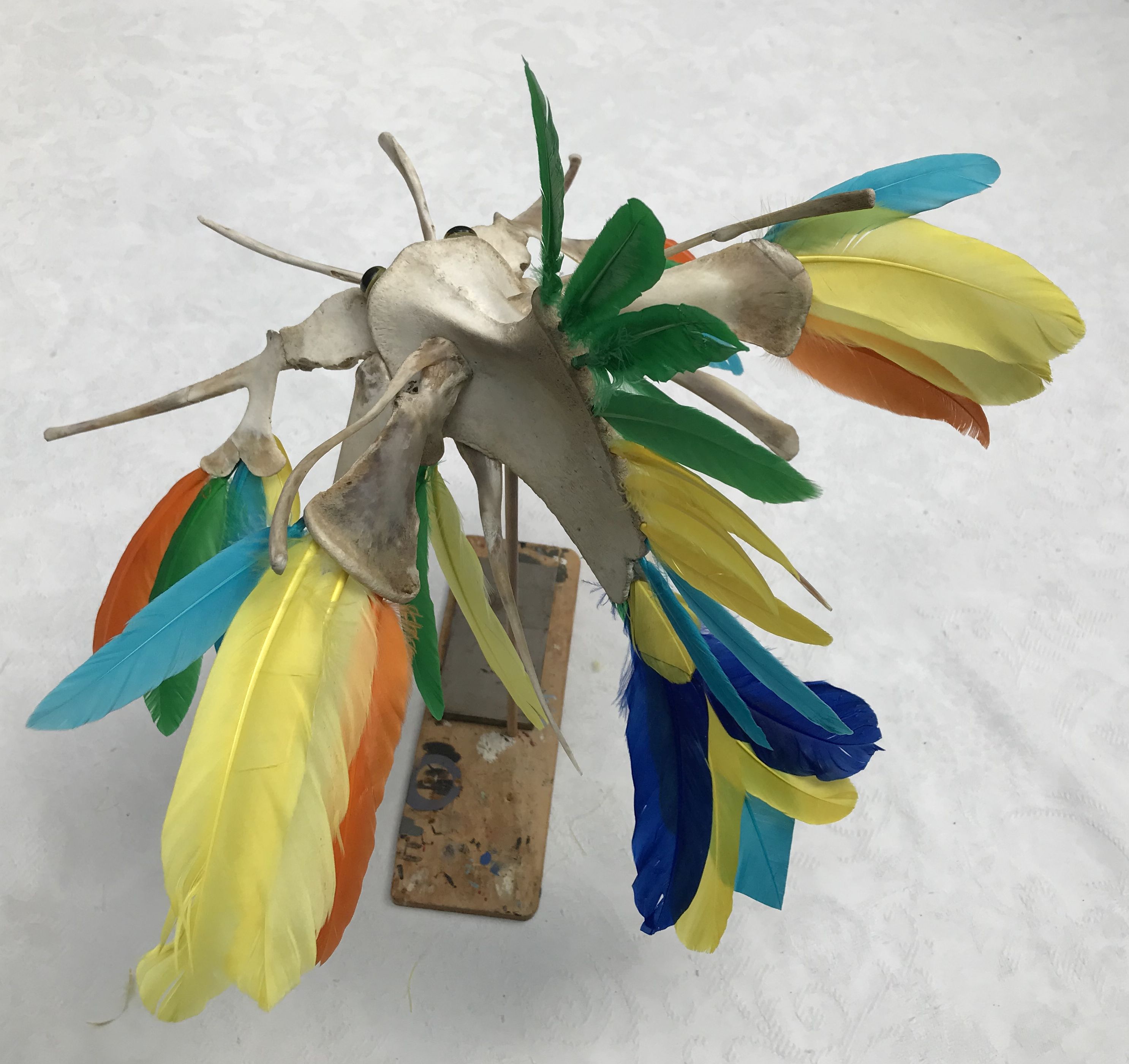
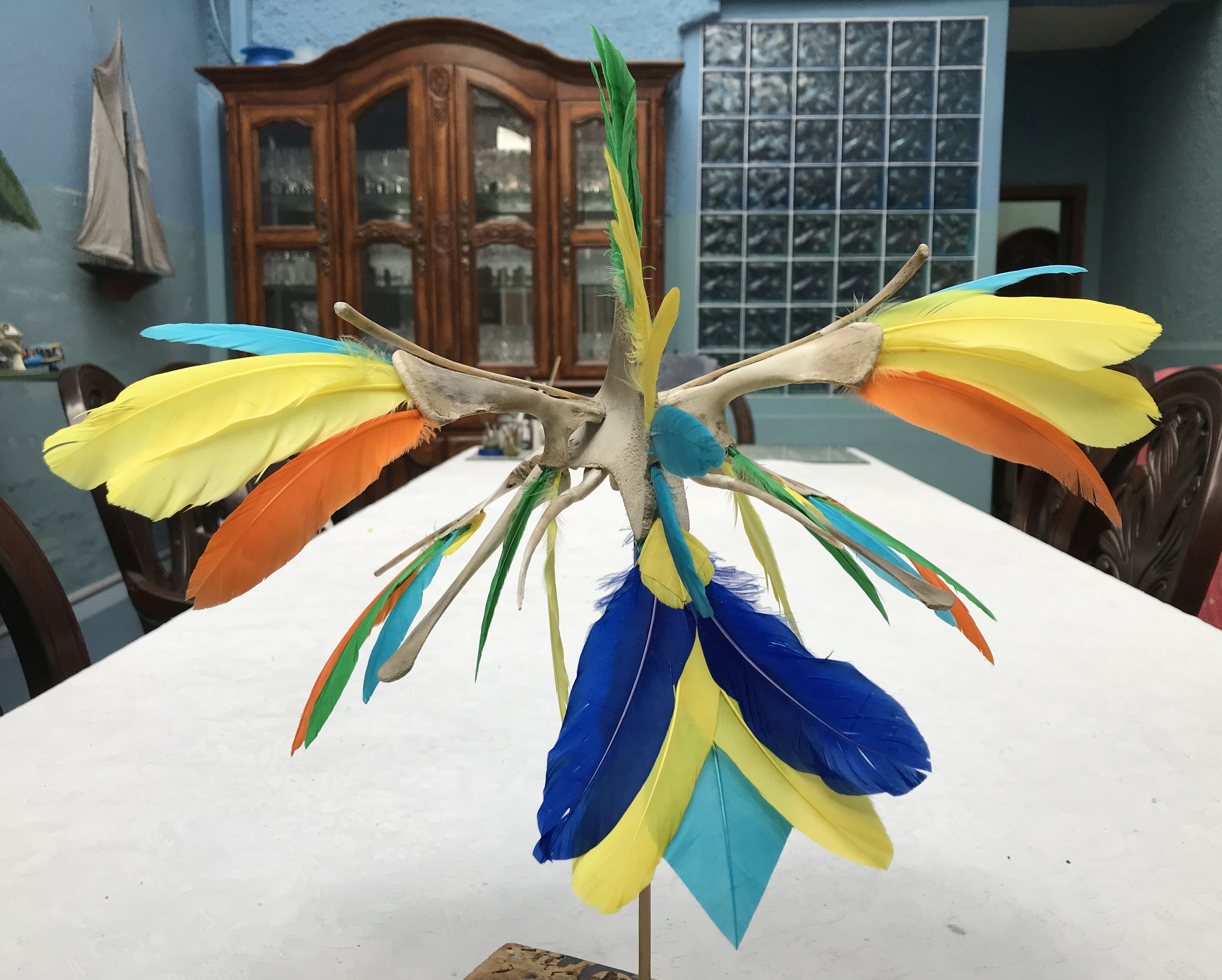
 Another turkey bone confection finished. Inspired by lionfish, although that may not be discernable. My wife has nicknamed it "Poonchki."


Saturday, July 4, 2015

Saturday, December 6, 2014

Glory Cloud

This post links to Sunday Snippets

This year so far is the best year I've had catechizing 6th grade, which is saying a lot, since even the worst year (which I clearly remember) was still a good year. It takes a couple of months for the children to adjust to how class works, but lately we've become quite the little family, laughing, learning, anticipating, finishing each other's sentences. It's like sitting around the dinner table and the topic of lively conversation is always Jesus and his Church. The last two classes were like group flow-states, if that's possible. The kids believe in themselves, partly because they know I believe in them and love them like my own children. Every Wednesday night we hit the ground running, and they are fearless thinkers, knowing that even a fabulously wrong answer can still be a good answer.

Last class we were discussing this Annunciation, and how aspects of both Church and Temple are present in the building.

 Panel from the Isenheim Altarpiece

The kids can relate new stuff to old stuff on the fly, and one of them asked if there had been a Shekhinah cloud over the Temple, as there had been over the Meeting Tent. "Huh...maybe as long as it contained the Ark; y'all may remember that the Ark was gone by the time Mary was born. But there's a Glory Cloud in the painting. I see it! Yes! And in the cloud? The dove, the Holy Spirit! Yes! But is it overshadowing the Ark? No, Mary! Yes, because...Jesus is in her? Yes, as of that very moment when both Holy Spirit and Glory Cloud overshadow her. Yes, what? Is there a Shekhinah in church? Uhh...never thought about it. I guess not. Well, maybe it's there but we can't see it because of sin (being blinded or veiled by sin is a standard idea). Wow, you could be right! There's all sorts of glory and saints and angels at Mass with us, so I wouldn't be surprised if the whole church (arms waving around) might be lit like the sun with God's presence. It might be like visions Isaiah and Daniel had (they know them). Wow. We'll get to some of that later this year." And then we continued to discuss the painting.

I know this vignette is a small thing, but for that weekly hour of class we hover on the cusp of Heaven. This is my life. As the song says, God Has Been So Good to Me.

Friday, March 21, 2014

Kids Wanna Know

The next few posts link to RAnn's Sunday Snippets

Too Catechetical for Words

We had 28 class meetings on this year's Wednesday Night Sunday School schedule. Since New Year's we've lost two days to snow, plus about another 1/2 class to other events. The later in the year I lose classtime, the harder it is to compensate. I don't talk faster because we already move at the Speed of Comprehension. What I do instead is prioritize and eliminate, like Frederick the Great.

Two evenings ago we covered the Resurrection through the Ascension.  We use a handout showing an image of the Anastasis, and a Supper at Emmaus by Rembrandt. In covering the Anastasis, for reasons of time I didn't translate a couple of Greek abbreviations in the picture, although I did explain the Greek word Anastasis, and show the kids how to pronounce the letters. Then we moved on.

After class one of the kids asks, what do these two things mean, i.e., the IC and XC.


See, what I leave out is exactly what someone wants to know. I go over the squiggies and the letters. In moments like this when a child wants to know something particular, I always want to answer the question directly, but than add a bit that points to the bigger picture. So I say a bit about words on ikons, and also write on the board similar squiggied-letters that often appear in Mary-ikons: MP and ThY, which abbreviate Μητηρ Θεού MITIR ThEOU, Mother [of] God. It was a nice little lesson.

Now, this isn't just a chance to for a child to take away something extra; it's also a chance to involve the parents. Next week I'll give her a prayer card like this one:


Is has MR-ThY and also IC-XC. Thanks to reader Moonshadow, I understand that to the left and right are the Archangels Michael and Gabriel. The Greek says O AP M  (The ARchangel Michael) and O AP G (The ARchangel Gabriel). I'll write the translations on the back. I'll also get her to tell me what the angels are holding, and why they matter (they're a few of the Instruments of the Passion). I'm confident she'll know the cross and the spear. But what's that other thing? I blew it up for a closer look, and I think it's the sponge on the hyssop stick. She already knows what it is, it's just not easy to recognize. I expect to give her hints, e.g. "I thirst." I'll conclude by saying she oughta show her parents what she's learned and impress the heck out of them.

In this business you never know when or where stuff will grow. Just throw the seeds, you won't run out.

If I had all the time in the world, a whole class could be spent on this single image: its visual catechesis, Queen of Heaven, King of Heaven, Mother of God, Fully God, Fully Man, Immaculate Conception, Crucifixion, angels, the Greek words, all of which allude to Scripture and of course the Big Catholic Picture.

For those who want to know more about cryptic Greek on ikons, here's an old post about John the Baptist.

Saturday, November 30, 2013

Fine Art 11: Die Maria Schützt Euch

This post links to RAnn's Sunday Snippets

Let's jump right in: I read Die Weise von Liebe und Tod des Cornets Christoph Rilke for the first time in 1982. Here's the backstory, but you don't have to look at it. All you need to know is that the Cornet is a prose poem in German, and an elegant introduction to the language.

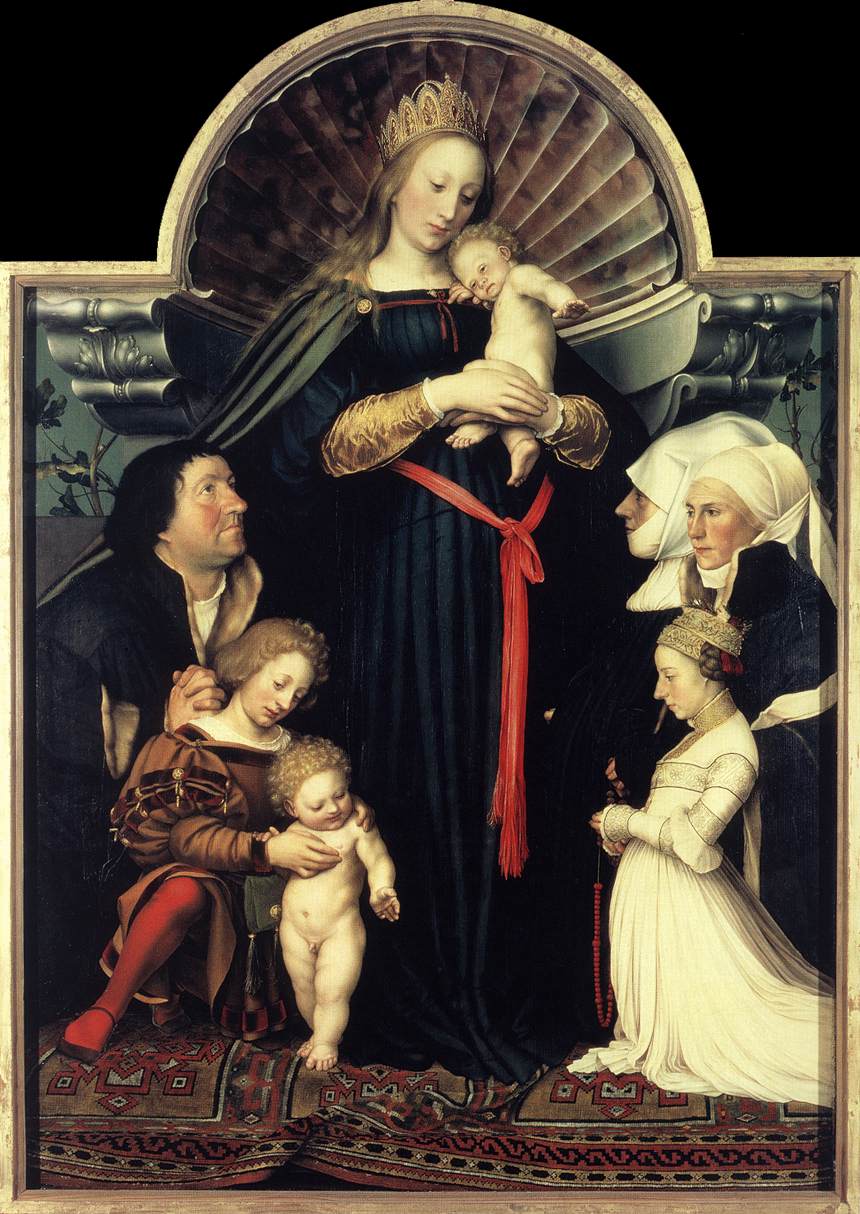
Yesterday I was admiring Hans Holbein's portrait of St. Thomas More:

So much of who I think More is comes from this painting. And the same is true for Holbein's portrait of Henry VIII. And Erasmus. And Anne of Cleves. So I started aimlessly browsing all the Holbeins I could find, because you can often see a lot just by looking. By and by I came across this one:

It's called the Darmstadt Madonna. It follows a standard formula in which the patron (in this case, Jakob Meyer, mayor of Basel, Switzerland) is at the right hand of Jesus, the Trinity, or a saint; and other members of the family, both dead and alive, are distributed starting at the central character's left hand. Notice in this case that although Mary is physically dominant, nobody looks at her: the patron focuses his gaze on baby Jesus, as does Mary herself. That's a little Catholic digression about a content-packed painting which is not the subject of this post.

But what struck me is Mary's cloak resting on Jakob's shoulder...a type of overshadowing I hadn't ever noticed before. Mary is protecting Jakob by 'spreading her wing' over him, recalling numerous Bible and liturgical examples of protective overshadowing. I assume that Jakob will extend this protection over his family, and that's why Mary's cloak doesn't overshadow to her left. This image of Mary's protection reminded me of a line from the Cornet, when two soldiers go their separate ways:

"Kehrt glücklich heim, Herr Marquis. > Return happily home, Herr Marquis."
"Die Maria schützt Euch, Herr Junker. > The Mary protects you, Herr Junker."

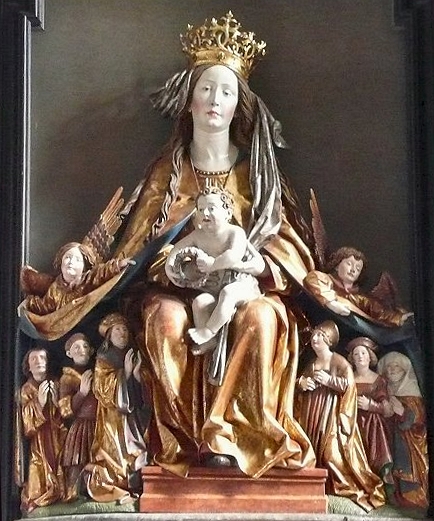
So then I wondered if that was a standard German idea, to seek or enjoy Mary's protection. A quick search on "schutz maria" turned up a town called Maria Schutz in Austria, but I was looking for piety, not places. Tried "schutz madonna", got Schutzmantel Madonna right away, which simply means Protection-cloak Madonna. It's a very common Catholic image in German-speaking cultures:

Looks just like his Momma.


Is the Son's swaddling cloth overshadowing his Mom?

Both the Queen Mother and her Son the King wear crowns


Even popes and bishops want in.

The Schutzmantel Madonna is such a vivid image that I want to get a statue like these for catechism class. It'll fit right in with our recurring theme of overshadowing. Yeah, I could print off a nice lettersize handout of one of these photos (and I may do so regardless) but a 3D teaching tool works better than its 2D version.

And the Schutzmantel isn't just a religious concept. The traditional way a German man would legally demonstrate his adoption (or legitimization) of a child was to publically extend his mantel over the child; so Mary isn't simply protecting a bunch of people- she's adopting them as her children. There's just something about a statue that'll make that point better than a picture. But for class we'll first do a quick skit of Mary extending her beach towel mantel over a couple of her peers. Once the kids figure out its significance, then I'll pull out the statue, we'll discuss some of the German history behind it, and connect it to the Bible examples we've already covered. Then right before class is over I'll distribute a Schutzmantel Madonna handout, and have the kids explain to me how they are going to explain it to their parents for homework.

Figure no more than 5 minutes on the skit and statue; no more than 2 minutes on the handout and quick review.

This material is also covered in this short audio file.

Sunday, November 24, 2013

Liturgical History in Four Hours


 Maybe not this exact style

Today I gave the last of four 1-hour presentations at Our Lady of the Rosary Catholic Church here in Greenville, S.C.  The overall subject was liturgical aspects of a Catholic church, divided into 4 threads:

1. The Biblical concept of overshadowing. Overshadowing was traced from Exodus through the Acts of the Apostles, and into the Liturgy of the Eucharist. I also explained the symbolic overshadowing function of a baldacchino.

2. The Bible history of food miracles: from Manna and Quail in the desert, through the Last Supper, and into the Liturgy of the Eucharist.

3. The Bible history of Arks and Tabernacles: from Noah's Ark through the Tabernacle in a Catholic church, and from there to the New Jerusalem in the Book of Revelation.

4. The Bible history of offering sacrifice: from Abel's lamb, through the Book of Revelation, and into the Liturgy of the Eucharist. 

The process included some Hebrew and Greek; audience participation; sacred art handouts; lots of drawing; lots of Bible; lots of learning; and based on comments, lots of fun.


Sunday, June 2, 2013

Fine Art 10: St. Apollinare in Classe

My parish included this mosaic in today's Corpus Christi missalette:


It's located in St. Apollinare in Classe, Italy. Classe is near Ravenna, which has some spectacular mosaics, including these two which I already use in Catechism class to discuss Abel, Abraham and Melchizedek as they show up in Genesis:


Two scenes from Abraham's life


Abel and Melichizedek

They're both in San Vitale, which was consecrated in A.D. 546. St. Apollinare was consecrated in A.D. 549, so it's no surprise that the art is similar.

Anyway, per this older post I use these mosaics in September to lay the groundwork for discussing this line from the Mass in April:

"Be pleased to look upon these offerings with a serene and kindly countenance, and to accept them, as once you were pleased to accept the gifts of your servant Abel the just, the sacrifice of Abraham, our father in faith, and the offering of your high priest Melchizedek, a holy sacrifice, a spotless victim."

But next year I'll use the St. Apollinare mosaic to discuss the Mass instead of using the two San Vitale mosaics twice in the same year. I'll point out that the mosaic of all 3 men and their offerings together around a common altar directly illustrates that line in the Mass. It shows that early on the liturgy was explicitly connecting their sacrifices to the sacrifice re-presented at Mass. Like a lot of things in Catechism class, I can always tell this to the kids. But when they can see it for themselves they learn better.


********************************************************

By the way I checked online for the oldest extant text of a Mass, and found the Gelasian Sacramentary from about A.D. 750. It says:

"...et accepta habere, sicuti accepta habere dignatus es munera pueri tui iusti Abel, et sacrificium patriarchae nostri Abrahae, et quod tibi obtulit summus sacerdos tuus Melchisedech, sanctum sacrificium, immaculatam hostiam."

In English:


"...and accept, just as you deigned to accept the offering of your just servant Abel, and the sacrifice of our patriarch Abraham, and that which your highest priest Melchisedech offered you, a holy sacrifice, a unstained offering." (thanks to Steve Perkins)


Wednesday, April 17, 2013

Pitchers 16: Revelations 4 & 5

This post links to RAnn's Sunday Snippets

Partial whiteboard from April 17, the second of three classes on the Mass:


Bits I read (not all at once!) while I draw and we discuss the continuity between the worship in Heaven and on Earth:

"At once I was in the Spirit, and lo, a throne stood in heaven, with one seated on the throne! 3 And he who sat there appeared like jasper and carnelian, and round the throne was a rainbow that looked like an emerald. Round the throne were twenty-four thrones, and seated on the thrones were twenty-four elders, clad in white garments, with golden crowns upon their heads. From the throne issue flashes of lightning, and voices and peals of thunder, and before the throne burn seven torches of fire, which are the seven spirits of God;  and before the throne there is as it were a sea of glass, like crystal. And round the throne, on each side of the throne, are four living creatures, full of eyes in front and behind:  the first living creature like a lion, the second living creature like an ox, the third living creature with the face of a man, and the fourth living creature like a flying eagle.  And the four living creatures, each of them with six wings, are full of eyes all round and within, and day and night they never cease to sing, "Holy, holy, holy, is the Lord God Almighty, who was and is and is to come!" I don't have time to draw everything; the goal is to draw enough.

 "And between the throne and the four living creatures and among the elders, I saw a Lamb standing, as though it had been slain...the four living creatures and the twenty-four elders fell down before the Lamb, each holding a harp, and with golden bowls full of incense, which are the prayers of the saints..." 

This was about 1/3 of the whole board, so figure 20 minutes of classtime on this developing image while talking about Mass, the Heavenly Worship, incense, harps, singing, elders-presbyters-priests, the Paschal Lamb, the Last Supper, the Crucifixion, the Holy Holy Holy, the 4 Evangelists and their attributes (Angel, Lion, Bull and Eagle); reading relevant bits of Eucharistic Prayer #1 from the Missalette; and of course, the Holy Tornado.  I draw something like this every year, but the content and execution varies with my interaction with the kids. I'm posting this to emphasize how drawing can organize information in a way that's easy to refer to as the discussion proceeds, and much more effectively than just writing words on the board. When it's done, it's an ensemble of concepts; not merely a listing of them.

Wednesday, January 2, 2013

Apple & Balloon


Our last class of the year covered December stuff: Immaculate Conception and Nativity scenes, mostly. We also talked about the transition from the Old Testament to the New, and got in a few minutes about John the Forerunner's miraculous conception.

For the last few years I've had a couple of girls portray this image, which I treat as the Great Hinge between the Testaments:

Yeah, I know, I show it in class every year around Christmas, and here at the blog. So what? It's a first-class catechetical tool, loaded with theological content like the work of Northern Renaissance artists such as van Eyck.

Anyway, the kids don't see the pic 'til we've discussed the content with our live models. This year, instead of saying, "Hey I need an Eve, get up here daughter...I need a Mary, yes, c'mon up," I did this:

"OK y'all I need two girl volunteers...two! not eight! And you aren't a girl! If you've already acted this year put ya hands down. Just one of you is left? OK daughter, you're it, come on up." I reach into my canvas bag. "Here, this apple's for you. Who is she? Eve! Yes, smarties! One more girl...NOT ALL OF YOU! Daughter, today's your birthday right? 12 years old on 12-12-12? Yes! OK, birthday girl gets the job!"

Now I pull out...a balloon?...and blow it up 'til it's about canteloupe size. "Here ya go, put this under your sweater like so. What's it for? Can y'all figure this out? She's pregnant! Ewww! Ewww! Ewww? Babies are great! Your mommas were pregnant with you! It's too weird! That's OK, you don't have to do it...who wants to be the pregnant woman? Me! Yes, c'mon up...there ya go. Who is she? Sarah! Good guess, but no. It's someone in the New Testament. Elizabeth! Ooh, great guess again, but no. Mary! Yes, and who's in the balloon? Jesus! Yes!" And from there we have the usual discussion followed by the image handout and more discussion. I like it better with the props, because then the kids can figure out, instead of being told, who the women are.

Couple of cartoons from class, similar to those in prior years:


Pressed for time during the Nativity discussion, I forgot this bit of Isaiah: A multitude of camels shall cover you, the dromedaries of Midian and Ephah; all those from Sheba shall come. They shall bring gold and frankincense, and shall proclaim the praise of the LORD; and thus left the camels out. But I remembered in 2010:


Wednesday, September 26, 2012

Pitchers 14: Ziggurats & All That

 This post links to RAnn's Sunday Snippets

As usual for these whiteboard posts, my comments are limited to the images and don't describe the whole class content.  Click the image for a bigger version.


Class starts with a quick review. That is, the kids tell me whom we've covered so far: God/ Adam & Eve/ Cain, Abel, Seth/ Enoch/ Methuselah/ Noah. I introduce Abram & Sarah. Brackets indicate 10 generations from Adam to Noah; and 10 more from Noah to Abram. As usual, a child objects to 'Abram'; I tell him God will change Abram's name in a few minutes.

The kids tell me about Mesopotamia. A quick map illustrates Abram's journey from Ur of the Chaldees to Canaan. While I draw they talk about the rivers, the people, the ziggurats. I draw a ziggurat. I mention Sumerian beer. They laugh.

When Abram gets to Canaan he makes an altar & offers a sacrifice [I add that beside the ziggurat]. We see that "offerings are typically done on something that gets the offering closer to heaven...such as...altars?  Yes, or...mountains?  Yes, or artificial mountains like...ziggurats!  Yes." But on one occasion, a priest named Melchizedek offers bread and wine for Abraham. "The Mass mentions Melchizedek, so y'all pay attention at Mass and tell me when. He's the King of Salem, which means King of Peace. Whom do you think of when I say King of Peace? Jesus.Yes. Melchizedek, like Abel (and Isaac, who hasn't come up just yet), is a type of Christ."

I add Abraham's wife Sarah. Quick review: "God is...? Powerful? Yes, and...knows everything? Yes, he's 'omniscient'. And...powerful? You said that already. [I start to draw a heart] Love! God is love! Yes. Remind me what love always wants to do. Ummm...create! Yes. Love creates. So tell me about Abraham and Sarah. They were married. Yes, so...they were in love? Yes, so...what does love do? Create! So? So their love made babies! Well, not just yet." We discuss their sadness, and jump into the Hospitality of Abraham using this mosaic:

And this fresco:


One of the kids explains mosaics; I add that a fresco is painted on wet (fresh) plaster to make it permanent.

When Sarah later gave birth to their only son, Abraham & Sarah were so happy they named him Yitzhak, laughter. In English we call him Isaac. I tell the kids that the neighboring tribes worshiped false gods such as Baal and Moloch, to whom the people sacrificed their firstborn sons. So Abraham knew he was getting a good deal from his God who didn't seem to require that.

But years later, God wants Abraham to make that sacrifice; we use the mosaic to guide our discussion. I draw Mount Moriah and add Abraham's altar on top. A child asks how Isaac would have felt. I say he and his parents probably weren't surprised that God would eventually ask for this sacrifice; but they'd sure be happy to swap a sheep for a son!

Class is over when this line of discussion ends.

Saturday, September 15, 2012

The Borrowers


6th-graders never mention this, but back when I was doing RCIA, this bit of Jeremiah always came up: "Seest thou not what they do in the cities of Judah and in the streets of Jerusalem? The children gather wood, and the fathers kindle the fire, and the women knead their dough, to make cakes to the queen of heaven, and to pour out drink offerings unto other gods, that they may provoke me to anger." You know...wayward Chosen People chasing after their neighbors' false gods; so Mary being Queen of Heaven is likewise an idolatrous mess of pagan pottage, right? Well, no: she's the King's Queen Mother. But I'm thinking it's time for a new topic already: Cherubim.

The Bible is full of cherubim. In Sunday School we use the Hebrew word, kerubim, the near ones, God's bodyguards. There are no surviving images of the kerubim mentioned in Scripture, such as:

"And you shall make two cherubim of gold; of hammered work shall you make them, on the two ends of the mercy seat.  Make one cherub on the one end, and one cherub on the other end; of one piece with the mercy seat shall you make the cherubim on its two ends. The cherubim shall spread out their wings above, overshadowing the mercy seat with their wings, their faces one to another; toward the mercy seat shall the faces of the cherubim be...Moreover you shall make the tabernacle with ten curtains of fine twined linen and blue and purple and scarlet stuff; with cherubim skilfully worked shall you make them." (From the LORD's instruction on the temple and its furnishings.)

From King David's Psalm 18: 

"In my distress I called upon the LORD; to my God I cried for help. From his temple he heard my voice, and my cry to him reached his ears. 7 Then the earth reeled and rocked; the foundations also of the mountains trembled and quaked, because he was angry. 8 Smoke went up from his nostrils, and devouring fire from his mouth; glowing coals flamed forth from him. 9 He bowed the heavens, and came down; thick darkness was under his feet. 10 He rode on a cherub, and flew; he came swiftly upon the wings of the wind."

 And from Psalm 80:

"Give ear, O Shepherd of Israel, thou who leadest Joseph like a flock! Thou who art enthroned upon the cherubim, shine forth 2 before Ephraim and Benjamin and Manasseh! Stir up thy might, and come to save us!"

On the other hand there are plenty of surviving pagan images of kerubs. Let's match a few up with the corresponding Bible descriptions:


 "The cherubim shall spread out their wings above, overshadowing the mercy seat with their wings, their faces one to another..."
 Isis and Nephthys overshadow Osiris.

 Isis and Nephthys in King Tut's tomb, protecting...nothing? Nope, protecting Tut's spirit.


"He rode on a cherub, and flew; he came swiftly upon the wings of the wind."

Maybe David saw God riding this Babylonian Kerub.


Or maybe this Phoenician one.


  "Thou who art enthroned upon the cherubim"

Maybe God's throne is like King Ahiram's.

Closer up...which reminds me of...


this old Papal chair.

And this one.

And this one.

All this talk of Cherubim reminds me of the Ark of the Covenant: "They shall make an ark of acacia wood; two cubits and a half shall be its length, a cubit and a half its breadth, and a cubit and a half its height. 11 And you shall overlay it with pure gold, within and without shall you overlay it, and you shall make upon it a molding of gold round about. 12 And you shall cast four rings of gold for it and put them on its four feet, two rings on the one side of it, and two rings on the other side of it. 13 You shall make poles of acacia wood, and overlay them with gold. 14 And you shall put the poles into the rings on the sides of the ark, to carry the ark by them."


Cubit-wise, it was bigger than this ark, found in King Tut's tomb:


No gold rings, though.


Of course the fact that assorted ancient pagan cultures had to work things out about God before the LORD revealed himself to Abraham doesn't make them automatically wrong in every jot and tittle; and doesn't make the Chosen People wrong for borrowing from them, either. Nor were they wrong to borrow pagan architecture or furnishings. And by extension, it wasn't wrong for the Church to borrow key philosophical concepts from the pagan Greeks and apply them to Christianity (I'm especially thinking of the Logos).

Nor is it wrong for the Church to understand Mary is the Queen of Heaven, assorted un-borrowed pagan 'Queens of Heaven' nonwithstanding.

Wednesday, August 29, 2012

The Forerunner

I bumped into this icon recently at Charleston Vocations:


Look at all that cryptic writing at the top...what does it say?

I like to translate as much icon Greek as I can just for the exercise. Because I use icons and other Greek art in Sunday School, I have to know what they say: the kids always ask about the funny marks. And it's good for Catholic kids to get a little exposure to Greek beyond Κύριε ἐλέησον*. The Greek on this icon is too fussy for 6th-graders; but not for you grownups, so let's have a look. 

On the upper left of this icon is a typical abbreviation, OA IO: O Agios Ioannis/  O Άγιος Ιωάννης/ The Holy (sanctus, saint) John (ω is lower-case Ω, O-mega, 'big O'). Now for the right...uh-oh...Led Zeppelin's glyph** ? It doesn't even look like Greek. But it pays to be patient...an M or Y...above that, a D/Δ or an L/Λ. Then...R/P...P/Π...O...S/ς.  Ha! O Pródromos, the Forerunner! But it's as much a puzzle as an abbreviation. The M (not a Y) overlays the P; the D (not an L) sits on top of them. R and O have to be pronounced twice: once in PRO, then in DRO. So the whole icon reads O Άγιος Ιωάννης O Πρόδρομος, Saint John the Forerunner. The West would never have made it so complicated- or so artful.

There are apparently some traditional limits as to how far an iconographer can go in playing with the letters. This recent icon by Efrem Carrasco is very similar, but not identical:


This very old mosaic in Hagia Sophia is more conservative, although it still is free with the letter arrangement. Maybe in Justinian's day the idea of letters-as-art wasn't so advanced.


Another mosaic, this one in Thessaloniki; not like the others, in that a single O does triple duty (pro-dro-mos) but still on the same page, so to speak:


But I'm happy that iconographers can still just spell it all out if they are so moved. Here's a recent work by Ελισάβετ-Ειρήνη Μιχαηλίδου (Elisabet-Irene Mikhailidou): like St. Lucy having her gouged-out eyes in her head and on a plate at the same time, martyred John is both decapitated and intact.

And all the words have all their letters. O AGIOS IOANNIS / O PRO...DROMOS, The Holy John / The Forerunner. As we say in the South: Thank Ya, Jesus, I can read!


*Kyrie eleison


**For those too young to know:

Thursday, April 26, 2012

Fine Art 9: Ravenna Encore

 This post links to RAnn's Sunday Snippets

During our Genesis classes in September I threw together a handout to accompany discussion of the Hospitality of Abraham, Abraham's sacrifice, Cain & Abel, and Melchizedek. Today was the last class of the year, and the last of three on the Mass. Part of the Mass-class fun is having the kids connect all the Bible stuff they learned this year to what happens or is said at Mass.

In past years when we got to this bit-

"Look with favor on these offerings and accept them as once you accepted the gifts of your servant Abel, the sacrifice of Abraham, our father in faith, and the bread and wine offered by your priest Melchizedech."

-I'd just read it out of the Missalette and we'd discuss. But this year I edited the earlier handout to make another handout, like so:

------------------------------------------------------------------------------------------------------------

"Be pleased to look upon these offerings with a serene and kindly countenance,
and to accept them, as once you were pleased to accept the gifts of your servant Abel the just,the sacrifice of Abraham, our father in faith, and the offering of your high priest Melchizedek,a holy sacrifice, a spotless victim."


These two mosaics flank the altar in San Vitale church in Ravenna, Italy
---------------------------------------------------------------------------------------------

Class was much better with the handout. The kids remembered the pictures and were able to explain them in Genesis terms. Then we read the quote and they sorted out why Abel, Abraham, and Melchizedek matter at this point in the Mass.  I reminded them that these two mosaics are to the immediate right and left of San Vitale's altar; wouldn't it be great to hear that bit of the Mass while being able to see the relevant Bible stories on the walls?

All the kids took the handout home (they can leave them on the desk if they don't want them). The parents will probably see it, and their children may catechize them a bit. (Equipping the children to teach their parents is a constant motivation in Wednesday Sunday School.)

Saturday, April 21, 2012

Fine Art 8: Van Eyck'll Do in a Pinch


A major goal of the Holy Tornado class is to show the relationship between Heavenly and Earthly worship at Mass. 90% of the visual support is drawn on the fly while reading from the Bible or the Missalette. I like to draw and talk at the same time because it's easy to maintain the kids' interest that way.

On the other hand, not everyone likes to draw. Fortunately, most catechetical stuff I like to sketch is also available as fine art; so if I (or you) wanted to skip the board & markers it'd be no problem to run the class with a handout.

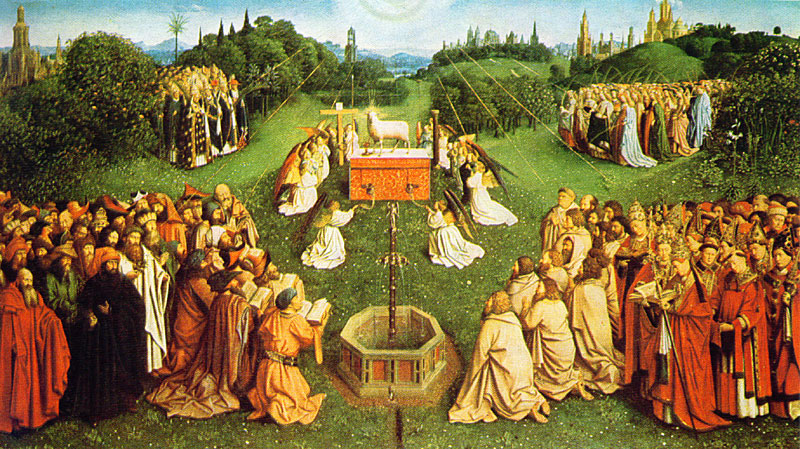
As an example, have a look at this panel from Jan van Eyck's Ghent Altarpiece:

Every year I use this image to discuss the Heavenly Worship outlined in Revelations and expanded upon in Eucharistic Prayer 1. Or I draw instead.  But when I don't draw, this works fine. I mean, van Eyck probably spent a whole day on it, while I slap out my pictures in seconds.

As it happens, My Wife the Art Historian treats this work in her textbook [Reflections on Art, Janet LeBlanc, copyrighted]. Let's take a quick excerpted tour through the incredible Biblical and Catholic content of the Adoration of the Mystic Lamb (1432):


"As noted earlier, the Lamb of God is Christ, whose blood was shed for the salvation of those who follow him. He is shown here on an altar, pouring out his blood into a chalice, thereby representing the Holy Eucharist offered up at Mass as the perpetual sacrifice of Christ. Two angels in the foreground swing censers high to release the sweet-smelling smoke of incense to carry the prayers of the faithful to heaven. The angels with censers are straight from the Book of Revelation, where they stand before the throne of God as angels sing Holy Holy Holy. The Mass therefore echoes on earth what is happening forever in heaven. The altar is surrounded by a host of angels. Four angels toward the back hold the instruments of the Passion, reminders of the means by which Christ was tortured and offered himself in sacrifice. On the left, one angel holds a large cross, and in his hand we see the crown of thorns. Next to him in an angel holding the nails used to hang Christ on the cross, and in the other hand this angel has the lance used to pierce Christ’s side. Across from them an angel steadies a column to remind us of Christ’s flagellation where he was whipped, and another angel holds the whip, and also a very tall pole with a sponge on top. This last object is a curious inclusion, but we will see it again. It’s the hyssop branch that was used to raise the wine to Christ’s lips during the Crucifixion, as described in the Gospel of John, and after drinking from the sponge, Christ said, ‘it is finished’ and he died.

This last object is not a means of torture like the others, but rather a critical component in understanding the Eucharist, which, after all, is the primary theme of this altarpiece. The institution of the Eucharist in the Bible begins at the Last Supper, which is accepted as the Passover Seder (feast). Passover, in turn, is the Jewish memorial to the original pass over in Egypt during the days of Moses (see Exodus chapter 12). After ten plagues were sent by God to persuade the pharaoh to let the Hebrews go free, God sent one last devastating blow; he killed all the firstborn across the land. The Jews were instructed that to have the hand of death pass over them and spare them, they were to slaughter a perfect lamb, they are use a hyssop branch to spread his blood above their doorpost, and then to prepare and eat the lamb. God was quite specific spelling out the details. In the Upper Room at the Last Supper, Jesus blessed the bread and stated that it was his body, which they must eat, and blessing the cup of wine, he claimed it was his blood which they must drink. Passover Seders according to the haggadah (the “program” for a Seder) of Jesus’ time passed the cup four times among the participants as they recited the Scripture accounts of the passover in Egypt from Exodus 12. The first part of the Seder was a festival blessing over the first cup of wine, which was served with bitter herbs. The second cup was blessed and passed after reciting the Passover narrative from Exodus and singing Psalm 113 (the Little Hallel). The third cup was the “cup of blessing” which followed the main meal of unleavened bread and lamb, which was followed by singing the Great Hallel which included the hymns of Psalms 114 through 118, and finally the fourth cup of wine was shared to end the Seder.

In the Gospels, the account of the Last Supper comes in with the third cup. Jesus blesses the bread, which is part of the main meal, then blesses the wine. Afterward they sing a hymn (the Great Hallel), but there is no mention of them completing the passover with the fourth cup. In fact before the great hymn, Christ says specifically that he will not taste the fruit of the vine again until he comes into his kingdom. It is not until the moment of his imminent death that Christ accepts the wine lifted up to him on a sponge, and at that moment he proclaims that “it is finished.” What is finished is the Passover, and with it the institution of the Eucharist and the New Covenant.

Below the altar of the lamb in the picture we find a rather interesting fountain spouting water from ten jets plus two more from the palms of the angel atop the fountain for a total of twelve, making reference to the twelve tribes of Israel as well as the twelve Apostles. The fountain itself is the fountain of life through baptism, and you may notice there is a small tap at the base of the fountain pool allowing the living water to stream out toward the viewer.

Surrounding this inner scene are several distinct groups of people, all humbled in the presence of the lamb and paying him homage. On the left in the foreground are Old Testament prophets and patriarchs witnessing the lamb’s sacrifice with reverence. Many hold their books in which they prophesied the coming Messiah. Behind them are pagans who lived their lives in pursuit of truth and who many believe anticipated Christianity, among them the great poet, Virgil, who can be singled out in his white robes wearing a laurel wreath on his head.

On the right are the kneeling Apostles dressed in beige robes. Without attributes it is impossible to tell one from another, except John the Evangelist who is clean-shaven. Curiously, if you count them you will come up with thirteen. Saint Paul is included here (see the bald guy in the back) and either his sidekick Barnabus was included, or more likely Matthias, the Apostle chosen replaced Judas Iscariot. Behind them are their successors through Apostolic Succession, the leaders of the Church, dressed in red robes to indicate that all those present here were martyred. First we see three popes; note their papal tiaras of the same style that the Lord wears above in heaven. Then in the second row we see a couple monks with their heads shaved in tonsure, and several bishops with their tall pointy miters. Further back stream a host of others not specifically identified as clergy.

Moving to the background, on the left we see more clergymen, bishops in their miters, and cardinals in their wide-brimmed red hats called galeros. Again we see monks sprinkled in among them. These men are dressed in blue to connote they did not die a martyr’s death. Opposite them on the right are the Virgin Martyrs waving their palm fronds, symbols of their martyrdom. The four in front are all identifiable by their attributes (or at least three of them are). Furthest away is Saint Agnes in the red skirt, who cuddles her lamb, and next to her is Saint Barbara who holds her attribute, a tower. Next is supposedly Saint Catherine of Alexandria according to some scholars, but she should have a wheel which is her attribute, and I for one do not see it there, but it could have been lost in repainting and cleaning over the centuries. Other scholars have suggested that it is Saint Ursula, but I cannot find her attribute of an arrow either, so who knows? Last is Saint Dorothy with her attribute basket of roses. A magnificent distant landscape spans the entire center panel. The city on the right behind the female martyrs in particular is believed by many to be the artist’s vision of the New Jerusalem as it is composed entirely of Churches."  (copyright 2012, Reflections on Art, Janet LeBlanc. All rights reserved.)

This image has more content than I have time for in my 6th-grade syllabus. Regardless, the kids love to take a few minutes figuring out who and what everything is, with help from me only as required.

On the other hand, a blow-up of the center is just right for my lesson plan's pacing and focus:


This is the essence of my Heavenly Liturgy sketch. And again, if the goal is to show the fusion of Heaven & Earth at Mass, the above detail would go well with Ariel Agemian's evergreen image of the Liturgy on Earth:


Someday I may butt them like so on lettersize (but match widths)...

 
...and add a couple of lines from Revelations at the top; and something from the Missalette at the bottom. Maybe I will do this next year....a great handout for the kids.

And a great handout for the parents as well.