Showing posts with label Wednesday Sunday School. Show all posts

Wednesday, March 4, 2015

Res Ipsa Loquitur 18: Tony Agnesi Show

Brighter Than Expected

This post links to Convert Journal

I hope that's kosher

Fun fun fun at the Communion retreat on Sunday with 7 and 8-year-olds. Four groups of 10 or so, 25+ minutes each time. The standard program covered the miracle of the Loaves and Fishes using step-by-step teacher's notecards, and miraculously-expanding big paper-doll type loaves and fish. Pretty neat. Of course the kids already knew the story, so I couldn't see spending the whole time on that one miracle. Plus they already knew other stories that tie into the Eucharistic theme. Why not connect the dots they know, and add a couple while we're at it?

So instead of the prepared program, I presented a stripped-down version of the 6-step Bible Miracle Food Pyramid:

0. What's a food pyramid? What's a miracle food pyramid? (2 minutes)

1. Moses, bread and flesh in the desert. (3 minutes)

2. Elijah, bread and flesh in the desert. (3 minutes)

3. Elisha multiplies bread. (3 minutes)

4. Jesus transforms water into wine. (3 minutes)

5. Jesus multiplies bread and flesh; helpers passed out hunks of French bread for some hands-on drama. (6 minutes)

6. Jesus transforms bread into flesh; and wine into blood. This miracle continues even until today in Masses all around the world. (5 minutes)

At each step we reviewed how each succeeding miracle compared to the prior ones. As appropriate, I'd dramatize the stories and draw pictures. None of the four sessions went quite the same.

First time I've worked with kids this young. Their attention spans are shorter than 6th graders', but they think as fast, and threw themselves into it as soon as I got them laughing. Nice gig.

This example is how I typically lesson-plan any new assignment. I consider allotted time, the audience, and what they probably already know. Then I figure how to cover the topic in a way that's fun and stimulating, connects to other stuff, and leads to a bigger Catholic picture. Always: how does this bit we are discussing tie into the rest of the Bible and the Faith?

Saturday, February 7, 2015

Pitcherfull

This post links to Convert Journal

that's a shapely one

Marriage is a recurring theme in catechism class because it is a recurring theme in the Bible. Typically we cover this story during our trip through the Gospels:

"Master, there were with us seven brothers: and the first, when he had married a wife, deceased, and having no issue, left his wife unto his brother. Likewise the second also, and the third, unto the seventh.
Therefore in the resurrection whose wife shall she be of the seven? Jesus said, Ye do err, not knowing the scriptures, nor the power of God. For in the resurrection they neither marry, nor are given in marriage, but are as the angels of God in heaven."

Without fail a child will ask me why I won't be married to my wife in heaven- won't we still love each other?

Part of my answer is that post-Eden, marriage lasts until the death of a spouse. But I also want to say something bigger about life after the Second Coming; that is, in the New Jerusalem- like so:

"Somebody tell me what wasn't good in Eden. Adam was alone! Yes, and? God made Eve out of his rib. Yes, and when he got his missing rib back he was completed, just like I am completed by by wife. Y'all tell me about my wife. You love her! I sure do...but why? Umm, she's you're wife? Well, yes...let's say I love her because she is good. Where's that goodness come from? God? Yes; tell me about creation. It was all good! Yes! So all the goodness we experience ultimately comes from...God. Yes. So my wife is like a book...or a TV...or Elisha's bones...c'mon, y'all know this... she's a media, cause God goes through her! Yes, a medium, she mediates God to me, like sacraments and all kinds of stuff do. Do I get the full dose of God though my wife? Huh? Is all the goodness of God available to me through my wife? Well, God's bigger than she is. Yes. But if I'm hanging out with Jesus after the Second Coming, do I get all God's goodness then? Yes! And if my wife is there...she gets it too. Yes. So is there more love between us now- or in the future? In the future! Yes. So if we will have even more love for each other while we're in God's company, how worried are we going be about how married we are? Well, maybe you wouldn't care anymore. Sort of, but not exactly...let's think of it this way: instead of the limited dose of love we get from each other here, we'll experience infinite love in heaven. It'll include all the love we have as husband and wife, but bigger: it will include everybody. Yes? But aren't you still going to miss being married in heaven? I don't think so. Imagine it like this:

Let's say I need water to live- without water I'd be incomplete, right? What? Can I live without water? No, you'd die. Without water would life be good? No you have to have it. Yes, so think of my wife, and the love she brings me, as water. I need it. And I'm ok, because I have a pitcher of lovewater right here, next to me, which is... your wife! Yes. I hug this pitcher against my heart like Adam's missing rib. And all around me right now in the classroom- is there more water? There's no water in here. Right. Except for my pitcher-full.

But eventually my wife and I will die- let's hope we'll both be in heaven, where love might be like an infinite ocean. Now imagine I walk into that sea of lovewater with my pitcher-full. See, it gets deeper and deeper, until...your pitcher is underwater!  Yes. Tell me about it. Well, the water in the pitcher is part of the ocean now. Yes. But the pitcher is still there, and it's still full, right? Yes, but the ocean is way bigger. Yes. The lovewater in my pitcher has merged with the infinite lovewater that's all around me and my pitcher. My little pitcher-full doesn't disappear: it's just where it was always meant to be. There will be many pitchers, but one water. So what we love about being married today will still be true in heaven and in the New Jerusalem, but unimaginably bigger and better."


***********************************

BTW, the above is similar to how I answer the question about pets in heaven:

"Everything that you love about your pets (and everything else) will be more fully available to you in heaven; and in the New Jerusalem I would expect to see dogs and trees and all the rest of creation, so be happy."

Saturday, May 17, 2014

Scapegoating the Body

This post links to RAnn's Sunday Snippets and Convert Journal

that's a relief

(This post is a bit of a sequel to the prior post.)

On April 30 I completed what I think is my 10th year of catechizing 6th-graders in Wednesday Night Sunday School. I love teaching, but I like to also sit down and have someone else be the teacher, especially if they really have something to teach. My classes are on Wednesday nights at the same time RCIA; and on Thursdays the parish offers lectures on assorted topics of interest to Catholics such as the Reformation, the Divine Comedy, and Islam. Both RCIA and the Thursday night series are led by our Director of Christian Formation T.J. Nielsen, who, like Goldilocks' porridge, is just right: brisk, informed, funny, comment-and-question oriented, and not too Powerpointy. But during the Catechetical year, having taught on Wednesday I don't wanna go back out on Thursday; so I attended only one of TJ's presentations before May, and two more since then. My loss. I may try harder next year.

When I hear anyone speak live about religion-philosophy-culture-society, it's usually from the pulpit on Sunday or a lectern during the week. I'm always catechetically assessing the moment-by-moment content of what I hear: do I cover that in class? If so, is this new content I can merge with what I already do? If I don't cover it, should I? How much time would it take? How would I teach it to kids? That sort of thing. It's affirming that most of what I hear from pulpit or lectern overlaps and harmonizes with lots of class content and thought-process, although the pitch is different. And even if there's no direct lesson-plan application of some memorable bit, inevitably some child will ask an off-the-wall question; and pow, I deliver an answer I mooched from someone else years ago.

So refining kids' content through exposure to adult thinking is second nature. But over the last couple of weeks being in TJ's class, I heard questions and comments coming from adults that I had already heard at least once from kids. And of course my 6th-grade answers were different from adult-type answers. So I felt constrained to strip the kiddie-approach out of anything I said before commented. But still: meaningful adult content lay within children's catechesis, content that wasn't likely to emerge in an adult-only learning environment.

Last night's parish lecture on the Catholic Worldview included discussion of a human being comprising a unity of a body and a soul. TJ mentioned Manicheans and Gnostics, who align the Soul with light and the good; and the Body with darkness and evil.  A woman asked why Christian heretics such as the Cathars would reinvent those old ideas- after all, Genesis observes that everything was good. Now, kids don't ask questions about Cathars or Gnostics. But kids ask questions about how our bodies and souls go together; and discuss why people don't like to apologize or accept blame; why sin is bad; its effects; why bad things happen. In class, Body and Soul is a theme that runs all the way from Genesis through the Mass. There was a good, kid-type answer to that woman's question, but I had to think about it. After the lecture was over and people were chatting, I asked her if I could respond to her question especially with reference to the Genesis bit. She said sure.

I crouched down so I could touch the floor. "You're right that Genesis says everything God made was good. That means even stuff like rocks. It was all good 'cause everything that comes from God is good unless something messes it up. But Adam and Eve sinned, and God said to Adam, "Because you have listened to the voice of your wife, and have eaten of the tree of which I commanded you, 'You shall not eat of it,' cursed is the ground because of you." You may already know adama is Hebrew for earth, ground, dirt. So Adam was made from Adama and God's breath (I pretend to scoop up dirt, breathe into it, and mold it), and he was good. Now Mr. Dirt has sinned. But Adam's sin doesn't just affect Adam the man; Mr. Dirt's sin also curses the dirt, the adama (I angrily smack the floor), because they are connected. Adam sins, and all Creation pays for it. Now nobody wants to think their sins have such repercussions; but I think when I sin, it may have some bad effect centuries or light years from here, like throwing a sin-rock into clean, calm water. I don't know how far the bad ripples will go, but I expect to be appalled when I find out. If God showed me right now all the bad I've caused, it'd probably kill me or at least drive me insane. And being prideful, I look for an easy way around that Matterhorn of guilt- you know, I'm not as bad as Hitler, or my prodigal brother, or Judas. Or my sins are just on me, so no biggie to get God's pro-forma forgiveness.

I expect everybody looks for that sort of out: one that lets us keep most of our pride intact. So people take advantage of a major consequence of sin: death. See, death separates the body and soul, and the body belongs to the visible, physical world, which we already know is a mess: famine, plague, tornadoes, tigers, yuck! It was a mess before I got here! So that must be the problem: our souls, our invisible real selves are good and pure, and not morally responsible for being stuck in these lousy sin-prone bodies. This heresy simply scapegoats the Body, in order that the Soul may get a pass. A convenient construct, but a false one. A human being is singular, even if we can imperfectly perceive different aspects of that singularity. We're a bit like Jesus in that respect: Jesus comprises God/Man/Body/Soul all at once. But Jesus is singular; prying him apart is heretical. Likewise the Trinity: the three-ness is singular. Prying them apart is heretical.

The whole person sins. There's no Gnostic spiritual better-half with an eternal get-out-jail-free card. That's why there will be a Resurrection of the Dead before the Final Judgement: the whole person is good or bad, so the whole person will be judged. Ouch.

That's why that heresy remains popular. And it's why the Catholic Church is always clear about why it truly is heretical: the only out is true repentance, and the sacrifice of one's pride."

And that's also why we have, you know, Confession. Ouch again.

(Audio version here.)

Friday, March 21, 2014

Kids Wanna Know

The next few posts link to RAnn's Sunday Snippets

Too Catechetical for Words

We had 28 class meetings on this year's Wednesday Night Sunday School schedule. Since New Year's we've lost two days to snow, plus about another 1/2 class to other events. The later in the year I lose classtime, the harder it is to compensate. I don't talk faster because we already move at the Speed of Comprehension. What I do instead is prioritize and eliminate, like Frederick the Great.

Two evenings ago we covered the Resurrection through the Ascension.  We use a handout showing an image of the Anastasis, and a Supper at Emmaus by Rembrandt. In covering the Anastasis, for reasons of time I didn't translate a couple of Greek abbreviations in the picture, although I did explain the Greek word Anastasis, and show the kids how to pronounce the letters. Then we moved on.

After class one of the kids asks, what do these two things mean, i.e., the IC and XC.


See, what I leave out is exactly what someone wants to know. I go over the squiggies and the letters. In moments like this when a child wants to know something particular, I always want to answer the question directly, but than add a bit that points to the bigger picture. So I say a bit about words on ikons, and also write on the board similar squiggied-letters that often appear in Mary-ikons: MP and ThY, which abbreviate Μητηρ Θεού MITIR ThEOU, Mother [of] God. It was a nice little lesson.

Now, this isn't just a chance to for a child to take away something extra; it's also a chance to involve the parents. Next week I'll give her a prayer card like this one:


Is has MR-ThY and also IC-XC. Thanks to reader Moonshadow, I understand that to the left and right are the Archangels Michael and Gabriel. The Greek says O AP M  (The ARchangel Michael) and O AP G (The ARchangel Gabriel). I'll write the translations on the back. I'll also get her to tell me what the angels are holding, and why they matter (they're a few of the Instruments of the Passion). I'm confident she'll know the cross and the spear. But what's that other thing? I blew it up for a closer look, and I think it's the sponge on the hyssop stick. She already knows what it is, it's just not easy to recognize. I expect to give her hints, e.g. "I thirst." I'll conclude by saying she oughta show her parents what she's learned and impress the heck out of them.

In this business you never know when or where stuff will grow. Just throw the seeds, you won't run out.

If I had all the time in the world, a whole class could be spent on this single image: its visual catechesis, Queen of Heaven, King of Heaven, Mother of God, Fully God, Fully Man, Immaculate Conception, Crucifixion, angels, the Greek words, all of which allude to Scripture and of course the Big Catholic Picture.

For those who want to know more about cryptic Greek on ikons, here's an old post about John the Baptist.

Monday, March 17, 2014

More Nice

Between Sports and the Party: When Teaching the Faith Feels Like Babysitting

A fired-up catechist shares successful lessons with a frustrated volunteer.

Wednesday, February 19, 2014

Monday, February 17, 2014

Look Inside


I browsed a couple of catechist-related books yesterday. Not reading the books, but reading through the Look Inside bits on Amazon. Fr. Philip N. Powell mentions them at his blog.

The first one is The Pedagogy of God: Its Centrality in Catechesis and Catechist Formation. My Look Inside rating: No Sale. I'm the wrong audience for this prose.

Whoops- I should define my rating system. It's a lot like Sun Bear's rating system. Who? Sun Bear, "who was born Vincent LaDuke, was a writer and actor who is probably best known for founding the Bear Tribe in the 1970's in Washington." A New Age personage. I don't know much about the guy, but I have been fond of a Sun Bear aphorism for about 35 years. Here it is:

“If your religion doesn’t grow corn, I don’t want to hear about it.”

Speaking as a catechist, I love it. Modified to fit my situation, it's “If your catechetical book/ article/ post/ workshop/ lecture won’t improve my catechesis, I don’t want to hear about it.” I don't mean something mightn't be useful to someone else, but if it doesn't look like it'll help me in my classroom, I got other things to do. Like what things? Like read the second book:

Catechism of the Catholic Church and the Craft of Catechesis. My Look Inside rating: Buy. As I said, I only read the excerpts, but that's one way I decide to spend money on books. Or not. I don't care for this book's writing style either. But it appeals to me based on the 12 Keys of Catechesis listed at the book's end; and how I do or don't reference them in my 6th-grade class:

1. HOLISTIC: the Faith Professed, the Faith Celebrated, the Faith Lived and the Faith Prayed.

I'm good on the first 3. We don't pray a lot in my class. An opening prayer and a closing prayer. For all I know that's typical in all catechism classes. Maybe we do pray a lot. Classwise, I'm more focused the other three. I want to know more.

2. GRACEFUL: We maintain the primacy of grace. 

This, I don't know...."maintain the primacy of grace"? This sort of statement bugs me. What does that mean in the classroom? Why not: maintain the primacy of love? Why not: maintain the primacy of faith? Or: maintain the primacy of Christ? Dunno. I think it means we hope for mercy instead of justice. We cover that explicitly in class. But I'm intrigued. If I buy the book, I expect to have it explained.

3. ORGANIC: We practice an organic reading and teaching of the Faith.

I already apply the term 'organic' to my catechesis. Curious if the authors and I mean the same thing.

4. PERSONAL: Doctrine and its transmission is essentially personal.

Yes to this. I believe personal witness is the sine qua non of catechesis. I look forward to reading more.

5. TRUE: We proclaim the mysteries of the Faith as true...

Yes...seems awfully obvious though.

6. ATTRACTIVE: We highlight the innately attractive nature of the Faith...

Yes. I do this explicitly and continually. I want to read the book to see what specific examples the authors will provide.

7. PURPOSEFUL: We immerse doctrine within the dynamic of God's plan...

Yes. Intrinsic to class. The book may show ways of being purposeful that I don't know about.

8. FAITHFUL: We use the Catechism, drawing on the language of Scripture and Tradition.

Yes. I'm on this 100%, and curious as to the book's take on this all-important synergy.

9. EVANGELIZING: (go Look Inside)

I'm not moved at all by the book's phrasing here, but an explicit goal of my catechesis is to evangelize and catechize at the same time, all the time. Tell me more.

10. SCRIPTURAL: We let our catechesis be soaked in the Scriptures...

Yes. 100% on this, and want to read more.

11. LITURGICAL: (go Look Inside)

Not fond of the phrasing. Still, understanding the Mass is a big deal in class, so I want to read more.

12. PRAYERFUL: We make our catechesis a school of prayer...

Sounds vague and fluffy. I say it should be a school of faith. I'll want some elaboration.


Saturday, February 8, 2014

Linus, Cletus, Clement, Sixtus, Cornelius

This post links to RAnn's Sunday Snippets

hinge

Each year in Wednesday Night Sunday School we spend a few minutes on the fun parts of Isaiah 22.  I play the role of King Hezekiah and two volunteers play Shebna and Eliakim. When we get to Matthew 16 a couple of months later, we recall Isaiah 22. Then when we discuss the Mass in April, the kids learn that Linus, Cletus, Clement, Sixtus, Cornelius were some of the popes that succeeded Peter. But I have never connected those guys to either Isaiah 22 or Matthew 16. I want all learning to be integrated with other learning, and this was a weak point in that respect. But this year is different, and better.

This year we did our Eliakim skit as usual in November. Then last Wednesday I treated Matt 16 like so:

I got two volunteers to come up and be Shebna and Eliakim. We did a quick refresher on Is 22. The kids remember only Eliakim's name, but that's ok. I care about the story and why it matters. They remember it just fine. We quickly re-enact it. Corrupt Shebna sits down. Now we cover Matt 16. I read bits from the chapter, and the kids figure out I'm now Jesus and the other actor is now Peter. We act out the keys again, and draw parallels between the two Kings and their Prime Ministers. The rest of the class play the 11 other apostles. They figure out the significance of Jesus borrowing from Isaiah.

Then I get five more boys to come up and stand in a row next to Peter. I stand behind them with my invisible keys. Peter dies and falls to the floor. The kids tell me to pass the keys to the next boy, he'll be the next pope. As each pope dies and falls to the floor, the King of Heaven gives the keys to the next boy. At the end they're all dead. I get them all to stand back up.

"Y'all tell me who these people are. Umm...they're the first popes! Yes! Some of them. Who's the first one? Peter! Yes, that was easy. Who's next? No guesses, that's OK, he's Linus. Linus, your name is...Linus! Yes, ya too smart, Linus! And these other popes are Cletus, Clement, Sixtus, and Cornelius. Do those names sound familiar to anyone? Yes! Where do you know Linus, Cletus, Clement, Sixtus, and Cornelius from? Umm....I don't remember. That's OK, we'll find out in April."

"Who's the pope now? Francis! Yes. He's the 266th pope. Who was before him? B...Benedict! Yes, good. Is Benedict dead? No, I think he just stopped being pope. Yes. That's very unusual, for a pope to retire. Trick question: in the Isaiah story, who picked Eliakim, the new prime minister? The King! Yes, Heze...Hezekiah! Yes. And who picked Peter? Jesus! Yes. Who is...the King! Yes. Did Benedict pick Francis to succeed him? No the other people did. Who exactly? Bishops? Well, sort of. They all wear red...like a bird...that is red...cardinals! Yes, a small group of bishops called cardinals. The bird is named after the men. Cardinal means hinge in Latin. Y'all remember we talked about hinges in December. For example, doors hang on, depend on, hinges. So to say something is cardinal, like a cardinal rule, means it's important like a hinge because other things depend on it, hang on it. But the cardinals don't just pick who they like for pope...remind me who picked the first pope. Jesus. Yes, so who still picks them? Umm...Jesus? Yes, good job! The King still has the power to pick his key-man. But Jesus put the cardinals in charge of making his pick. That's why the cardinals all pray for the Holy Spirit to guide them in making the right choice."

It only takes a few minutes to knit this together. And it prepares the children to jump all over Linus, Cletus, Clement, Sixtus, and Cornelius when those names pop up in our Mass classes in April.

Friday, January 24, 2014

Torque Curve

This post and the next link to RAnn's Sunday Snippets

that kind of car, but not that kind of burnout

Catechists, other church volunteers, and paid staff always run the risk of burnout. You know, knocking yourself out for Jesus until you're punch-drunk from stress and disappointment. It's nicely treated in a piece at Team RCIA, which prompts this post. On cars.

Generally speaking, when people say their cars are powerful, they're really describing their engine's torque, not its power. As my father's college textbook Internal Combustion Engines says, "power is a measure of the rate at which work is done," while "Torque is a measure of the ability of an engine to do work". People like what's called good tip-in, when a car pulls smoothly and quickly away from a stoplight at the first press of the accelerator; or being able to pass or go up a hill without a downshift. All that is torque-related, that is, how easily the engine does the work.

Intuition says that the faster the engine turns and the more gas it burns, the greater the torque. But that's usually not the case. Maximum torque is typically produced at a moderate RPM. Let's look at this graph of my Camaro's LS1 V8:

The light blue line is the torque curve. You can see that max torque of 330 lb-ft is available at about 3900 rpm. But if the engine revs beyond 5000rpm, less torque is available. Less ability to do work. Less durability.

This is how I understand my own productivity, especially when I volunteer. I think of myself as an engine. There's a point where my ability to be productive is maximized. It's not when I'm relaxing, and not when I'm overstressed. I always aim for that peak of productive stress and avoid going under or over it. With respect to volunteering, the best way to stay at the peak is to know when to say no, and then actually say no. As the Team RCIA post says, "We tell ourselves that we are sacrificing for the sake of the church or the people or Jesus." And that is true; but the point of volunteering isn't to sacrifice, it's to build up the church. So don't run too fast, and don't run too much, and you may run for a long, long time.

Wednesday, January 22, 2014

Pitchers 19

Second Board, January 22, 2014

1. Loaves & Fishes just like in prior years. Jesus gives thanks to the Father and effects a food miracle. Grumpy apostles mediate between Jesus and the people.

2. Plan of church shows same relationships: Father>Jesus>food miracle>ministers>people.

3. Triangle shows divine power flows through Jesus; then it's mediated through a small group of authorized agents to everyone else. It's a lateral hierarchy; but hierarchies are usually laid out vertically. So...

4. Triangle rotates to become Mount Sinai. (The kids already know how the Old Covenant works.) We see the same pattern in blue as described in Exodus: Israelites at the bottom, Levites halfway up, Moses in the Shekhinah cloud at the top connecting with YHWH on behalf of the others.

5. Same hierarchical pattern in blue is fulfilled and perfected in the Church in green: the faithful, the ministerial priesthood, Jesus at the top connects to the Father per Hebrews & Revelation.

It'd be virtually impossible to discuss these connections with 12-year-olds with words alone. But with a few pictures, the kids don't just learn, they think and draw conclusions.

Thursday, January 16, 2014

Class Stuff

This post and the next link to RAnn's Sunday Snippets
 
you must have a detailed lesson plan

 Some stuff about the last couple of Catechism classes:

We finished the Jan. 8 class by spending about 20 minutes on the Healing of the Paralytic: acting, drawing, discussion, Bible-reading, the usual. This week among other things, we covered Jesus healing a man's withered arm on the Sabbath; a leper; Jairus' daughter; the woman with a hemorrhage; and the centurion's servant. Every story involved a little skit, with kids obliged to think on their feet about why the characters acted as they did, and draw conclusions. We ended with Jesus blessing the little kids, which sets the stage for next week's Loaves and Fishes miracle.

But these healing stories aren't just treated as disconnected snippets of Jesus Is So Nice; like all Bible stories, they are explicitly connected to Catholic themes, both individually and also as a group. From the Paralytic to the Centurion I emphasized these concepts:

1. Having a physical encounter with Jesus is the normal way to get a miracle. Nobody just stays home and prays if it's at all possible to engage Jesus both spiritually and physically. People will make a hole in a roof if that's what it takes. Nobody ever got a miracle in the NT without having a physical encounter with Jesus or one of his authorized agents.

2. Having a physical encounter involves an act of faith which anyone can see. That is, by what people do their faith can be seen.

3. Jesus will do someone a favor if someone else acts in faith on their behalf. That's intercession, and it still works.

4. Jesus can work a long-distance miracle; but the miracle is still initiated though a physical encounter.

5. Jesus can work miracles through physical stuff just like the Moses and Elijah, as when the woman grabbed his tassel: boom! Healed! Who touched me?

6. Faith by itself is good; faith in action is better. We comprise a body and a soul; so our bodies acting in harmony with our souls just makes sense. If ya ain't doin' ya prob'ly ain't believin' either.

7. Jesus has a body and a soul, too. That's why everyone was so excited: to be able to access God physically was a big deal.

8. It's still the norm to have a physical encounter with Jesus. That's what sacraments are for, especially the Eucharist and Confession. Eating God is a big deal. But just like the centurion, you have to believe without seeing.

9. Healing physical sickness matters; but healing spiritual sickness matters more.

Wednesday, December 11, 2013

Pitchers 18: Teach and Draw

This post links to RAnn's Sunday Snippets
Board from the December 11 Class. Click to Enlarge.

Stuff on the board was drawn in more-or-less chronological order. Not everything covered in class was drawn on the board.

1. Christmas. The Nativity. A bit of Spanish: Navidad.

2. Isaiah, the Christmas Prophet: virgin, tidings, star, shepherds, sheep, kings, gold, incense, Dromedaries, ox, ass, manger, and the manger's master. A bit of Old English: tidings. A bit of Luke: myrrh. A bit of French: manger. A bit of Greek: aggelos, evangelion.

3. The Flight to Egypt. Maybe to Alexandria where young Jesus, like you kids, would learn some Greek.

4. Isaiah, Jeremiah, the boy Jesus, and the adult Jesus all at the Temple. A bit more Spanish: escribir.

5. John the Baptist at the Jordan, site of water miracles. The Jordan runs from Galilee to the Dead Sea. More Greek: baptizo. Still more Greek: dromos = run, race. Like a fast camel: a Dromedary. John is the Prodromos, the Forerunner, the herald. As John's father Zechariah prophesied: "you will go before the Lord to prepare his ways." 

Not just words in books. Proclaim. Write. Act. Sing. Draw.

Photo by Guest Bouncer John Biediger

Saturday, December 7, 2013

Epiclesis

This post links to RAnn's Sunday Snippets and Convert Journal

 Size doesn't matter

Up until I was eight years old I belonged to St. Francis de Sales parish in Houma, La., whose church is a lovely Gothic revival structure completed in 1938. My Catholic imagination was well-nurtured by its elegant proportions; the Bible stories vividly presented in the stained glass windows; and a dove whose wings overshadowed the crucifix, tabernacle and altar.  The dove was painted on the green underside of a gracefully arched canopy which was cantilevered from the wall just above the crucifix.

Of course I knew the dove represented the Holy Spirit. But the canopy made the point, not the bird. It emphasized and protected Jesus on the cross; and also in his little house, the Tabernacle. It was clear to a kid: what's under the canopy is more worthy of attention and protection than what's not under it. I didn't understand until decades later that the canopy was yet another expression of Biblical-liturgical overshadowing; and that the little canopy was properly called a baldacchino.

At Mass, I'm frequently reminded of that green canopy during the Epiclesis:

Roman Missal 3rd Edition, Eucharistic Prayer II:  "Make holy, therefore, these gifts, we pray, by sending down your Spirit upon them like the dewfall, so that they may become for us the Body and Blood of our Lord, Jesus Christ."

Roman Missal 2nd Edition, Eucharistic Prayer II: "Let your Spirit come upon these gifts to make them holy, so that they may become for us the body and blood of our Lord, Jesus Christ."

I remember the canopy not so much because of the words, but because of the gesture which accompanies those words:


Is the priest making a little canopy over the gifts? I think it's implicit in the gesture. More specifically, I think he's overshadowing the gifts. I know, the prayer doesn't say that. I'm conflating "Let your Spirit come upon these gifts..." with this bit of Luke 1: "The Holy Spirit will come upon you, and the power of the Most High will overshadow you; therefore the child to be born will be called holy, the Son of God." That is, at the moment of Mary's overshadowing, God became physically present in her womb. And at the Epiclesis, God becomes physically present in the accidents of bread and wine. So I like the overshadowing gesture; and if I had been in charge of the New Translation, that bit would be something like "Let your Spirit come upon these gifts to make them holy; and let your power overshadow them, that they may become for us the body and blood of our Lord, Jesus Christ." But I can't find any Mass in Latin that mentions overshadowing even once; so it'd be going beyond the Latin to include any explicit mention of it.

But Christianity is bigger than the Latin Church. And the Eastern Christians usually embrace mystery with an enthusiasm that often escapes the rational West. Are any of them explicit about overshadowing in their Divine Liturgies?

At least one is, the Ethiopian Orthodox Church. In the opening prayer of its Divine Liturgy we hear, "How awful is this day and how marvellous this hour wherein the Holy Spirit will descend from heaven and overshadow and hallow this sacrifice. In quietness and in fear, arise and pray that the peace of God be with me and with all of you." I like that.

And at the epiclesis the priest says, "We pray thee and beseech thee Lord, that thou wouldest send the Holy Spirit and power upon this bread and upon this cup." I think the couplet of 'Holy Spirit and power' alludes to Luke 1 as well, but a bit more explicitly than the Latin Masses do.

So in April of next year, when we are discussing the Epiclesis in Catechism class, I'll make the same gesture as the priest. And then I'll get the kids to figure out what it means, and connect it to other overshadowings they're already familiar with. Time permitting, I'll draw the old canopy at St. Francis and a baldacchino; and have the children tell me how they relate to the priest's overshadowing hands.

This material is also covered in this short audio file.

Saturday, November 30, 2013

Fine Art 11: Die Maria Schützt Euch

This post links to RAnn's Sunday Snippets

Let's jump right in: I read Die Weise von Liebe und Tod des Cornets Christoph Rilke for the first time in 1982. Here's the backstory, but you don't have to look at it. All you need to know is that the Cornet is a prose poem in German, and an elegant introduction to the language.

Yesterday I was admiring Hans Holbein's portrait of St. Thomas More:

So much of who I think More is comes from this painting. And the same is true for Holbein's portrait of Henry VIII. And Erasmus. And Anne of Cleves. So I started aimlessly browsing all the Holbeins I could find, because you can often see a lot just by looking. By and by I came across this one:

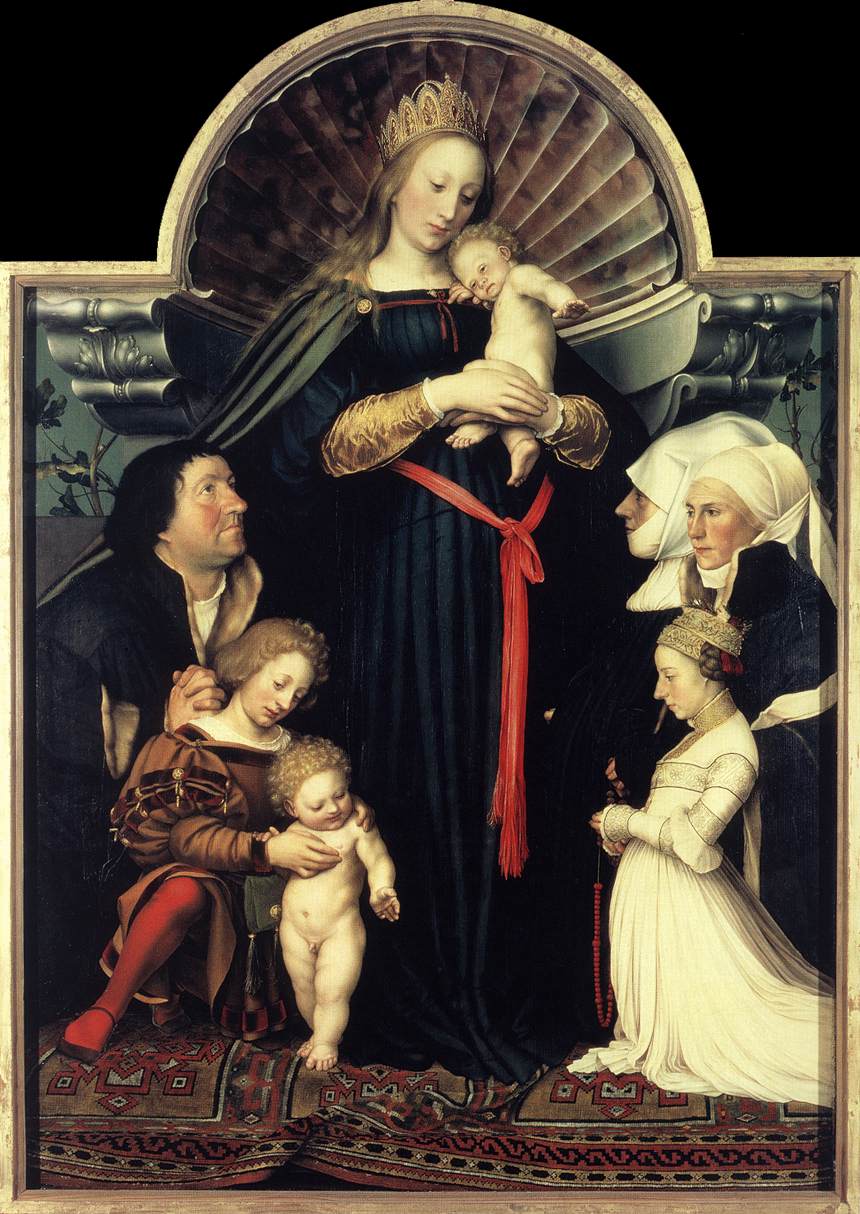
It's called the Darmstadt Madonna. It follows a standard formula in which the patron (in this case, Jakob Meyer, mayor of Basel, Switzerland) is at the right hand of Jesus, the Trinity, or a saint; and other members of the family, both dead and alive, are distributed starting at the central character's left hand. Notice in this case that although Mary is physically dominant, nobody looks at her: the patron focuses his gaze on baby Jesus, as does Mary herself. That's a little Catholic digression about a content-packed painting which is not the subject of this post.

But what struck me is Mary's cloak resting on Jakob's shoulder...a type of overshadowing I hadn't ever noticed before. Mary is protecting Jakob by 'spreading her wing' over him, recalling numerous Bible and liturgical examples of protective overshadowing. I assume that Jakob will extend this protection over his family, and that's why Mary's cloak doesn't overshadow to her left. This image of Mary's protection reminded me of a line from the Cornet, when two soldiers go their separate ways:

"Kehrt glücklich heim, Herr Marquis. > Return happily home, Herr Marquis."
"Die Maria schützt Euch, Herr Junker. > The Mary protects you, Herr Junker."

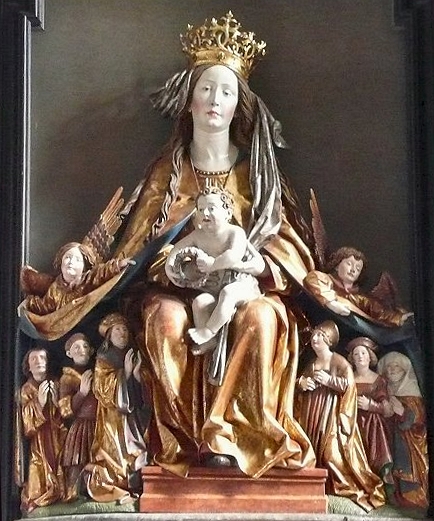
So then I wondered if that was a standard German idea, to seek or enjoy Mary's protection. A quick search on "schutz maria" turned up a town called Maria Schutz in Austria, but I was looking for piety, not places. Tried "schutz madonna", got Schutzmantel Madonna right away, which simply means Protection-cloak Madonna. It's a very common Catholic image in German-speaking cultures:

Looks just like his Momma.


Is the Son's swaddling cloth overshadowing his Mom?

Both the Queen Mother and her Son the King wear crowns


Even popes and bishops want in.

The Schutzmantel Madonna is such a vivid image that I want to get a statue like these for catechism class. It'll fit right in with our recurring theme of overshadowing. Yeah, I could print off a nice lettersize handout of one of these photos (and I may do so regardless) but a 3D teaching tool works better than its 2D version.

And the Schutzmantel isn't just a religious concept. The traditional way a German man would legally demonstrate his adoption (or legitimization) of a child was to publically extend his mantel over the child; so Mary isn't simply protecting a bunch of people- she's adopting them as her children. There's just something about a statue that'll make that point better than a picture. But for class we'll first do a quick skit of Mary extending her beach towel mantel over a couple of her peers. Once the kids figure out its significance, then I'll pull out the statue, we'll discuss some of the German history behind it, and connect it to the Bible examples we've already covered. Then right before class is over I'll distribute a Schutzmantel Madonna handout, and have the kids explain to me how they are going to explain it to their parents for homework.

Figure no more than 5 minutes on the skit and statue; no more than 2 minutes on the handout and quick review.

This material is also covered in this short audio file.

Saturday, November 23, 2013

Hinge

This post links to RAnn's Sunday Snippets
At about this time every year in Wednesday Sunday School, we finish the Old Testament. Before beginning the New, we learn and review some big-picture ways to envision the Two Testaments, such as:

1. The Bible is an iceberg; the small part, the NT, is easily seen. But it's supported by the less-obvious OT. Be aware of the whole iceberg, not just what sticks out.

2. The Bible roughly divides into books written before Jesus was born; and books written after he was born. But the whole thing is about Jesus.

3. Two women personify the Testaments and their separate, but related plotlines: Eve, who freely cooperated with the Devil; and Mary, who freely cooperated with God. Every year we do a skit of sorts with two girls and analyze some sacred art featuring these two women. I always refer to the break between the Testaments as an intermission, or a hinge, and I open and shut my held-up Bible at the titlepage of the NT to make the point.

So last week I was looking at the lesson plan and thinking about the Hinge Thing, and how my Bible, the book itself, doesn't really have a literal hinge, since it "hinges" at every page. Which gave me an idea. I bought a nice, heavy 4" hinge at the hardware store with a removable pin. I needed the pin to slide in and out easily, so I filed the thick part down around the top until it did so. This Wednesday when we got to the end of the OT, we did the Iceberg Bit as usual. But then:

"Hey y'all I need two girl volunteers! Me! You aren't a girl. I want real girls. Yes, you two real girls come on down! Daughter One, stand here, and [I give her a hinge leaf] hold this in your left hand, out where we can see it. It's the leaf of a door hinge. You're the Old Testament. Daughter Two, what are you? The New Testament. Yes, and hold this leaf in your right hand..... Well? Well what? Well, do something! This is a skit! [They try to align the two hinge leaves. It's hard without the pin.] Whassamatta wit' y'all? Can't you Testaments get together? They need the stick thing! Yes, they need the pin. [I bring it out and slide it into place.] There y'all go. So tell me about them now. They make the Bible! Yes. And what is the pin? It's...it's Jesus! Yes, genius, the pin is Jesus. What holds the the leaves together? The pin! And all three together make...a hinge. Yes. But if I take the pin out...like so...then it doesn't work. Yes, so in Bible terms, the two Testaments hinge upon...Jesus. Yes. OK, let me have the leaves...but don't sit down yet! Class, tell me: this girl is the...Old Testament, yes and she's...the New. Yes. But they aren't just Testaments-  they're also two particular women in the Testaments....." And we segued into item 3.

Some teaching points:

1. This is better than my old way of just telling the kids Jesus forms the hinge between the Testaments. This new way the kids have to figure it out instead of being told.

2. It's better when they figure out an abstract concept through something physical than without something physical.

3. The hinge is like a book even though it didn't come up.

4. I could also have done this by simply pointing to a hinge on the door to the classroom. But it's better to have the kids physically participate; and it's better for them to see there is no hinge unless the pin holds the leaves together.   


Wednesday, October 2, 2013

I Never Noticed This Either #2


Last night I attended a mission at Our Lady of the Rosary in Greenville, SC. The speaker was Michael Cumbie, whose faith journey is not the usual; I was pleasantly surprised by both the plot and the content of his 90-minute presentation (the 2nd of 3).

One of the Bible stories he covered was the Road to Emmaus, per Luke 24. I'm editing a bit:

"That very day two of them were going to Emmaus and talking about all these things that had happened. 15 While they were talking, Jesus himself drew near and went with them. 16 But their eyes were kept from recognizing him. 17 And he said to them, "What is this conversation which you are holding?" 18 Cleopas answered him, "Are you the only visitor to Jerusalem who does not know the things that have happened?"  "What things?"  "Concerning Jesus of Nazareth, who was a prophet, and how our chief priests and rulers crucified him. 21 But we had hoped that he was the one to redeem Israel. Yes, and besides all this, it is now the third day since this happened. 22 Moreover, some women of our company were at the tomb early in the morning 23 and did not find his body; and they came back saying that they had even seen a vision of angels, who said that he was alive." 25 And he said to them, "O foolish men, and slow of heart to believe all that the prophets have spoken! 26 Was it not necessary that the Christ should suffer these things and enter into his glory?" 27 And beginning with Moses and all the prophets, he interpreted to them in all the scriptures the things concerning himself."

In catechism class I always thump on that last line. It reminds us that the disciples were average guys; and unlike scribes and Pharisees, didn't have wads of Scripture committed to memory. They didn't spend their workdays thinking about Isaiah; they thought about, oh, catching fish. Nor would it be obvious to even an expert that golly, Jesus sure has fulfilled an awful lotta Scripture on this, the very first Easter Sunday! So Jesus had to explain it all from God's viewpoint as they were walking; and he probably needed every minute of the journey to do so.

"So they drew near to the village to which they were going. He appeared to be going further, 29 but they constrained him, saying, "Stay with us, for it is toward evening and the day is now far spent." So he went in to stay with them. 30* When he was at table with them, he took the bread and blessed, and broke it, and gave it to them. 31 And their eyes were opened and they recognized him; and he vanished out of their sight."

And I jump on that as well, and y'all are familiar with  it. The bread-breaking is a big deal, because that's the moment Jesus was recognized, not merely seen. In other words, anyone can see, but does everyone understand what they are seeing? Of course this alludes to Mass, and the necessity of not just seeing what things may look like, like, you know, bread; but recognizing what they are.

But Cumbie also pointed out that not only was Jesus recognized when he broke bread, but that he was not recognized during hours of Scripturally enlightening the two disciples about himself. And the two disciples seem surprised at that: "They said to each other, "Did not our hearts burn within us while he talked to us on the road, while he opened to us the scriptures?" Yeah....wouldn't that have been the time for recognition? Nope. They knew Jesus when he broke bread; not when he showed them how all Scripture had been fulfilled in himself. Huh.

I never noticed. But boy howdy am I using it in catechism class when we cover this passage in March. I expect to Go Negative, like so:

"Later on Easter Sunday, Jesus ran into a couple of sad disciples. Why would they be sad? 'Cause they thought Jesus was dead. Yes. Let's listen to Luke's Gospel: "That very day two of them were going to Emmaus and talking about all these things that had happened. 15 While they were talking, Jesus himself drew near and went with them." But y'all just said Jesus was dead. He's alive again, it's Easter! Oh, oh yeah, that's right. "But their eyes were kept from recognizing him." Who kept them from recognizing Jesus? Umm, I guess Jesus did. Yes, why? I don't know. That's ok, let's see if you can figure it out. Then Jesus said, "What is this conversation which you are holding?" 18 Cleopas answered him, "Are you the only visitor to Jerusalem who does not know the things that have happened?"  "What things?"  "Concerning Jesus of Nazareth, who was a prophet, and how our chief priests and rulers crucified him. 21 But we had hoped that he was the one to redeem Israel. Yes, and besides all this, it is now the third day since this happened. 22 Moreover, some women of our company were at the tomb early in the morning 23 and did not find his body; and they came back saying that they had even seen a vision of angels, who said that he was alive." Who are they telling Jesus about? They're telling him about himself! Yes! Do they know who he is yet? No! Right! And Jesus said, O foolish men, y'all don't understand all the stuff the prophets predicted! Prophets like who? Isaiah! Yes. But are these guys Bible experts? No! Right, they need a little help: "And beginning with Moses and all the prophets, he interpreted to them in all the scriptures the things concerning himself." Now once Jesus explained everything to them, did they recognize him? Yes! No! Trick Question! Jesus walked with them most of the day explaining how he fulfilled all those prophecies, but they still didn't know who he was!

"So they drew near to the village to which they were going. The disciples said, "Stay with us, for it is toward evening and the day is now far spent." So he went in to stay with them.  When he was at table with them, he took the bread and blessed, and broke it, and gave it to them. 31 And their eyes were opened and they recognized him; and he vanished out of their sight."

"So tell me about it. They knew he was Jesus. Yes of course, but tell me how they knew. Jesus let them see. Yes, but why did Jesus let them see now? Why didn't he do it when they were having Bible Study all day [going negative]? OK, hard question? Y'all listen again and tell me why he waited:  "he took the bread and blessed, and broke it, and gave it to them. 31 And their eyes-" It's like at Mass! Yes; what's like at Mass? That's what we say at Mass. Yes, what the priests says. So try again: why didn't he do it when they were having Bible Study all day? He wanted to wait until the bread stuff. Yes, good. Now can y'all recognize Jesus in the Bible? Yes. And can you recognize him at Mass? Yes. But which one of those ways is Jesus emphasizing in the story? Mass! Yes! And even the disciples are surprised: "Did not our hearts burn within us while he talked to us on the road, while he opened to us the scriptures?" See, even they notice that Jesus didn't let them recognize him until he "blessed the bread, broke it, and gave it to them."

The Bible never runs out of Catholic ideas.

Wednesday, September 25, 2013

Letter to Parents 2013

Wednesday Night Sunday School has changed a lot in the last 2 years, figured it was time to update my letter to the parents:


September 4, 2013

Dear Parents of 6th Grade Religious Ed Students,

1. You are invited to come to class anytime. Parents who do come tend to enjoy it, and every additional adult in the room improves the learning environment.

2. There's no book for this class, and no homework. Isn't that great? This year we'll cover the whole Bible, from Genesis through Revelations; and follow that with the Mass, and how the Bible relates to Mass. So if you've never looked at the Bible in one big sweep, now's your chance.

3. On the other hand, every week builds on the prior weeks' information, so the more your child comes to class and participates in discussion, the easier it is to keep up and have fun learning.  Encourage your child to pay attention, participate, and not interfere with other students' learning.

4. Sometimes the children will bring home color handouts of fine art that we use to spark discussion in class. Have your child explain what he or she learned about those handouts. Now that I think about, make them tell you what they learned after every class, handout or not. Explaining to you what they learn is part of their evangelization practice.

5. We take attendance; please have your child come to class regularly and on time.

6. Encourage your child to contribute to discussions, and to ask questions. At the start of each class students can ask any question about God/ religion/ Christianity/ Catholicism/ current events/ encounters with non-Catholics/ you name it. We want the kids to get answers to their faith questions; if they don't ask 'em, we can't answer 'em!

7. Encourage your child to sit toward the front; it's the easiest place to learn, and harder to be bored there.

8. You can contact me at 123-4567 or chrisleb1@aol.com with any questions or comments.


Thanks for your support,

Christian LeBlanc      

Monday, September 23, 2013

Catechists' Workshop


Demonstrated some of my favorite Bible-based catechizing techniques twice at a diocesan event this past weekend.  Had 75 minutes to work with each time, cut into five 15-minute units:

1. Drawing as a teaching tool

2. Using skits as a teaching tool.

3. Teaching through learning bits of New Testament Greek.

4. Using fine art as a teaching tool.

5. Using props as teaching tools.

I presented the first four methods the same way as I did last March at another event. A synopsis of that 60-minute session is here: Teachers' Conference.
 
For the 5th unit, I used a balloon, a rubber fetus, two beach towels, three volunteers, and an umbrella to make a few observations about Mary's perpetual virginity. The essential content is here.

It was the quickest 75 minutes of my life, and I'm ready for another gig.