Monday, June 4, 2018

Techos

My Neighbor the Tailor is roofing his house. I don't say re-roofing because this will be the first time the house will have tiles. Like our house, It's about 40 years old. Instead of a tiled roof, it has had corrugated fiber-cement boards that come painted in a terracotta color. They have about a 30-year lifespan if they are exposed to the weather. Here's a similar roof across the street:


Eventually they will leak and need to be covered or replaced. The direct sun and thin air is tough on them. It's very common here to build a nice house, and postpone the rooftile expense until the deck is so worn it needs protection. On my neighbor's house I'd say they replaced 25% of the deck as it was too beat-up by the elements to serve as a reliable substrate. I can hear the workers cutting out old deck right now.

Here's some of the new roof:


Viewed fullsize you can see each tile is an s-tile, i.e. each tile curves like an s in section. Its makes for a very clean appearance.

This is a roof on our house, built with traditional tiles. There are drain tiles and cover tiles, they don't install as easily as the more modern s-tiles, but I like the irregular presentation and glazing variations. Plus the draintiles aren't glazed, which adds some interest.


Tremors have caused some of the tiles to shift (most of them are friction-fit); those I can safely reach I've pushed back in place and sometimes applied some silicone to keep them there.

Here's the underside of our roof, semi-modern with small fiber-cement boards and rough lumber. A lot of light leaks in through the roof, but water doesn't. A full-on trad roof has no decking and a lot more wood, very labor-intensive. Plenty of older buildings have that, along with wattle-and-daub walls. Oddly enough, there's one a couple of doors down from me, it's the oldest structure in what's a relatively-new neighborhood. The wattle shows in places, but it's not bad enough yet to fix.


Even today this kind of semi-dimensional lumber is readily available along with bamboo. About a mile away there's a lumberyard that sells both.

The nicest trad roofs are heavy timber construction with cathedral ceilings. They tend to be small-span with no bottom chords. One of the additions to our house is like that:


Ours is the only heavy-timber roof I've seen with skylights. BTW, these aren't factory-made units, but panes of tempered glass built into the roof. Yep: no leaks.

BTW: τέκτων, tekton, Greek. A builder, especially a carpenter. Tectum, roof, Latin. Tetto, Italian. Toit, French. Techo, Spanish.

Tuesday, March 6, 2018

Allusions, etc.


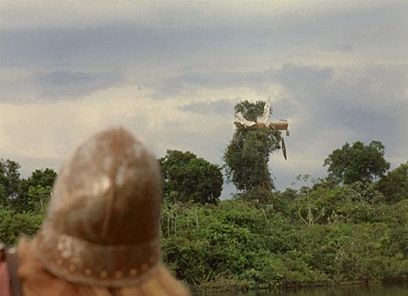
Long ago I first saw the movie "Aguirre, Wrath of God," about a Spanish conquistador going nuts amid a disastrous Peruvian expedition.  Here's a memorable image from that film:


It's Aguirre regarding the wreck of a sailing vessel in a tree. Why is it there? How did it get into a tree? What can I say, it's a peculiar movie. Even so, the ship is a very odd element that makes no contribution to the plot beyond weirdness. Of course everyone remembers the ship years after having watched the movie.


       ******************************************************************************

Today Google's doodle visually remembered the author Gabriel Garcia Marquez: 


 91.º aniversario del nacimiento de Gabriel García Márquez

Right away the tilted ship that seems perched on the letter "l" reminded me of Aguirre's wreck. Given that the movie and Garcia's stories take place in South America, are the two ships related? An article about the doodle linked the ship to Garcia's best-known novel, "One Hundred Years of Solitude." Checking online, I found this relevant bit from the book:

"Always following his compass, he kept on guiding his men toward the invisible north so that they would be able to get out of that enchanted region. It was a thick night, starless, but the darkness was becoming impregnated with a fresh and clear air. Exhausted by the long crossing, they hung up their hammocks and slept deeply for the first time in two weeks. When they woke up, with the sun already high in the sky, they were speechless with fascination. Before them, surrounded by ferns and palm trees, white and powdery in the silent morning light, was an enormous Spanish galleon. Tilted slightly to the starboard, it had hanging from its intact masts the dirty rags of its sails in the midst of its rigging, which was adorned with orchids. The hull, covered with an armor of petrified barnacles and soft moss, was firmly fastened into a surface of stones. The whole structure seemed to occupy its own space, one of solitude and oblivion, protected from the vices of time and the habits of the birds. Inside, where the expeditionaries explored with careful intent, there was nothing but a thick forest of flowers. The discovery of the galleon, an indication of the proximity of the sea, broke Jos Arcadio Buenda's drive. He considered it a trick of his whimsical fate to have searched for the sea without finding it, at the cost of countless sacrifices and suffering, and to have found it all of a sudden without looking for it, as if it lay across his path like an insurmountable object. Many years later Colonel Aureliano Buenda crossed the region again, when it was already a regular mail route, and the only part of the ship he found was its burned-out frame in the midst of a field of poppies. Only then, convinced that the story had not been some product of his father's imagination, did he wonder how the galleon had been able to get inland to that spot. But Jos Arcadio Buenda did not concern himself with that when he found the sea after another four days' journey from the galleon. His dreams ended as he faced that ashen, foamy, dirty sea, which had not merited the risks and sacrifices of the adventure."

Which is very much like the mood of the movie. So I wonder:

1. In general, did this passage have any influence on the movie?
2. In particular, did this passage prompt the inclusion of the ship in the tree?
3. Did the doodle artist regard his ship as an allusion to the ship in the tree?

I like to answer yes to all three.

Thursday, September 28, 2017

Alcazar & All That

Close, but no plátano


Fun bits while improving my Spanish-

Years ago I learned the the word pato. It's the name of a Stan Getz song from his bossa nova days. It means duck (the noun, not the verb) in Portuguese and Spanish.

Yesterday I saw the word pavo in a food context. Pavo, pato, not so different. Could it be a bird that one eats? Can't be chicken, that's pollo (like poulle in French, pullet and poultry in English). So maybe it's turkey. Checked later, yep, turkey it is. Nice.

And some kind of food called uvas. Sounds like ovum, Latin for egg. But eggs are huevos. Umm...grapes? Yes! More nice.

A small store in Spanish is a tienda, literally a tent or booth. A big store is an almacen. I kept thinking that almacen was Arabic (starts with al, a big hint) and that it was familiar to me in an etymological sense, that there were words like it in English, but I couldn't quite nail them down. Then I got it: macen is like magazine, a storehouse, a warehouse, a protective place. Al-macen is the-storehouse. And the m- would be the prefix that takes a verb and makes it into the thing that does the verb: jihad/fight; mujihad/fighter. Or adding -ador to a Spanish verb, e.g. matar, to kill; matador, killer. Checking this morning to confirm, yes, almacen is Arabic. The base triliteral (3-letter) root is h-z-n, to protect. So protector would be m-h-z-n with vowels filling in as needed between the consonants (this is way simplified by an amateur). The protector then is al-mahzan (the plural is al-mahzin, like mujihadin) From almahzan/almahzin the West gets almacen in Spanish, magasin in French, magazzino in Italian, Magazine St. in New Orleans, etc.

Also nice.

Friday, April 7, 2017

Our New House

We will be moving to Cuenca, Ecuador this summer. Here is the house on an overcast day, all natural lighting in the photos:

The front. There's a nice view of the historic center of town from the balcony.

This is one of three spaces that were originally open courtyards. They have glass roofs now, so plants do well in them even though they are nominally interior spaces.

The kitchen looking into the space shown above. The glass ceiling over the former courtyard lets light in through the kitchen window.

The second former outdoor space.

And the third.

This now-covered balcony overlooks the third former courtyard, and connects from the main house to a semi-detached bed, bath, and workspace. The climate is moderate year-round, so the house has no heat or A/C systems, which is typical here. The glass roof is open at the eaves to allow for plenty of outside air.

View from balcony.


Monday, February 27, 2017

Real Leer

leer

leer

Have a look at these Spanish words:
leer
creer
caer
paraiso
real
leal
paella
oír
raíz
maestro
peaton
cautivo
poseer
They are cognates of these words:
legere (Latin, to read)
credere (Latin & Italian, to believe)
cadere (Latin & Italian, to fall)
paradise
regal
legal
patella (Latin, pan)
audire (Latin, to hear)
radix (Latin, root)
magister (Latin, master)
pedestrian
captive
possess
In each case Spanish has dropped a consonant but still says two syllables. That is, "real" is said "reh-AHL." Now that I see the pattern, I'll be on the lookout for other Spanish words whose meaning might be sussed out by adding back a lost consonant between two vowels.
Nice.

Sunday, February 12, 2017

A Southern Catholic Thing

This post links to Convert Journal

Not Seminary Ridge

Last month I found myself way in the back of the church a couple of minutes before Mass started. We typically arrive about 15 minutes early and sit near the front where I can see without glasses, so the back is a mysterious and alien place.

When I came in, the organist was playing the last notes of the prelude, then stopped. At this point, the whole church was dim, quiet, and packed. In front of me was the priest, a couple of deacons, eight or so altarboys, the censor and the crucifer, all close around the baptismal font, waiting.

Then the church bell rang 11 times. Within a few seconds of the last peal, the lights came up, and the small bell inside the nave was rung once. A second or so after that, the pipe organ let loose a huge belch of sound, the choir and congregation belted out the opening words of the entrance hymn, and the procession began to advance.

For the next few weeks I kept reflecting on that prepared waiting for the moment- it was so compelling in its dark, hushed stillness. It seemed familiar, but not from church...yet I had still imagined aspects of it before. Finally yesterday, or maybe this morning, I remembered- it's this:

"For every Southern boy fourteen years old, not once but whenever he wants it, there is the instant when it’s still not yet two oclock on that July afternoon in 1863, the brigades are in position behind the rail fence, the guns are laid and ready in the woods and the furled flags are already loosened to break out and Pickett himself with his long oiled ringlets and his hat in one hand probably and his sword in the other looking up the hill waiting for Longstreet to give the word and it’s all in the balance, it hasn’t happened yet, it hasn’t even begun yet, it not only hasn’t begun yet but there is still time for it not to begin against that position and those circumstances which made more men than Garnett and Kemper and Armstead and Wilcox look grave yet it’s going to begin, we all know that, we have come too far with too much at stake and that moment doesn’t need even a fourteen-year-old boy to think This time."- William Faulkner, Intruder in the Dust

As Kylie said in Strictly Ballroom, "That was unexpected."


Photo from the vestibule of St Mary's, Greenville SC


Friday, June 17, 2016

Visibly Anonymous

This article is crossposted to Convert Journal
Clayton Moore Lone Ranger and Silver.JPG

My Fabulous Wife and I went out to dinner for Mother's Day at our neighborhood Mexican restaurant. Our adult kids are living in other cities, or were at work in this one; I think it was just the two of us for the first time ever. Monterrey's is a middle-class to working-class place to eat, and a young married couple and their three kids arrived and sat across the aisle from us. I'd guess the kids to be 2, 4, and 6 years old. Mom and Dad on one side of the booth; two littl'uns on the other, toddler in a baby chair. A perfect portrait of modest married bliss regardless of job, income, or mortgages.

It occurred to me that I should pay for their dinner. But I didn't want to be seen getting up and sorting it out with the cashier- they'd figure out who had done it, and I wanted anonymity. But because we started eating first, I could take care of it when we left. That way we'd be long gone when they went to pay. No worries.

But they finished first! Aaack! Off they went to the cashier. Too late to treat them on the sly. I got up and and went over to the counter. I said to the mother, "Are you having a good Mother's day?" She was indeed. I asked the kids, "Are y'all being nice to your mama today?" Yes they were! I turned to their father and said, "You have such a lovely family, I'd like to pay for y'all's Mother's Day dinner." He gave me quizzical look. "Really?" I said, "Look, I know what's it's like to take a family out to eat. But all my kids are grown, and I'm past that expense now. So y'all take off and enjoy the rest of Mother's Day." And you would not believe how happy the parents were- just beaming from this little unexpected treat. "Wow...thank you so much!" "Truly, it's my pleasure, 'bye now!" "Bye!"

Here's my point- I was wrong to think I should have done this without being seen. The human aspects of the exchange would have been missed, and that would have been a loss for all of us. I'd say that the act of freely giving and accepting this small gift counted for more than the meal itself. At the same time, although they saw me and spoke to me, I remain anonymous.

And without a doubt it was the best dinner I ever bought.