Wednesday, January 1, 2014

Healing the Paralytic

This post links to RAnn's Sunday Snippets

Acting it out with Q&A at OLR's Youth Retreat last September:

The paralytic's friends have just plopped him in front of Jesus (yes, they literally carried him in). Even though there's not a lot of action in this impromptu skit, there's way more audience engagement and participation, simply because it's live and physical. The difference between teaching this story from behind a lectern and getting down on the ground with a volunteer is all the difference in the world.

Photo by OLR Youthgroup maestro Mikael McKinney

Saturday, December 28, 2013

2nd & Charles


"Always be prepared to make a defense to any one who calls you to account for the hope that is in you, yet do it with gentleness and reverence..."

I had a great time at the new used bookstore this afternoon. I was browsing the Bible shelves...rolling my eyes at the study notes in them: "Oh wow, that was easy...Jesus couldn't possibly mean what he said." A couple were next to me, the man had a huge book in his hands. He and she were talking about what it was for, how to use it. I turned toward them to go, and they asked me if I knew about the book: Strong's Concordance. Wow, I love Strong's Concordance! Yeah, lemme show ya how it works! If you're wanting to learn more about how the Bible thinks, ya want this book (or the online equivalent). And I asked them some questions like I do my Catechism class kids, such as, "Y'all tell me why Sarah and Abraham were unhappy...yep, and then...uh huh, and what did Sarah do...laughed, that's right..and they named him...Isaac. Yes, so we check Strong's like so and see that Isaac means...and why does that matter? Yes. And so when God wanted Abraham to kill Isaac...yep! See, and without knowing the Hebrew you miss that very human and pro-life part of the story!" And we went through a couple more examples, and how the Concordance shows how similar Hebrew words share a common root, and that sometimes their meanings overlap in ways that matter, but won't show up in English or Greek, like Adam and Ground. Where do I go to church? St. Mary's? That's Catholic right? The man was a former Catholic and now a deacon at his non-denom. We talked about growing up with the Latin Mass, how that alienated him, and how I loved reading the Latin and English out of my father's Missal. Talked some more about faith journeys, other Bible bits, what some other Hebrew names mean, such as Elizabeth. Discussed our decisions to take Jesus seriously. So we had a great time faith sharing without arguing, and without me selling Catholicism the least bit short.


Image from 2nd & Charles in case you were wondering. 

Wednesday, December 11, 2013

Pitchers 18: Teach and Draw

This post links to RAnn's Sunday Snippets
Board from the December 11 Class. Click to Enlarge.

Stuff on the board was drawn in more-or-less chronological order. Not everything covered in class was drawn on the board.

1. Christmas. The Nativity. A bit of Spanish: Navidad.

2. Isaiah, the Christmas Prophet: virgin, tidings, star, shepherds, sheep, kings, gold, incense, Dromedaries, ox, ass, manger, and the manger's master. A bit of Old English: tidings. A bit of Luke: myrrh. A bit of French: manger. A bit of Greek: aggelos, evangelion.

3. The Flight to Egypt. Maybe to Alexandria where young Jesus, like you kids, would learn some Greek.

4. Isaiah, Jeremiah, the boy Jesus, and the adult Jesus all at the Temple. A bit more Spanish: escribir.

5. John the Baptist at the Jordan, site of water miracles. The Jordan runs from Galilee to the Dead Sea. More Greek: baptizo. Still more Greek: dromos = run, race. Like a fast camel: a Dromedary. John is the Prodromos, the Forerunner, the herald. As John's father Zechariah prophesied: "you will go before the Lord to prepare his ways." 

Not just words in books. Proclaim. Write. Act. Sing. Draw.

Photo by Guest Bouncer John Biediger

Saturday, December 7, 2013

Epiclesis

This post links to RAnn's Sunday Snippets and Convert Journal

 Size doesn't matter

Up until I was eight years old I belonged to St. Francis de Sales parish in Houma, La., whose church is a lovely Gothic revival structure completed in 1938. My Catholic imagination was well-nurtured by its elegant proportions; the Bible stories vividly presented in the stained glass windows; and a dove whose wings overshadowed the crucifix, tabernacle and altar.  The dove was painted on the green underside of a gracefully arched canopy which was cantilevered from the wall just above the crucifix.

Of course I knew the dove represented the Holy Spirit. But the canopy made the point, not the bird. It emphasized and protected Jesus on the cross; and also in his little house, the Tabernacle. It was clear to a kid: what's under the canopy is more worthy of attention and protection than what's not under it. I didn't understand until decades later that the canopy was yet another expression of Biblical-liturgical overshadowing; and that the little canopy was properly called a baldacchino.

At Mass, I'm frequently reminded of that green canopy during the Epiclesis:

Roman Missal 3rd Edition, Eucharistic Prayer II:  "Make holy, therefore, these gifts, we pray, by sending down your Spirit upon them like the dewfall, so that they may become for us the Body and Blood of our Lord, Jesus Christ."

Roman Missal 2nd Edition, Eucharistic Prayer II: "Let your Spirit come upon these gifts to make them holy, so that they may become for us the body and blood of our Lord, Jesus Christ."

I remember the canopy not so much because of the words, but because of the gesture which accompanies those words:


Is the priest making a little canopy over the gifts? I think it's implicit in the gesture. More specifically, I think he's overshadowing the gifts. I know, the prayer doesn't say that. I'm conflating "Let your Spirit come upon these gifts..." with this bit of Luke 1: "The Holy Spirit will come upon you, and the power of the Most High will overshadow you; therefore the child to be born will be called holy, the Son of God." That is, at the moment of Mary's overshadowing, God became physically present in her womb. And at the Epiclesis, God becomes physically present in the accidents of bread and wine. So I like the overshadowing gesture; and if I had been in charge of the New Translation, that bit would be something like "Let your Spirit come upon these gifts to make them holy; and let your power overshadow them, that they may become for us the body and blood of our Lord, Jesus Christ." But I can't find any Mass in Latin that mentions overshadowing even once; so it'd be going beyond the Latin to include any explicit mention of it.

But Christianity is bigger than the Latin Church. And the Eastern Christians usually embrace mystery with an enthusiasm that often escapes the rational West. Are any of them explicit about overshadowing in their Divine Liturgies?

At least one is, the Ethiopian Orthodox Church. In the opening prayer of its Divine Liturgy we hear, "How awful is this day and how marvellous this hour wherein the Holy Spirit will descend from heaven and overshadow and hallow this sacrifice. In quietness and in fear, arise and pray that the peace of God be with me and with all of you." I like that.

And at the epiclesis the priest says, "We pray thee and beseech thee Lord, that thou wouldest send the Holy Spirit and power upon this bread and upon this cup." I think the couplet of 'Holy Spirit and power' alludes to Luke 1 as well, but a bit more explicitly than the Latin Masses do.

So in April of next year, when we are discussing the Epiclesis in Catechism class, I'll make the same gesture as the priest. And then I'll get the kids to figure out what it means, and connect it to other overshadowings they're already familiar with. Time permitting, I'll draw the old canopy at St. Francis and a baldacchino; and have the children tell me how they relate to the priest's overshadowing hands.

This material is also covered in this short audio file.

Saturday, November 30, 2013

Fine Art 11: Die Maria Schützt Euch

This post links to RAnn's Sunday Snippets

Let's jump right in: I read Die Weise von Liebe und Tod des Cornets Christoph Rilke for the first time in 1982. Here's the backstory, but you don't have to look at it. All you need to know is that the Cornet is a prose poem in German, and an elegant introduction to the language.

Yesterday I was admiring Hans Holbein's portrait of St. Thomas More:

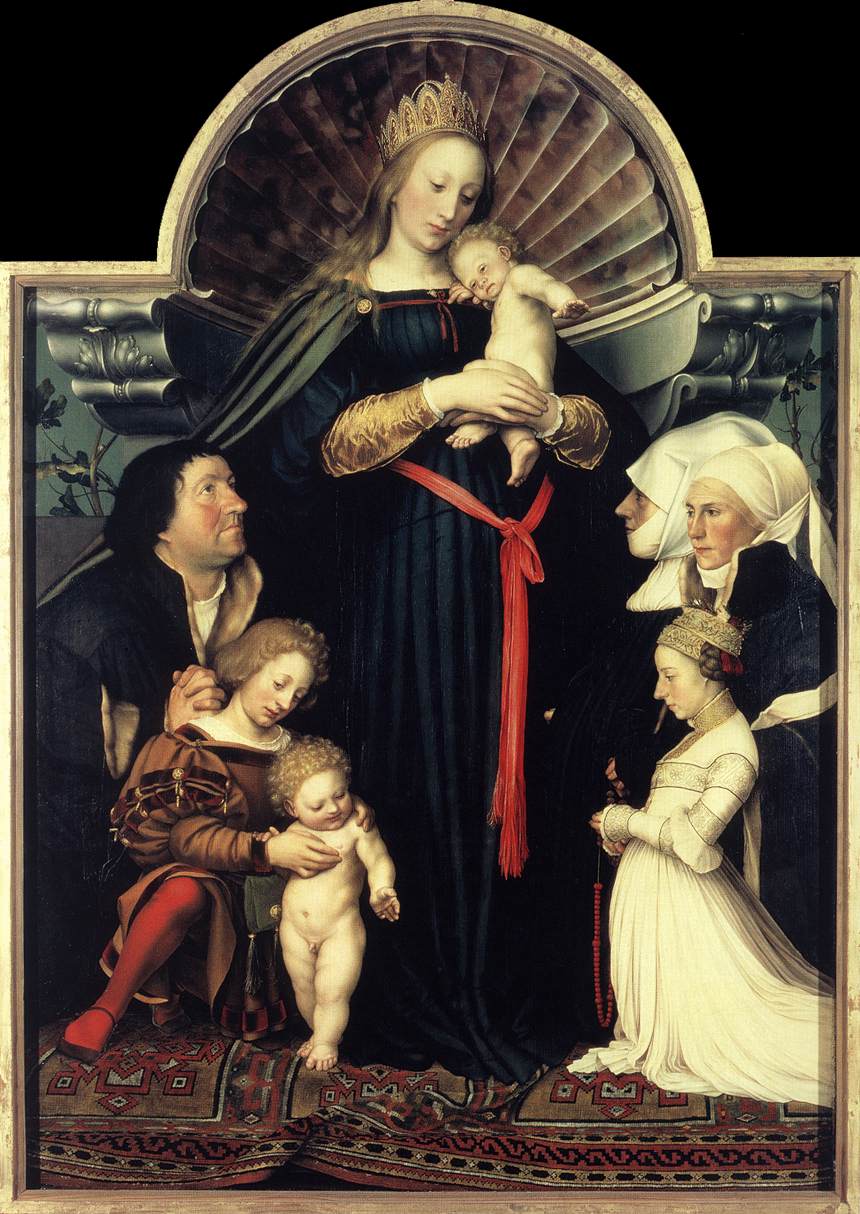
So much of who I think More is comes from this painting. And the same is true for Holbein's portrait of Henry VIII. And Erasmus. And Anne of Cleves. So I started aimlessly browsing all the Holbeins I could find, because you can often see a lot just by looking. By and by I came across this one:

It's called the Darmstadt Madonna. It follows a standard formula in which the patron (in this case, Jakob Meyer, mayor of Basel, Switzerland) is at the right hand of Jesus, the Trinity, or a saint; and other members of the family, both dead and alive, are distributed starting at the central character's left hand. Notice in this case that although Mary is physically dominant, nobody looks at her: the patron focuses his gaze on baby Jesus, as does Mary herself. That's a little Catholic digression about a content-packed painting which is not the subject of this post.

But what struck me is Mary's cloak resting on Jakob's shoulder...a type of overshadowing I hadn't ever noticed before. Mary is protecting Jakob by 'spreading her wing' over him, recalling numerous Bible and liturgical examples of protective overshadowing. I assume that Jakob will extend this protection over his family, and that's why Mary's cloak doesn't overshadow to her left. This image of Mary's protection reminded me of a line from the Cornet, when two soldiers go their separate ways:

"Kehrt glücklich heim, Herr Marquis. > Return happily home, Herr Marquis."
"Die Maria schützt Euch, Herr Junker. > The Mary protects you, Herr Junker."

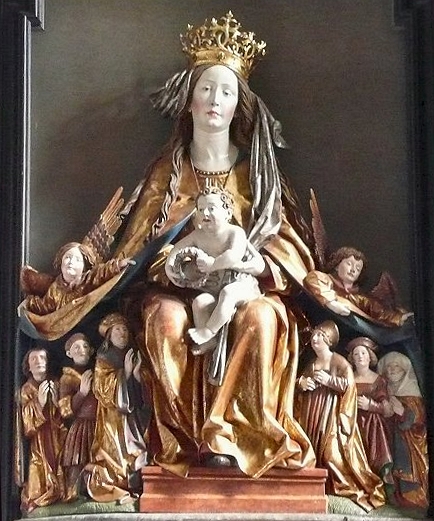
So then I wondered if that was a standard German idea, to seek or enjoy Mary's protection. A quick search on "schutz maria" turned up a town called Maria Schutz in Austria, but I was looking for piety, not places. Tried "schutz madonna", got Schutzmantel Madonna right away, which simply means Protection-cloak Madonna. It's a very common Catholic image in German-speaking cultures:

Looks just like his Momma.


Is the Son's swaddling cloth overshadowing his Mom?

Both the Queen Mother and her Son the King wear crowns


Even popes and bishops want in.

The Schutzmantel Madonna is such a vivid image that I want to get a statue like these for catechism class. It'll fit right in with our recurring theme of overshadowing. Yeah, I could print off a nice lettersize handout of one of these photos (and I may do so regardless) but a 3D teaching tool works better than its 2D version.

And the Schutzmantel isn't just a religious concept. The traditional way a German man would legally demonstrate his adoption (or legitimization) of a child was to publically extend his mantel over the child; so Mary isn't simply protecting a bunch of people- she's adopting them as her children. There's just something about a statue that'll make that point better than a picture. But for class we'll first do a quick skit of Mary extending her beach towel mantel over a couple of her peers. Once the kids figure out its significance, then I'll pull out the statue, we'll discuss some of the German history behind it, and connect it to the Bible examples we've already covered. Then right before class is over I'll distribute a Schutzmantel Madonna handout, and have the kids explain to me how they are going to explain it to their parents for homework.

Figure no more than 5 minutes on the skit and statue; no more than 2 minutes on the handout and quick review.

This material is also covered in this short audio file.

Friday, November 29, 2013

The Sun Poured In


Thanksgiving Day was cold and clear, and My Fabulous Wife was adding Blondie ingredients to a mixing bowl on the kitchen island. There's a big skylight over the island, which was lit up like all outdoors. I idly watched Janet pour in a bag of little tan goobers. What's that stuff? "Butterscotch." Huh- you put butterscotch in Blondies? "Yep." Huh...and I was seeing the sunlight all over her and the bowl, and trying to recall something about the sun and butterscotch that for a few seconds gave me that Jesus-kill-me-now good feeling.

Later that night I was still trying to make sense of sun and butterscotch. Searched online for "sun butterscotch" and found:

And the sun poured in like butterscotch and stuck to all my senses.

Oh that's right, it's from Chelsea Morning by Joni Mitchell. I probably first heard it sung by Judy Collins on the radio in 1968, when I was 11, then later on by Joni. Chelsea Morning has always colored my image of Manhattan: bright, busy, full of possibility. And it also influenced my idea of romance.

So I listened to it again; and at 56, it moves me more today than it did when I was young. For as well as the lyrics hinted at the love I imagined as a teenager, they better describe the real love I have now. 'Cause in my life, every morning is a Chelsea morning.

Happy Thanksgiving!

Woke up, it was a Chelsea morning, and the first thing that I heard
Was a song outside my window, and the traffic wrote the words
It came a-reeling up like Christmas bells, and rapping up like pipes and drums

Oh, won't you stay
We'll put on the day
And we'll wear it 'till the night comes

Woke up, it was a Chelsea morning, and the first thing that I saw
Was the sun through yellow curtains, and a rainbow on the wall
Blue, red, green and gold to welcome you, crimson crystal beads to beckon

Oh, won't you stay
We'll put on the day
There's a sun show every second

Now the curtain opens on a portrait of today
And the streets are paved with passersby
And pigeons fly
And papers lie
Waiting to blow away

Woke up, it was a Chelsea morning, and the first thing that I knew
There was milk and toast and honey and a bowl of oranges, too
And the sun poured in like butterscotch and stuck to all my senses
Oh, won't you stay
We'll put on the day
And we'll talk in present tenses

When the curtain closes and the rainbow runs away
I will bring you incense owls by night
By candlelight
By jewel-light
If only you will stay
Pretty baby, won't you
Wake up, it's a Chelsea morning

Chelsea Morning lyrics © Joni Mitchell/Crazy Crow Music/Siquomb Music, Sony/ATV Music Publishing LLC

Sunday, November 24, 2013

Liturgical History in Four Hours


 Maybe not this exact style

Today I gave the last of four 1-hour presentations at Our Lady of the Rosary Catholic Church here in Greenville, S.C.  The overall subject was liturgical aspects of a Catholic church, divided into 4 threads:

1. The Biblical concept of overshadowing. Overshadowing was traced from Exodus through the Acts of the Apostles, and into the Liturgy of the Eucharist. I also explained the symbolic overshadowing function of a baldacchino.

2. The Bible history of food miracles: from Manna and Quail in the desert, through the Last Supper, and into the Liturgy of the Eucharist.

3. The Bible history of Arks and Tabernacles: from Noah's Ark through the Tabernacle in a Catholic church, and from there to the New Jerusalem in the Book of Revelation.

4. The Bible history of offering sacrifice: from Abel's lamb, through the Book of Revelation, and into the Liturgy of the Eucharist. 

The process included some Hebrew and Greek; audience participation; sacred art handouts; lots of drawing; lots of Bible; lots of learning; and based on comments, lots of fun.