Wednesday, May 23, 2012

It's Bobby


People my age will remember that John F. Kennedy picked his younger brother to be his Attorney General. JFK joked about how he would make the announcement: "I'll open the front door of the Georgetown house some morning about 2:00 a.m., look up and down the street, and if there's no one there, I'll whisper, 'It's Bobby.' "


Thursday, May 10, 2012

Altarations


Hey y’all, for the next few classes we’re going to learn about things in church; what they’re for, where they come from, stuff like that.

Somebody tell me again where Abraham was from.  Mesopotamia!  That's right. What did Mesopotamians build? Ziggurats!  What were they for? I think people prayed there or something. Yes. Couldn't they pray on the ground? I guess so. So why'd they bother with ziggurats? 'Cause they're high! Yes…why does that matter? 'Cause if you're high you're closer to God?  Yes. People throughout history have tried to get closer to God by going up. 


Tell me about Aztecs. They had pyramids and they killed people on them. Well, it was more particular than plain-old killing. They sacrificed them?  Yes...to? The sun?  Yes. Was there a real sun-god?  No, they were pagans.  Yes. But they had the right idea about getting up closer to God. When people offer sacrifices, they are trying to make a powerful connection with God, much more than just a prayer.

File:MW-Teotihuacan9.jpg

Tell me about Abraham & Isaac.  Isaac was his only son.  And? God said Abraham had to kill Isaac. More specifically…he had to sacrifice him. Yes. Did Abraham build a ziggurat? No, I think he just went up a mountain. Yes, Mount Moriah.  If you live where there are mountains, do you need a ziggurat? No you just go up a mountain to get closer to God. Yes. So tell me about places that have pyramids or ziggurats. They’re flat!  Yes. Is toting a sacrifice up a mountain or a ziggurat easy? No, it’s hard. Yes. But suppose Abraham said, “God, I’m too old to get up Mount Moriah, I’ll just take care of this Isaac business behind my tent.” God wouldn’t like that. Right. God wants us to put some effort into making a special connection with Him: if we climb up as high as we can, then God will reach down the rest of the way. So when Abraham got to the top of Mt. Moriah did he throw Isaac down on the ground and cut his throat? No he made an altar. Yeah…what’s an altar? A big rock?  Yes, or a pile of smaller ones. What’s the point? Huh?  Is it ok to sacrifice on the ground?  No it’s dirty!  Right. It’s undignified; a sacrifice should be nice and clean. So being on the mountaintop isn’t enough: Abraham had to make an altar to get his sacrifice up off the dirt and one last bit closer to God.
So tell me about the altar in church. Like what?  Like anything.  It’s made of stone!  Yes, and? It’s up off the ground!  Yes. Is it on a mountain? Well, the church isn’t on a mountain. Yes…although it’d be nice if it were. But inside the church, is the altar at the same level as the pews? No, you have to go up some steps! Right. The altar sits a bit higher than the people.

So an altar is for…sacrificing!  Yes. But in a Catholic church we don’t actually kill a sacrifice, we only offer it. Our sacrifice was killed a long time ago…well? Is it Jesus? Yes, when? When he was crucified! Yes.
Good children!


Thursday, May 3, 2012

Where the Wild Things Are

The Bunnies have returned to the Ponderosa.

A baby we've seen on the edge of the ivy a few times:


The daughter likes to write on the front porch, made that with her phone. The animal doesn't take exception to her.


We also have lots of hawks in our neighborhood. Yesterday the wife & daughter were sitting out when one pounced down at the ivy without scoring.

*********************************************************************************

Coda of Coincidence: today my poet friend Pavel Chichikov wrote this:

WILD RABBITS

We have wild rabbits in our yard
Pulling up the fresh young clover,
Each new rabbit is a ward
Beneath protection of our cover

The fir tree and the fig tree shade
The coverts that they use to hide,
For which at dawn and dusk they trade
The hazards of the open sky

See them mumble blade and stem,
Jaws rotating as they feed,
Green the pasture given them
Apportioned to a rabbit’s need

But overhead the red shinned hawk
The buzzard and the scavenge crow,
While in the alley something stalks,
A hunter that they do not know

We from vantage overhead
Can wish them every fortune fine,
Clover as we have our bread
And rainy weather for the wine


Pavel
May 5, 2012

Saturday, April 28, 2012

Pitchers 13: Fin de Siècle 2

Not the end of the century, but the last class. I like the look and sound of Fin de Siècle more than The Last Class.

The second half of the last class is a weaving-together of assorted Biblical threads into the fabric of the Mass, especially by way of the by-now-familiar handout that compares the plan and function of a Catholic church to the Meeting Tent/ Temple:
 
 This is enhanced by reading excerpts from the Missalette and the book of Hebrews, which the kids then apply to the plans. Of course the board gets covered with sketch'n'scribble:

1. The kids help compose this quick chart which compares the Old Covenant liturgy in the Temple with that of the New Covenant's in a Catholic church:


The people can see the Levites & priests; but the High Priest's work in both cases is hidden behind a veil.

 2. The Missalette lists some of the first martyrs who participate with us at Mass, such as Stephen. Here's Stephen with his attribute, which is rocks: he was stoned to death.


3. One of the kids jumps ahead, and says we have cherubim guarding the Tabernacle in church. He mislocates them as the high angels facing the congregation, but that's ok. I draw what he describes, then ask if anyone can tell me where the guarding cherubim are, as opposed to the assisting angels. One of the altar boys says they're carved into the wood screen behind the Tabernacle, and I add them in.


Photo of the church for comparison:


I do a blow-up of the cherubim. I like to draw their wings overshadowing the Tabernacle even though ours don't actually do so:


Photo of the Cherubim:


4.  With only few minutes left in the year, I ask the kids to tell me everything they can think of from the Bible that's present in the Mass. Going clockwise from the lower left they name the Loaves & Fishes, Melchizedek, Cana, Manna, Abraham & Isaac, the Last Supper, Abel, the Crucifixion, and John da Baptis'. No prior class has done this well.


I compliment their thinking skills and add the Wedding Feast of the Lamb; then close by singing the last lines of Supper's Ready by Genesis:

There's an angel standing in the sun, and he's crying with a loud voice,
"This is the supper of the mighty One",
The Lord of Lords,
King of Kings,
Has returned to lead His children home,
To take them to the new Jerusalem.

The children count down the last seconds on the clock, 5, 4, 3, 2, 1, ZERO!!! and their Year of Suffering is over.

Thursday, April 26, 2012

Fine Art 9: Ravenna Encore

 This post links to RAnn's Sunday Snippets

During our Genesis classes in September I threw together a handout to accompany discussion of the Hospitality of Abraham, Abraham's sacrifice, Cain & Abel, and Melchizedek. Today was the last class of the year, and the last of three on the Mass. Part of the Mass-class fun is having the kids connect all the Bible stuff they learned this year to what happens or is said at Mass.

In past years when we got to this bit-

"Look with favor on these offerings and accept them as once you accepted the gifts of your servant Abel, the sacrifice of Abraham, our father in faith, and the bread and wine offered by your priest Melchizedech."

-I'd just read it out of the Missalette and we'd discuss. But this year I edited the earlier handout to make another handout, like so:

------------------------------------------------------------------------------------------------------------

"Be pleased to look upon these offerings with a serene and kindly countenance,
and to accept them, as once you were pleased to accept the gifts of your servant Abel the just,the sacrifice of Abraham, our father in faith, and the offering of your high priest Melchizedek,a holy sacrifice, a spotless victim."


These two mosaics flank the altar in San Vitale church in Ravenna, Italy
---------------------------------------------------------------------------------------------

Class was much better with the handout. The kids remembered the pictures and were able to explain them in Genesis terms. Then we read the quote and they sorted out why Abel, Abraham, and Melchizedek matter at this point in the Mass.  I reminded them that these two mosaics are to the immediate right and left of San Vitale's altar; wouldn't it be great to hear that bit of the Mass while being able to see the relevant Bible stories on the walls?

All the kids took the handout home (they can leave them on the desk if they don't want them). The parents will probably see it, and their children may catechize them a bit. (Equipping the children to teach their parents is a constant motivation in Wednesday Sunday School.)

Saturday, April 21, 2012

Fine Art 8: Van Eyck'll Do in a Pinch


A major goal of the Holy Tornado class is to show the relationship between Heavenly and Earthly worship at Mass. 90% of the visual support is drawn on the fly while reading from the Bible or the Missalette. I like to draw and talk at the same time because it's easy to maintain the kids' interest that way.

On the other hand, not everyone likes to draw. Fortunately, most catechetical stuff I like to sketch is also available as fine art; so if I (or you) wanted to skip the board & markers it'd be no problem to run the class with a handout.

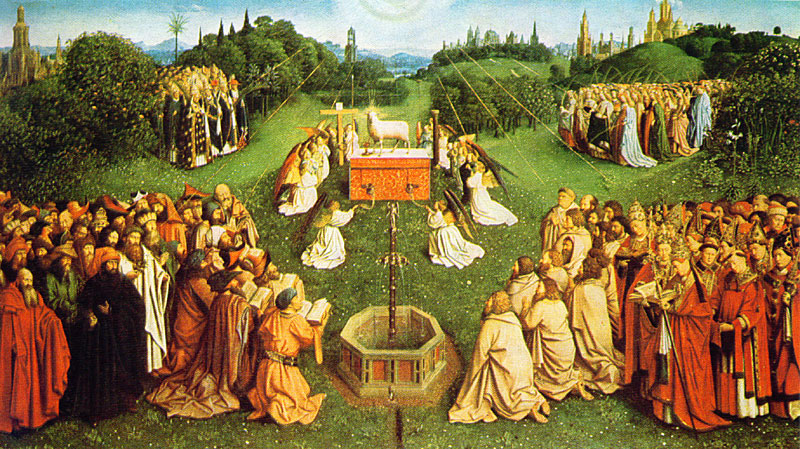
As an example, have a look at this panel from Jan van Eyck's Ghent Altarpiece:

Every year I use this image to discuss the Heavenly Worship outlined in Revelations and expanded upon in Eucharistic Prayer 1. Or I draw instead.  But when I don't draw, this works fine. I mean, van Eyck probably spent a whole day on it, while I slap out my pictures in seconds.

As it happens, My Wife the Art Historian treats this work in her textbook [Reflections on Art, Janet LeBlanc, copyrighted]. Let's take a quick excerpted tour through the incredible Biblical and Catholic content of the Adoration of the Mystic Lamb (1432):


"As noted earlier, the Lamb of God is Christ, whose blood was shed for the salvation of those who follow him. He is shown here on an altar, pouring out his blood into a chalice, thereby representing the Holy Eucharist offered up at Mass as the perpetual sacrifice of Christ. Two angels in the foreground swing censers high to release the sweet-smelling smoke of incense to carry the prayers of the faithful to heaven. The angels with censers are straight from the Book of Revelation, where they stand before the throne of God as angels sing Holy Holy Holy. The Mass therefore echoes on earth what is happening forever in heaven. The altar is surrounded by a host of angels. Four angels toward the back hold the instruments of the Passion, reminders of the means by which Christ was tortured and offered himself in sacrifice. On the left, one angel holds a large cross, and in his hand we see the crown of thorns. Next to him in an angel holding the nails used to hang Christ on the cross, and in the other hand this angel has the lance used to pierce Christ’s side. Across from them an angel steadies a column to remind us of Christ’s flagellation where he was whipped, and another angel holds the whip, and also a very tall pole with a sponge on top. This last object is a curious inclusion, but we will see it again. It’s the hyssop branch that was used to raise the wine to Christ’s lips during the Crucifixion, as described in the Gospel of John, and after drinking from the sponge, Christ said, ‘it is finished’ and he died.

This last object is not a means of torture like the others, but rather a critical component in understanding the Eucharist, which, after all, is the primary theme of this altarpiece. The institution of the Eucharist in the Bible begins at the Last Supper, which is accepted as the Passover Seder (feast). Passover, in turn, is the Jewish memorial to the original pass over in Egypt during the days of Moses (see Exodus chapter 12). After ten plagues were sent by God to persuade the pharaoh to let the Hebrews go free, God sent one last devastating blow; he killed all the firstborn across the land. The Jews were instructed that to have the hand of death pass over them and spare them, they were to slaughter a perfect lamb, they are use a hyssop branch to spread his blood above their doorpost, and then to prepare and eat the lamb. God was quite specific spelling out the details. In the Upper Room at the Last Supper, Jesus blessed the bread and stated that it was his body, which they must eat, and blessing the cup of wine, he claimed it was his blood which they must drink. Passover Seders according to the haggadah (the “program” for a Seder) of Jesus’ time passed the cup four times among the participants as they recited the Scripture accounts of the passover in Egypt from Exodus 12. The first part of the Seder was a festival blessing over the first cup of wine, which was served with bitter herbs. The second cup was blessed and passed after reciting the Passover narrative from Exodus and singing Psalm 113 (the Little Hallel). The third cup was the “cup of blessing” which followed the main meal of unleavened bread and lamb, which was followed by singing the Great Hallel which included the hymns of Psalms 114 through 118, and finally the fourth cup of wine was shared to end the Seder.

In the Gospels, the account of the Last Supper comes in with the third cup. Jesus blesses the bread, which is part of the main meal, then blesses the wine. Afterward they sing a hymn (the Great Hallel), but there is no mention of them completing the passover with the fourth cup. In fact before the great hymn, Christ says specifically that he will not taste the fruit of the vine again until he comes into his kingdom. It is not until the moment of his imminent death that Christ accepts the wine lifted up to him on a sponge, and at that moment he proclaims that “it is finished.” What is finished is the Passover, and with it the institution of the Eucharist and the New Covenant.

Below the altar of the lamb in the picture we find a rather interesting fountain spouting water from ten jets plus two more from the palms of the angel atop the fountain for a total of twelve, making reference to the twelve tribes of Israel as well as the twelve Apostles. The fountain itself is the fountain of life through baptism, and you may notice there is a small tap at the base of the fountain pool allowing the living water to stream out toward the viewer.

Surrounding this inner scene are several distinct groups of people, all humbled in the presence of the lamb and paying him homage. On the left in the foreground are Old Testament prophets and patriarchs witnessing the lamb’s sacrifice with reverence. Many hold their books in which they prophesied the coming Messiah. Behind them are pagans who lived their lives in pursuit of truth and who many believe anticipated Christianity, among them the great poet, Virgil, who can be singled out in his white robes wearing a laurel wreath on his head.

On the right are the kneeling Apostles dressed in beige robes. Without attributes it is impossible to tell one from another, except John the Evangelist who is clean-shaven. Curiously, if you count them you will come up with thirteen. Saint Paul is included here (see the bald guy in the back) and either his sidekick Barnabus was included, or more likely Matthias, the Apostle chosen replaced Judas Iscariot. Behind them are their successors through Apostolic Succession, the leaders of the Church, dressed in red robes to indicate that all those present here were martyred. First we see three popes; note their papal tiaras of the same style that the Lord wears above in heaven. Then in the second row we see a couple monks with their heads shaved in tonsure, and several bishops with their tall pointy miters. Further back stream a host of others not specifically identified as clergy.

Moving to the background, on the left we see more clergymen, bishops in their miters, and cardinals in their wide-brimmed red hats called galeros. Again we see monks sprinkled in among them. These men are dressed in blue to connote they did not die a martyr’s death. Opposite them on the right are the Virgin Martyrs waving their palm fronds, symbols of their martyrdom. The four in front are all identifiable by their attributes (or at least three of them are). Furthest away is Saint Agnes in the red skirt, who cuddles her lamb, and next to her is Saint Barbara who holds her attribute, a tower. Next is supposedly Saint Catherine of Alexandria according to some scholars, but she should have a wheel which is her attribute, and I for one do not see it there, but it could have been lost in repainting and cleaning over the centuries. Other scholars have suggested that it is Saint Ursula, but I cannot find her attribute of an arrow either, so who knows? Last is Saint Dorothy with her attribute basket of roses. A magnificent distant landscape spans the entire center panel. The city on the right behind the female martyrs in particular is believed by many to be the artist’s vision of the New Jerusalem as it is composed entirely of Churches."  (copyright 2012, Reflections on Art, Janet LeBlanc. All rights reserved.)

This image has more content than I have time for in my 6th-grade syllabus. Regardless, the kids love to take a few minutes figuring out who and what everything is, with help from me only as required.

On the other hand, a blow-up of the center is just right for my lesson plan's pacing and focus:


This is the essence of my Heavenly Liturgy sketch. And again, if the goal is to show the fusion of Heaven & Earth at Mass, the above detail would go well with Ariel Agemian's evergreen image of the Liturgy on Earth:


Someday I may butt them like so on lettersize (but match widths)...

 
...and add a couple of lines from Revelations at the top; and something from the Missalette at the bottom. Maybe I will do this next year....a great handout for the kids.

And a great handout for the parents as well.