Tuesday, August 9, 2011

Tissot & Rockwell

James Tissot (1836-1902) was a French painter known for a series of paintings on the life of Christ, and an uncompleted series treating stories from the Old Testament. In pursuit of historical accuracy, he made assorted trips to the Middle East. Tissot researched its architecture, clothing and other details which are evident in his work.

I like to use his paintings in Wednesday Sunday School, and can usually recognize a Tissot. This is a personal favorite:

Sarai Is Taken to Pharaoh's Palace

Pharaoh: "Hey baby, you're lookin' good...can I get you a beer? That putz you're traveling with says you're his sister... izzat right? Sarai...what sorta name is that? Cat got your tongue? You no speaka Egyptian? Hey, look at me when I'm talking to you."

***********************************************************************************

New topic: this afternoon I was surfing around and found a Prodigal Son that I wasn't familiar with:


I use Rembrandt's Prodigal Son in class, and am familiar with others, including Tissot's, but never saw this one before today. Based on the buildings and the clothes, I'd say the parable is set in a Dutch/ Flemish medieval context, which was a typical way that Dutch/ Flemish medieval artists would paint Bible stories. After chasing several Dutch/ Flemish dead ends, I accidentally learned that this painting was done in 1862 by...Tissot!? (he painted more than one Prodigal Son). I'm not sure what moved him to paint the story this way (I suppose it's an homage to Northern Renaissance artists), but Tissot shows all the expected details. There are steep Flemish roofs; a stepped gable; flying buttresses on a Gothic church. Faithful Fido. The Jewish family's father is well-dressed, and the women wear their wimples. Leaning on the half-painted green wooden porch, the elder son, who couldn't be happier to see his brother, is a bit less finely-clad than his father.

But looking at Tissot's painting reminded me of a 1945 painting that wasn't a Prodigal Son, but rather its thematic opposite, the Responsible Son. A painting in which a son, having also suffered much, returns from "his journey into a far country" not having shirked responsibility, but having borne it. Whose family and dog "receive him safe and sound," and are uniformly happy to greet him from a half-painted green wooden porch.


Was Rockwell influenced by Tissot? I don't know beyond my own opinion. Born and bred in New York City, Rockwell would've had ample opportunity to see scores of Tissot's paintings in local collections. But you may wonder, if Rockwell was influenced in this case, then why is his composition vertical rather than horizontal?

Because his format was fixed:


Let us eat and make merry; for this my son was dead, and is alive again; he was lost, and is found. 

Sunday, August 7, 2011

The Safety Corner


I have been living in my city since 1965. Like most kids my age, I rode a bike all over the place through highschool, and then through 4 years of college. Never had a problem sharing the road with cars.

A popular Saturday spot in my teen years was a little bridge in a downtown park. Among the many unremarkable corners I rode around to get there is one that in the last year or so has received numerous ummm, safety enhancements.

First, as part of an ongoing local practice of giving bikes their own separate lanes,  separate bike lanes were added going straight & turning right.

And a picture of a bike was painted on the lane going straight just to make it clear that's not a lane for motorcycles or Smart cars or runners or people with strollers. And a straight-ahead arrow was painted too, in case a cyclist wanted to turn right into the car lane (I think); as the Australians soldiers said in the trenches of 1918: too late, chum!

To further separate bike & vehicular traffic, a curb was added, which has the side effect of pinching the turn for cars.

And a sign was added to indicate that bikes bear right, and vehicles keep left, although the vehicle side seems to conflict a bit with the bike and arrow painted on the ground which are going straight. It may be best not to pay too much attention to the sign's arrows.

Then a set of three pickets (is three pickets enough- I'm thinking seven) and reflectors were added to physically separate the vehicles and bikes that go straight without turning right. I think. If my aging joints get too crabby about the high-impact of running, and I start riding a bike again, I'll have to be careful here not to impale myself three times. And if I ran around this corner I suppose I'd use the bike lane. I'm not sure. Maybe runners need their own lanes too; no runner wants to be hit by cars or bikes. I should mention that I run without a helmet- in case that's relevant.

I've read the local paper every day for 25 years, never seen a word about this corner being a danger for anyone (which isn't exhaustive research). Which isn't to say that nobody on a bike was ever injured here, although the local papers seem to be vigilant in reporting car vs. bike accidents. But as a once and future bike-rider around this very corner, I think it may have been safer when it was dangerous. If that's what it was in the first place.


 The Safety Corner

Tuesday, August 2, 2011

Vremya & Avrupa


After our visit to Ravenna, the ship stopped next in Bari. I didn't know a thing about Bari before planning our day there, but we were both pleasantly surprised. Among the places we visited was Bari Cathedral, also known as San Sabino, whose relics rest there. The current church was constructed on the site of the prior cathedral, and consecrated in 1292. Walking around in San Sabino, it's obvious that many bits of the older church were re-used, which emphasize how old Bari is compared to cities in the US.

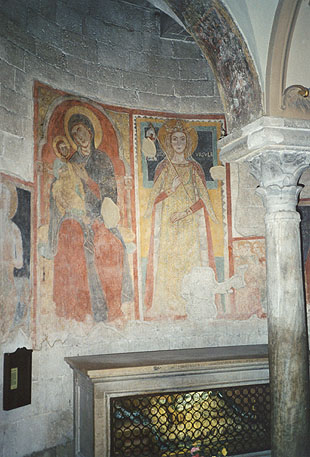
Among San Sabino's visual treats are the remnants of frescoes which used to be much more comprehensive:


This fragment was particularly striking:


That looks like a child held by its mom on the left; I don't know who they are. To the right, I suppose that's Jesus being nursed by Mary. But what's interesting isn't so much those images, but the areas around them. My first impression looking at this fresco was that it had been vandalized. See all the diagonal white scratches in the outlined areas below:


But looking more closely you can see that the scratches aren't from abuse: such scoring enables a new fresco to be applied over an old one without sliding off. That is, the nursing Jesus fresco is newer, and lies on top of an older fresco. Part of what impresses is simply how many centuries of human effort have left their mark here: prior cathedrals built on the same site, possibly dating back to the 400s; the cathedral built in the 11th century and destroyed in the 13th; the present cathedral built using bits of the ruined church; and then assorted encrustations over the next thousand years or so, including frescoes atop frescoes, and later architectural features (some of which were removed in the last century to restore the church to a more original state). But also remarkable is how casually old stuff was cast aside, covered up, reused, or demolished without much ado. Time in Europe is so much older, more pervasive, more substantial than time in the New World. For example, when the Mississippi River last changed its course from the Atchafalaya Basin to its present route past New Orleans, there was probably already a cathedral church in Bari. And a cathedral is likely to be there still when the Mississippi returns to the Atchafalaya.

During the rest of the day in Bari I was percolating on the glacial pace of human time in Europe; and how to express a movement that may run more slowly than the Mississippi changes its course. Usually English has the right words; sometimes it doesn't. And the words that best told me what I grasped at in Bari were Vremya...and Avrupa. Vremya, время,  is the Russian word for 'time'. Avrupa is how the Turks say Europe. To say Time and Europe with regard to Bari's cathedral sounds too sleek, too glib, to express the scale of time that lies there, millennium upon millennium with such lack of fuss. Vremya & Avrupa suggest more primal concepts. They speak to the difference between my time-world, and a place which was civilized long before there were minutes and seconds.

Think of it as Catholic Time.

Thursday, July 28, 2011

It's Your Turn to Marry Zsa-Zsa


 There's a joke I remember from Letterman years ago, from the Top Ten Consequences of Growing Old: "Sooner or later it's your turn to marry Zsa-Zsa." At my house it's constantly modified to suit the occasion, as in "Sooner or later it's your turn to get a colonoscopy," or "Sooner or later it's your turn to visit Venice." Which reminds me that thematically, Venice and Zsa-Zsa have a lot in common.

I've been to Venice enough times since the '80s to be comfortable getting around, finding restrooms, eating relatively inexpensively, etc. Someone who cruises asked recently at a forum about how to see Venice when the cruise ship will be there for a single day, 7 a.m. to say, midnight. As we had just the week before departed Voyager of the Seas early in the morning to spend a long day in Venice, courtesy of My Wife the Art History Prof and Travel Agent, I was able to give a timely answer which may be useful when it's your turn to marry Zsa-Zsa.

This itinerary starts on a cruiseship, but if you aren't on a cruise, that's ok: just ignore the parts about getting from the ship to Piazzale Roma. If you come from Marco Polo airport via taxi or bus, you'll be dropped off in Ple. Roma anyway. If you arrive by train, I'll cover that too.

Starting at a cruiseship in the morning:

Eat breakfast on the ship. Bring a hat (or umbrella if the sun really bugs you) and a map you've already gotten familiar with. The places I refer to can all be found on any map of Venice.

Walk out of the cruiseship terminal (there may be a free shuttle). Once you are out of the cruise terminal, head for the PeopleMover station, a new elevated monorail. Buy two 1 tickets (one for the return trip) from a ticket machine (cash) and take the PeopleMover to Piazzale Roma (public restrooms at P. Roma near where the image below says "Your Taxi stands here").

At Piazzale Roma, walk left out of the PeopleMover exit for a couple hundred yards to the ticket booths for the vaporetti (water buses). You have to go past assorted bus ticket windows and down some gentle stairs to get to the water where the vaporetti booths are.


 Buy a 24 (12 hr pass might not last long enough) hour pass (they take creditcards; let your card companies know when & where you'll be traveling. I don't like to have any cash out in Ple. Roma.) Walk a few more steps to the vaporetto stops, find the red-circle-2 symbol on one of the floating waiting rooms, activate your pass cards (watch other people do this) and get on vaporetto #2 to Piazza San Marco. #2 runs in a circle both clockwise & counterclockwise; you take the clockwise route to start. See map:


You might copy this #2 route-map and take it to Venice. The regular vaporetti route map shows all the lines and is less easy to read...like so:


For this day in Venice you will take only the #2 vaporetto. It saves a lot of heartburn, hits the hotspots, and you won't have time to see everything along the #2 route anyway, much less the other lines.

We like to sit on the open-air seats at the back of the vaporetti; you might give it a try.

The whole process of getting from the ship to actually sitting on the #2 vaporetto can be stressful; just relax and know you have plenty of time.

Remember, you can just take the #2 all day and not worry about the other lines. Per the #2 map you'll get on at P. Roma. If you came on the train, it's a bit simpler. You'll walk straight out of the station and (almost) fall into the Grand Canal. Buy your pass at the ticket booth on the water, and get on the #2. This stop is called Ferrovia (iron-way, railway). From the #2 map you see it's the stop right after Ple. Roma, going clockwise. The clockwise route will take you down the Grand Canal to Piazza San Marco, where you'll get off.


Piazza San Marco by Renoir

I like this shot of San Marco; at the upper right you can see the original brick church behind the fanciful facade which was added centuries later:


At this hour of the morning it shouldn't be too hot or crowded. Also the lines to get into the church and the Doge's Palace should be short. You can also aimlessly check out the streets around the church & square, as well as the pleasant views along the Canal. It's hard to be lost for long.

When you've had your fun, walk from P. San Marco to Rialto bridge. It's a wander, there are a few ways to get there, and don't worry about getting lost, there are directional signs painted on the buildings. There are also shops & stuff on the way, and public restrooms near San Marco. Also many ATMs; I use my regular bank card to make withdrawals, and the machines have an English option. Generally stores take creditcards; street vendors want cash; public restrooms want 1.5; restaurants are ok with creditcards, but the waiters want cash tips. 

On the Grand Canal by the Rialto bridge on the St Mark's side (before you cross over) there's an affordable self service cafeteria if you want lunch or something to drink. It has a restroom for patrons. In this photo the cafeteria is to the right of the Hotel Rialto:


There are shops, etc., on both sides of the bridge, and on the bridge itself. Cross over the Rialto bridge. At this point because I like art & churches I'd walk over to the Basilica di Santa Maria dei Frari. From there I'd go see the paintings around the corner at the Scuola Grande di San Rocco. So much of the art is on the ceilings that you can borrow a mirror so you won't wear out your neck.

After all that edification it's time for sitting down & having refreshments at Campo Santa Margherita. Once restored, head to Accademia Bridge (public restroom). From Accademia you can:

1. Walk over to Santa Maria della Salute church (the big white-domed one):

 Salute by Canaletto

I like Salute (sa-LU-teh). By the way, the name means Saint Mary of Health. The church was built after Mary's intercession spared the city from the worst ravages of plague. You may notice on the #2 map that there's a Salute stop, but it's not on the #2 circuit and so I don't count it.

2. Or cross over Accademia bridge and take a gondola ride right on the other side (I think it's worth the money to silently glide in those narrow side canals):
 

3. Or take the #2 vaporetto to the city park at Giardini (Gardens) stop and then walk along the water back to San Marco. On the way back, near the Zaccaria stop you'll see the famous (and ho-hum) Ponte dei Sospiri, the Bridge of Sighs:

 ...and the bridge- it sighs
Sigh.

Also at Zaccaria is San Zaccaria church, which has the relics of John the Baptist's father.

4. Or take #2 out to the Lido stop, and promenade along the lovely Gran Viale Santa Maria Elisabetta with a gelato. Walking to the beach and back is pleasant and not too long. The Lido is not like Venice, and has its own charm, having been a glamorous resort going on 150 years.


Many of the houses & hotels have a light Viennese character in contrast to the more sober textures of Venice proper. Returning from Lido to Venice on the vaporetto also provides a seaward, historical approach to the former Mediterranean power:

La Serenissima from her best angle

5. Or take the #2 to the San Giorgio and Redentore stops to visit the Palladian churches of the same names. Depending on the time of day, just up from the Redentore stop is the Palanca stop which has affordable places to eat & drink.

San Giorgio by Canaletto

 Il Redentore (the Redeemer) by Canaletto

For dinner I suggest taking the #2 (or walking) to the Zattere (or Palanca) stop, and dining at one of the outdoor restaurants there. Zattere means "rafts:" it's the wharf where rafts once delivered bulk materials to the city. Now the only rafts are those which provide restaurant dining right on the water. The breeze is welcome, the view across the Giudecca Canal (you can see both of the above-mentioned churches) is gracious, and the prices for pizza are not paralyzing (but check the posted menus).  A bonus is that the cruise ships all tiptoe through the Giudecca Canal to reach the Adriatic, and you may see this happen. Some ships are so crazy big that they ruin the scale of the city:

 Wave at the people on the ship

Also at Zattere is La Chiesa dei Gesuati, well worth a peek and a prayer if it's open. If you do dine at Zattere you might then take the #2 across the Giudecca to the Palanca stop, and stroll over to the Hilton Molino Stucky for a pricey drink and included hors d'oeuvres at the rooftop bar with its splendid views (again, I thought it was worth it).

It was once Conrad Hilton's turn to marry Zsa-Zsa

Once your day is done, if it's not too late take the #2 back through the Grand Canal again before getting off at Ple. Roma: at night it's more mysterious...eerie...morbid, even. Plus you can see inside a lot of the grand main rooms of the palazzi.  Let's say you had drinks at the Hilton. You'd be near the Palanca stop. From Palanca if you had time, you'd take #2 counterclockwise to see the Grand Canal before getting off at Ple. Roma. But if you just wanted to get on the ship, you'd take the #2 clockwise back to Piazzale Roma (and then the PeopleMover back to the cruise terminal.) If you're taking the train, you'd get off at Ferrovia.

Here's the easy way to tell if a vaporetto's route is clockwise or counterclockwise: let's say you're at Palanca (per the #2 map). If the boat is coming from the left, from Zattere, it's counterclockwise. If approaches from Redentore, to the right of you, it's clockwise.

The regular vaporetto routes cut way down at midnight or so; get on before then.

My strategy for the day is to stick with the #2; strike a balance between walking and vaporetting; and between gotta-see and wandering. I've listed more than can be done in a day, so don't run yourself ragged. Also consider that sometimes you can walk straight between points such as Accademia & Zattere, or Rialto & San Marco more quickly than you can take a vaporetto.

Of course, your mileage may vary, and you have my blessing to do your own thing.

Also have a look around Venice using Google Earth; it's a great way to get a sense of the city before you visit.

Monday, July 18, 2011

Ravenna Catechism

My family and I returned home early Sunday morning from a couple of days in Venice, preceded by an Adriatic cruise (the family preceded the cruise with a 10-day Catholic land-tour of Italy), all arranged by My Wife the Travel Agent.

Among the ports we visited was Ravenna, Italy, home to many of Eastern Christendom's best-preserved mosaics. Like most people who study Architectural History, I was familiar with the churches, baptisteries, and tombs I'd see, and their more well-known mosaics. But I was pleasantly surprised by the catechetical content of less-famous mosaics which I hadn't seen before. 

We first visited San Vitale. With the viewer facing the altar at communion-rail distance (there isn't a communion rail) the following image is high to the right of the altar:

The area under the arch is called a tympanum. On the left is Abel offering up a lamb (Gen 4); on the right, Melchizedek offers bread and wine (Gen. 14). The Hand of God reaches down from Heaven to accept their offerings from the shared altar. I plan to use this image in class this year. Visual details are useful: while I read the stories bit by bit from Genesis, the kids can tell me why Melchizedek's house and clothes are nicer than Abel's, and locate the wine on the altar. Check out the close-up:


But why is the poor shepherd Abel wearing that red robe? What other Bible figure is often depicted wearing a red robe? Uh-huh. With a little guidance the kids will figure out the significance.

Directly across from Abel and Melchizedek is this mosaic:

Just fyi, on the upper left is Jeremiah; upper right, Moses. For class I'll crop that image, so the focus is on the tympanum. The first 2/3 of the image depicts the L'Ospitalità di Abramo, The Hospitality of Abraham, as recounted in Genesis 18:1-15. I outline here how I treated this in class last year with a fresco painting I don't like as well as this mosaic. The mosaic has lively visual cues from the story that will help the kids listen to the text: the tent on the left, the slaughtered young steer about to be served by Abraham, the shady tree. Who knows, maybe 1400 years ago when that passage was read in San Vitale, parents would point the images out on the walls to their kids.

The last 1/3 of the image shows the Sacrifice of Isaac (Gen. 22). Nice of the artist to show the ram which will be sacrificed instead of Isaac, and also the Hand of God reaching down to interrupt Abraham. By the way, seeing a character appear in different scenes within the same composition is not unusual.

This shot gives some context:


In the center is a young, beardless Christ (not unusual in the East) flanked by two angels. At the extreme left is St. Vitale; at the far right I think is the guy who paid for the church (he's offering a miniature church to Jesus). To the lower left and right of the high windows are buildings labeled Jerusalem and Bethlehem. I won't cover this picture in class, but it's instructive to see how densely-packed the church is with graphic catechetical information.

I already treat these four stories in class as part of an Old Testament lead-up to the Mass. But this pair of mosaics flanking San Vitale's altar shows the kids that for a very long time these stories have been connected to each other, and to what happens on the altar at every Mass. I can always tell them that; but they'll learn it better if they can vividly see it for themselves. I expect to hand out 8x5 color copies of the appropriate tympanum as we cover each of the Old Testament stories. At the end of any class that I hand out copies, I take them back up unless any kids want to take their copies home. Nice color copies ain't cheap, and by taking them up the DRE saves some money; plus it means if kids want to keep the copies they must say so. I believe that requires a bit of commitment on their part not to throw it away when they go home. I know that sometimes kids will take a picture from class to show their parents what they are learning, which is terrific. Having the kids evangelize their parents is a conscious part of my catechesis. So each tympanum may be handed out twice, for a total of four stories, and taken up again in the first few weeks of class. The kids won't see them again until we cover the Mass months later, when we get to this point in the Eucharistic Prayer:

"Be pleased to look upon these offerings
with a serene and kindly countenance,
and to accept them,
as once you were pleased to accept
the gifts of your servant Abel the just,
the sacrifice of Abraham, our father in faith,
and the offering of your high priest Melchizedek,
a holy sacrifice, a spotless victim."

I'll hand out both tympanums this time, and we'll revew the four stories. Having the pictures will help them remember. I'll say a bit about San Vitale, and explain where the mosaics are located in the church. Then through a series of questions and answers,  the kids will work out why the artists at San Vitale would have put those images so near the altar, and why 3 of the 4 stories are referred to in the Eucharistic Prayer.

Should be fun.

Thursday, July 7, 2011

Ciao dall'Italia

This post is linked to RAnn's Sunday Snippets
My 22 year-old youngest son, Christian, Jr., may have a vocation to the priesthood. This Fall he'll spend his senior year of college living in the diocesan discernment house near campus, in its first year of operation. That's him as a 4-year old (I think) in the blogtitle.

Tempus Fugit.

Every now & then over the last decade, people have commented on his altar service, observing that he does a good job. Before college, the mother of another server once said of him, "He's very I-don't-know-what...I suppose he has a modesty of motion so you aren't really aware of what a good server he is." Modesty of motion. I like that: being noticed for not being noticeable.

Christian, his two sisters, and My Wife the Travel Agent are on a Catholic tour of Italy right now (Popes, shrines, relics, Eucharistic miracles, etc.). I'll join them in a few days.

My wife has been posting about the trip on Facebook; this bit's interesting:

"We are in Florence now, leaving tomorrow for Padua and Venice, but the past few days have had some truly curious twists and turns, especially for Christian:

 Lanciano

First, we were in Lanciano to see the famous 8th century Eucharistic Miracle. We got there on Sunday morning shortly before Mass so the local priest asked that we quickly go in before Mass started. Our group filed single file in front of the altar to climb up behind to view the Eucharistic Miracle which is elevated above the altar. The church was full with the choir trying out some of the hymns before Mass, so we were parading in front of the congregation kind of by default. When Christian rounded the altar after his viewing, an older nun rose out of her pew and approached him, embraced him and gave him a kiss in the cheek. Others in the group asked if he knew her but of course he'd never seen her before in his life. After greeting Christian, she returned to her seat without explanation, and she did not greet anyone else or speak to anyone else in the group.

Crocifisso di San Damiano nella Basilica di Santa Chiara

The following day we were in Assisi, and among the many stops was time spent in the Basilica of Saint Clare. Christian was praying before the Crucifix of San Damiano, and this time a Franciscan friar approached him and handed him a small replica of the crucifix - none of the rest of us were so honored. Oooeeeooo - kind of an interesting couple of days for Chrisbo!"

I'll say. Must've been that modesty of motion. Or something.

Sunday, July 3, 2011

Food Pyramid

This post is linked to RAnn's Sunday Snippets

 Pero yo quiero Taco Bell

Let's talk about the food pyramid. No, not that food pyramid...a virtuous food pyramid, a Bible food pyramid with six groups like so:
  6
  4 5
  1 2 3
Let's treat them in chronological order.

Food group #1: 

The Israelites were 6 weeks away from Egypt, 16 chapters into Exodus, and slap out of vittles:  "...the whole congregation of the people of Israel murmured against Moses and Aaron in the wilderness (murmur against is the nice way to say whine about), and said to them, "Would that we had died by the hand of the LORD in the land of Egypt, when we sat by the fleshpots and ate bread to the full; for you have brought us out into this wilderness to kill this whole assembly with hunger."

I have to digress already. This is a timeless line: "...we sat by the fleshpots and ate bread to the full." I love the visceral "fleshpots," and the vivid imagery (I think of Homer Simpson: mmm...fleshpots). Hard to believe that at least one modern Bible version (which shall remain nameless) says "we sat around pots of meat and ate all the food we wanted." I have reasons beyond mere opinion for ummm, murmuring against this phrasing which I'll explain presently. And I probably shouldn't mention that "pots-meat-food" brings this image to mind:

 I hope that's Kosher

So anyway, you know the story: "And the LORD said to Moses, "I have heard the murmurings of the people of Israel; say to them, 'At twilight you shall eat flesh, and in the morning you shall be filled with bread; then you shall know that I am the LORD your God." In the evening quails came up and covered the camp; and in the morning dew lay round about the camp. And when the dew had gone up, there was on the face of the wilderness a fine, flake-like thing, fine as hoarfrost on the ground. When the people of Israel saw it, they said to one another, "What is it?" For they did not know what it was. And Moses said to them, "It is the bread which the LORD has given you to eat."

But aren't quail flesh and bread separate food groups? Well...yes. Actually I'm not so interested in making a pyramid of food groups as I am in making one of food miracles. So the quail and manna together are the first food miracle. Already you can see the parallel between the people whining in a Christian-LeBlanc-approved Bible about a lack of flesh and bread, and the LORD saying he's gonna give them...flesh and bread.

Food miracle #2:

Amid a God-induced drought, the LORD's authorized agent Elijah leaves Israel and heads to pagan Zarephath for his own safety. Food was scarce (drought = famine), but no worries: "And the ravens brought him bread and flesh in the morning, and bread and flesh in the evening; and he drank of the brook." I don't count that as Food Miracle 2 though. It's a reiteration of the bread and flesh theme, and a prologue to miracle 2:

Upon his arrival, Elijah asks a starving widow for a bit of bread: "...he called to her and said, "Bring me a morsel of bread in your hand." And she said, "As the LORD your God lives, I have nothing baked, only a handful of meal in a jar, and a little oil in a cruse; and now, I am gathering a couple of sticks, that I may go in and prepare it for myself and my son, that we may eat it, and die." And Elijah said to her, "Fear not; go and do as you have said; but first make me a little cake of it and bring it to me, and afterward make for yourself and your son....And she went and did as Elijah said; and she, and he, and her household ate for many days. The jar of meal was not spent, neither did the cruse of oil fail, according to the word of the LORD which he spoke by Elijah." Apparently the bread lasted until the drought ended.

Food miracle #3, Elijah's successor Elisha feeds a, umm, multitude with a few loaves of bread:

"Elisha came again to Gilgal when there was a famine in the land. And as the sons of the prophets were sitting before him...A man came from Baal-shalishah, bringing the man of God bread of the first fruits, twenty loaves of barley, and fresh ears of grain in his sack. And Elisha said, "Give to the men, that they may eat." But his servant said, "How am I to set this before a hundred men?" So he repeated, "Give them to the men, that they may eat, for thus says the LORD, 'They shall eat and have some left." So he set it before them. And they ate, and had some left, according to the word of the LORD."

That all seems weirdly familiar...why, it reminds me of Jesus' loaves & fishes miracle! Oops, it's the other way around: Jesus' miracle recalls Elisha's, which recalls Elijah's.

Those three Old Testament miracles form the base of the pyramid. The next three will form their own little pyramid, but it's given more heft and height by being built on this sturdy O.T. base.

Food miracle #4:

"On the third day there was a marriage at Cana in Galilee, and the mother of Jesus was there; Jesus also was invited to the marriage, with his disciples. When the wine failed, the mother of Jesus said to him, "They have no wine." And Jesus said to her, "O woman, what have you to do with me? My hour has not yet come." His mother said to the servants, "Do whatever he tells you." Now six stone jars were standing there, for the Jewish rites of purification, each holding twenty or thirty gallons. Jesus said to them, "Fill the jars with water." And they filled them up to the brim. He said to them, "Now draw some out, and take it to the steward of the feast." So they took it. When the steward of the feast tasted the water now become wine, and did not know where it came from (though the servants who had drawn the water knew), the steward of the feast called the bridegroom and said to him, "Every man serves the good wine first; and when men have drunk freely, then the poor wine; but you have kept the good wine until now." This, the first of his signs, Jesus did at Cana in Galilee, and manifested his glory; and his disciples believed in him." Let's agree right off the bat that wine is food. If you don't think so, ask an Italian or a Frenchman.

This miracle is particular. Unlike the prior three, it's transformative. Not a little bit of wine, or meal, or oil multiplied into a lot, but water turned into wine, and no going back. Count on any witnesses to this miracle to recognize Jesus is a food-miracle worker like Old Testament experts Moses, Elijah and Elisha; but maybe more...sophisticated in his miracle-working? Count on them to also tell others, creating expectations.

Food miracle #5, Jesus works a bread and flesh miracle, and feeds more people than Elisha using fewer loaves:

As [Jesus] went ashore he saw a great throng; and he had compassion on them, and healed their sick. When it was evening, the disciples came to him and said, "This is a lonely place, and the day is now over; send the crowds away to go into the villages and buy food for themselves." Jesus said, "They need not go away; you give them something to eat." They said to him, "We have only five loaves here and two fish." And he said, "Bring them here to me." Then he ordered the crowds to sit down on the grass; and taking the five loaves and the two fish he looked up to heaven, and blessed, and broke and gave the loaves to the disciples, and the disciples gave them to the crowds. And they all ate and were satisfied. And they took up twelve baskets full of the broken pieces left over. And those who ate were about five thousand men, besides women and children."

This miracle is clearly based on Elisha's, so much so that the Gospel writers borrowed the basic story line and changed the details. Surely people left that meal chattering about the Elisha-ness of it all, and what its significance might be. Of course the next day they found out that Jesus used the bread and flesh to prepare them to hear the bizarre Bread of Life discourse, and accept it not through experience or understanding, but through faith. This is the point where the food-miracle business gets a bit tough on the followers. Yesterday's miracle was real, literal; they felt it in their bellies. And the Old Testament miracles: they were literal...right? But Jesus' followers took the literalness of Elisha's loaves, and Moses' flesh & bread on faith. Now Jesus likewise expects to be accepted through faith when he says "the bread which I shall give for the life of the world is my flesh." Is it coincidence that a day earlier Jesus whipped out an Elisha bread-miracle, and now he speaks Moses-like of flesh and bread?

You can imagine the arguments that even the apostles must have had between this Passover and the next one, the occasion of...

Food miracle #6, the tip of the iceberg, the top of the food miracle pyramid, the Last Supper:

"And he took bread, and when he had given thanks he broke it and gave it to them, saying, "This is my body which is given for you. Do this in remembrance of me." And he took a cup, and when he had given thanks he gave it to them, and they all drank of it. And he said to them, "This is my blood of the covenant..."

At this climactic dinner,  amidst a torrent of information from Jesus, an apostle might reasonably think, "Aah, Jesus is recalling that flesh-and-bread eating business from last Passover. But could He mean this literally? Of course, changing one thing into something else that's better ain't the usual, but all that wine at Cana a few years ago was real. The loaves and fishes were real last year; and Jesus plainly drew on Elisha's miracle...and through that miracle, Elijah's at Zarephath. And He clearly said bread and flesh, as in Exodus when our ancestors ate manna and quail, and when the raven helped Elijah in 1Kings. If we don't believe those were miracles we may as well be pagans. And the Baptist calling him the Lamb. Wait...what's that about blood and covenant? Is he referring to Jeremiah? So is this bread truly His flesh? Well...for right now let's say maybe, and we can discuss it with Jesus later...hey, Judas, where ya goin'?"

So: why would God-Man Jesus stand atop a pile of sinners' food miracles stretching back to Exodus in order to cap it with mere food symbolism?

Well, he wouldn't; and didn't.

Audio based on this text here. Video here, scroll down to class 4.