Tuesday, May 24, 2011

Eclogue for Piano and Strings

This post has been linked to RAnn's Sunday Snippets

 In 1901 Gerald Finzi, a descendant of Italian-Jewish immigrants, was born in England. I thought his last name was 'Finsey' until I saw it written down. He's one of a batch of 20th century English composers that I'm fond of.

His 'Eclogue for Piano and Strings' is something I've returned to repeatedly over the last 20 years or so. It was written between 1925 and 1929; which is to say, after Britain's Pyrrhic victory in the First World War, and before the utter exhaustion of the Second.

I always hope to hear in a piece of music an echo of the time in which it was written. In the case of the Eclogue, I hear a traumatized nation hoping the world might be beautiful again; but also accepting that it might not.
Eclogue for Piano and Strings  (10 minutes)

Monday, May 9, 2011

Rembrandt & Wednesday Sunday School

Each year around Easter, our class discusses the state of Jesus's mind and body between the Resurrection and the Ascension. After having escorted the Old Testament saints from the waiting room of Sheol into Heaven, and in possession of his resurrected Easter body, Jesus just doesn't have much to do on Earth anymore. He says a few (important) things, flits in and out of dimensional reality, exhibits a langorousness that surely was not in evidence during his 3-year ministry. He's no longer at home in the sinful world. He may appear in it occasionally, but he belongs in heaven.

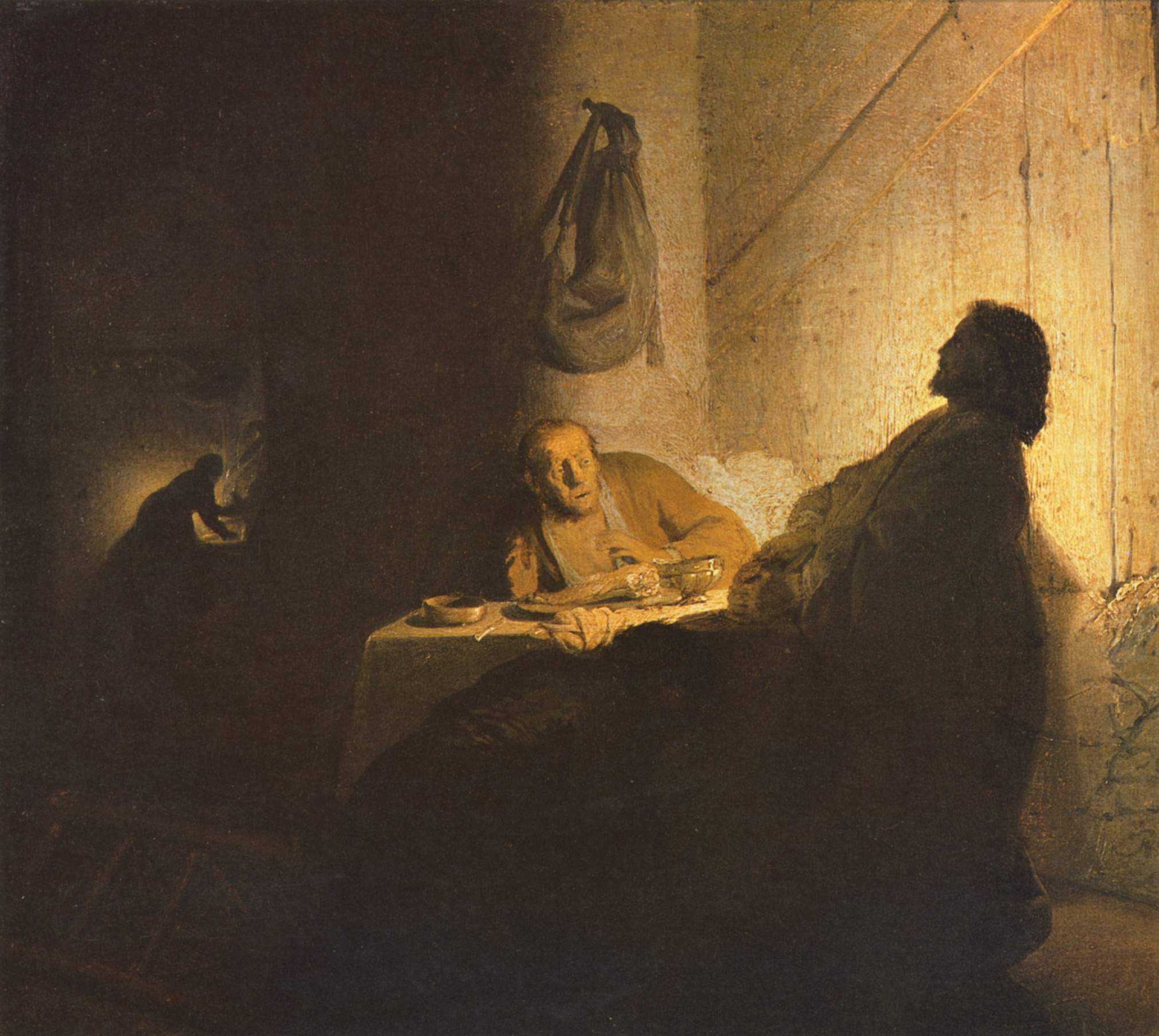
I like Rembrandt, especially his later work, which becomes more and more concerned with the message than the medium. For example, look at these two portrayals of the 'Supper at Emmaus.'

This one dates from 1628:


In 1628 Rembrandt was a 22-year-old hot hand, as we'd say in architecture school. Look at that dramatic rendering of the moment in Matthew's Gospel: "When he was at table with them, he took the bread and blessed, and broke it, and gave it to them. And their eyes were opened and they recognized him; and he vanished out of their sight." (Mt 24:30-31) The light; the darkness; the astonishment! It's very literal, and is a terrific illustration of the moment, perfect for engaging the kids, right?

Well...no. I wouldn't use that 1628 painting in class.

I'd use this one:


Here Rembrandt shows the benefits of twenty more years of reflection. I can use this portrait to deepen the kids' understanding as well.

First, the apostle's recognition of Jesus happens in the company of people who don't recognize him at all. This isn't so different from any number of people (thousands, I suppose) who saw and heard Jesus; and lacking faith, paid him no particular mind. This lack of recognition ties in well with a quick recap of one of Isaiah's Christmas prophecies: "The ox knows its owner, and the ass its master's manger; but Israel does not know, my people does not understand." (Is 1:3)

Next, the recognition focuses more on spiritual recognition than physical. The apostle's bodily reaction is so muted that the others don't notice; but his face reveals his gradual realization that this is Jesus.

And this Jesus, what a gift. This Jesus is barely there, on the verge of vanishing, already disengaged from the fallen world. A heavenly Jesus who didn't want to be touched by Mary Magdalene on Easter morning. One whose attention is quite reasonably elsewhere, counting the minutes until he at last ascends to the Father.

This is the image to teach from.

Wednesday, May 4, 2011

Arks & Tabernacles

This post is linked to RAnn's Sunday Snippets


continued from Wedding Reception

Mass is almost over now that we have received Communion; in a few minutes the feast will be over. This is a good time to look at how a Catholic church helps the feast take place.

But first, does anyone know who Balaam [on the board] is? No? How about Balaam's Ass [on the board]? (giggles & snickers) No? OK then: Balaam was a pagan who lived when the Israelites were getting established in the Promised Land after their 40 years of wandering in the desert. He was famous for blessing and cursing people, and making it stick. Well, the Israelites had been whipping their local enemies in battle so thoroughly that Balak, the king of Moab, wanted to pay Balaam to curse the Israelites. He didn't want to be next on their whipping schedule. Y-H-W-H (don't say it!) told Balaam not to visit Balak, but the Book of Numbers says, "Balaam rose in the morning, and saddled his ass, and went with the princes of Moab."(more giggles & snickers)  OK, what's 'ass' mean? Donkey? Yes. Now this is your last chance to act like babies when I say 'ass'...ready?  Ass. (fewer giggles & snickers) Alright, that was it. No more giggling like 5-year-olds. "But God grew angry because he went; and the angel of the LORD took his stand in the way as his adversary." An angel blocked the way to Moab. "And the ass saw the angel of the LORD standing in the road, with a drawn sword in his hand; and the ass turned aside out of the road, and went into the field; and Balaam struck the ass, to turn her into the road." [I act all this out] "Then the angel of the LORD stood in a narrow path between the vineyards, with a wall on either side. And when the ass saw the angel of the LORD, she pushed against the wall, and pressed Balaam's foot against the wall; so he struck her again." Poor donkey, she's doing Balaam a favor! "Then the angel of the LORD went ahead, and stood in a narrow place, where there was no way to turn either to the right or to the left. When the ass saw the angel of the LORD, she lay down under Balaam; and in anger Balaam beat the ass with his stick." Now I love this: "Then the LORD opened the mouth of the ass, and she said to Balaam, "What have I done to you, that you have struck me these three times?"  And Balaam said to the ass, "...I wish I had a sword in my hand, for then I would kill you." Then the LORD opened the eyes of Balaam, and he saw the angel of the LORD standing in the way, with his drawn sword in his hand; and he bowed his head, and fell on his face." Balaam decided to get himself some humility in a hurry. Trick question: why was Balaam riding the donkey with his eyes closed? His eyes weren't closed!  No? It says, "the LORD opened the eyes of Balaam, and he saw the angel." Doesn't that mean his eyes were shut? No, it means he couldn't see the angel until God let him. Oh. But the donkey saw the angel the whole time...how come? No guesses. Tell me, can we see water wash sins off a baby at Baptism? No. Can a saint see it happen? Yes. Why? No guesses? Put it this way: why can't we see it? 'Cause we're sinners! Yes, sin makes us...blind! Yes! So Balaam couldn't see the angel...'cause he was a sinner! Yes; but Balaam's ass could see the angel because...animals don't sin? Maybe so, the story doesn't say. But remember in one of Isaiah's Christmas prophecies, he said the people of Israel didn't know their master, but the the ox and ass did.

Now, back to the feast, listen again to another bit of Isaiah you've heard before: "And he will destroy on this mountain the covering that is cast over all peoples, the veil that is spread over all nations." Are 'all people' sitting under a giant blanket? No, it's not real. So what is covering them, what sort of veil is it? Is it sin? Yes, at Isaiah's feast the veil of sin will be "destroyed" so people will be able to see God clearly. And if sin is destroyed, where must the feast be? In Heaven. Yes.

Now let's look at this handout again, you've seen it before:

What's the first plan? Moses' Meeting Tent. Yes...did Moses design it? No, God did. Yes, God gave instructions about every detail of the Tent: "And let them make me a sanctuary, that I may dwell in their midst. According to all that I show you concerning the pattern of the tabernacle, and of all its furniture, so you shall make it." God showed Moses the heavenly pattern of all the stuff that went in the tent, even including little things like the candlesticks. And if God "dwelled" in the tent, then it was...his house? Yes, he lived in a tent because his people, the Israelites, lived in tents.

Somebody tell me, what's a tavern? Is it like a bar? Yes. Up North, like in Pennsylvania, people will say 'tavern' when we say 'bar'; I think tavern sounds more civilized. Anyway, taberna [on the board] is a Latin word for house. Yes? Why does it have a b? Because b's and v's sound almost the same in some languages. Somebody digame, como se llama twenty in EspaƱol? Somebody say twenty in Spanish.  Veinte [on the board]! Yes. See, it's spelled with a v, but listen to the sound, please say it again. Veinte. Does it sound like a b or a v? Kind of in between. Yes.

So taberna means house, and a tabernaculum [adding to taberna] is a little house, or a tent or a log cabin. Where an English Bible says 'tent,' a Latin Bible will say tabernaculum. What word do we get  from that? Tabernacle. Yes. We have a tabernacle in church! Yes, good, we're getting to that. The whole meeting tent was the tabernacle, God's dwelling. Now look at the Holy Spaces where only the priests could go: what separates them? A veil. Yes. Is it a real veil? Yes!  Right, it was a beautiful curtain that prevented everyone from seeing what? The Ark!  Yes. Only one person could go behind the veil...who? The High Priest? Yes. The other priests could tootle around the rest of the Meeting Tent, but they couldn't go past the veil. So who would offer the most important sacrifices to Y-H-W-H? The High Priest. Yes; he offered sacrifices for the whole nation, all the people of Israel, right in front of God. Was God there physically? Well, God doesn't have a body. Right; but Y-H-W-H's presence was right above the Ark, between the cherubim. What's ark mean? A container! Yes, good. And what was in the Ark? Come on, y'all know this. Umm...the Ten Commandments? Yes, and...the miracle bread...manna!  Yes, a pot of manna; and Aaron's staff. Are those things God? Ummm, no? Right; God wouldn't live in a box. God's stuff is in the box. But the Israelites had super-respect for that box of stuff.

Now look at Solomon's Temple: it's bigger and nicer and more permanent than the Meeting Tent; but it has the same pattern as the Tent. Who designed the pattern? God! Yes. Is that a real veil? Yes!  Right; just like in the Tent. And look at the Church: tell me about the pattern. It's the same! Yes, almost.

In the New Testament there's an Epistle to the Hebrews...what's Epistle mean? Letter. Yes, so it's a letter written to Jews who had become Christians. I think they might've been worried about not going to the Temple in Jerusalem every year and sacrificing a Passover Lamb. The Epistle explains to them that it's not necessary anymore, because "we have a great high priest who has passed through the heavens, Jesus, the Son of God...who is seated at the right hand of the throne of the Majesty in heaven, a minister in the sanctuary and the true tent which is set up not by man, but by the Lord." So where is the "true tent"? In Heaven! Yes; tell me, who is the High Priest in the church? Jesus. Yes, and where is the High Priest? In Heaven. Yes, he's the slain Lamb, a perfect Lamb, who offers himself right in front of the Father's throne in Heaven, in the true tent. So the Hebrew Christians didn't need the Temple priests to sacrifice and offer lambs for them anymore. And how long will Jesus be a High Priest? Umm...forever? Yes, at least until the Final Judgment in Revelations. The Epistle says we have "a hope that enters into the inner shrine behind the veil, where Jesus [has] become a high priest for ever after the order of Melchizedek." What's the deal with Melchizedek? He offered bread and wine! Yes; like...Jesus! Yes, at...the Last Supper! Yes! Y'all are too smart!

At Mass, can we see Jesus offer himself in Heaven? No. Right; now tell me about the veil on the church plan. It's not in the church! Right; is it a real veil? No, it's sin! Yes, sin veiled Balaam's eyes from seeing the angel, and sin veils us from seeing what's in Heaven. But if we become saints, and free from sin...then we can see. Yes. So the pattern in a church stops at the veil of sin, and the rest of the offering of the sacrifice takes place beyond that veil, in...Heaven, yes which is the true tent, not an earthly copy.

Now tell me about the Ark in the church plan. There isn't an Ark, there's a tabernacle. Yes; what's the difference? No guesses? What's ark mean? Container! Yes, in this case, a box. And what goes in a box...people? No, stuff!  Yes. Is Jesus stuff?  No, a person! Yes, and if Jesus wants to dwell with us in church, would you have him live in a box? No!  What do people live in? A house? Yes, so Jesus...has to have a house. Yes, but he doesn't take up much room under the appearance of bread; he doesn't need a full-size taberna, but a...tabernacle! Yes, a "little house."  Why do tabernacles often look like little houses? Because Jesus lives there. Yes, as the Bible might say, Jesus dwells with us in the Tabernacle.

Now in the Tent and the Temple the Jews had great respect for the box of God's stuff. But what should get more respect: God's stuff in a box, or God himself in his little house? God in his little house! Yes, so always behave in church with the respect that Jesus deserves.

Now after people eat a feast, what needs to be washed and put away? The dishes? Yes; who does them...the guests? No, the person who invited them. Yes, the host or hostess. Well, after Communion, the priest does the dishes. When he's done, Jesus is put back into his little house, and we all sit down. Following a short prayer and any announcements, the priests blesses us and says, "Go forth, the Mass is ended." Somebody digame how to say Mass in Spanish. Misa! Yes [on the board]. It comes from this Latin word: missa [on the board]. At the end of Mass in Latin, the priest says "Ite, missa est" [on the board]. It means "Go, it's the dismissal." That's where we get the word Mass, from the dismissal. And the people say...thanks be to God! Yes. Then what happens? Well, we leave? Yes, the Mass is over.

And our year of 6th grade Wednesday Sunday School is over too, along with all your misery. I do hope y'all learned a thing or two while y'all suffered so dreadfully. And for the rest of your lives, if you have a question about being Catholic, or the Bible, or the Mass, or whatever, get a hold of me and I'll find you an answer.

Before class is "dismissed" I want to draw one last picture that pulls together a lot of what we learned this year. [I draw] What's this? The altar. Yes, which is also a...table...yes. It represents...Mass? Yes...and here's the priest, who stands in for...Jesus. Yes. Now around the Mass I want y'all to name six things we learned that tie into the Mass. The Last Supper! Yes, and? A man who offered bread and wine...Melchizedek! Yes, and...blood on the doorposts...Passover! Yes....miracle bread in the desert...Manna! Yes...miracle bread...Jesus...apostles...Loaves & Fishes! Yes, and last of all...we learned it tonight...wedding...Wedding Feast! of...the Lamb! who is... Jesus! Yes, good children!

Praised be Jesus Christ!

Now and Forever!

Class over!

Monday, May 2, 2011

Res Ipsa Loquitur 3


 Here are the audio files of the class recounted in the post Manoah and the Angel. The written account is a condensation of this class, and classes from prior years covering the same material, so the audio and the post vary a bit in content & flow.

For more live classes, click on the Res Ipsa Loquitur label at lower right.

Saturday, April 30, 2011

Altar Boys & Vocations


Some observations about my 2,000-household parish regarding vocations:

We have had a boys-only corps of altar servers for at least the last 10 years; currently there are 49 servers, ranging from 6th grade through college. To have ten at the 11am Solemn Mass is not unusual.

We had one ordination in 2005.

We had another in 2007.

We currently have two seminarians.

Two of our college-age men (including my youngest son) will live in the diocesan discernment house next Fall. That's 2 out of a total of 8 for the whole diocese.

And of course there are also highschool-age servers who are explicitly considering vocations; one of our senior servers plans to go straight from highschool into the seminary.

I do not suggest a direct cause-and-effect here; nonetheless, the boys-only approach has a positive influence on vocations, and is a critical part of an overall conscious intent in the parish to nurture them.

The corps in action (scroll ahead to about 2:00)

2013: Our third former altar boy was ordained  this summer.

2014: Our fourth former altar boy will be ordained this summer.

Friday, April 29, 2011

Wedding Reception


Hey y'all, Lent is over, and last Sunday was Easter. So instead of praying an Act of Contrition for Lent, we have an Easter season prayer, which I will sing because it's also a hymn to Mary that's about 900 years old. It tells her to be happy because Jesus isn't dead anymore:

"O Queen of Heaven, be joyful, alleluia.
For He whom you have humbly borne for us, alleluia.
Has arisen, as He promised, alleluia.
Offer now our Prayer to God, alleluia"

Ok, last week in our Mass class we stopped with the priest saying, "command that these gifts be borne by the hands of your holy Angel to your altar on high in the sight of your divine majesty," and referred to that great image of the angel going up to heaven in the Holy Tornado.


Moving forward in the Mass from there, the priest says, "Remember also, Lord [those] who have gone before us with the sign of faith, and rest in the sleep of peace." Who are these people? Saints? Yes. And the priest mentions some of them: "graciously grant some share and fellowship with your holy Apostles and Martyrs:" John the Baptist, who y'all know; Stephen, who was the first...? He was stoned to death...the first martyr!  Yes. Matthias, who replaced...the bad apostle...Judas! Yes. Barnabas, who traveled with St. Paul; Ignatius, Alexander, Marcellinus; Peter, the first...pope! Yes. And now a group of women saints: "Felicity, Perpetua, Agatha; Lucy, who was tortured by...putting her eyes out! Yes, and "Agnes, Cecilia, [and] Anastasia." These saints were all among the first Christian martyrs. And I like Anastasia because her name comes from Anastasis, which is Greek for...Easter! Yes, it means "resurrection."

And when the priests asks for "fellowship" with the saints, what's he mean? To be friends with them? Yes, to be part of the Communion of Saints, who are at Mass with us even if we can't see them.

Tell me, when we think about our sins, do we want God's justice? No, we want his mercy! Yes, his forgiveness. That's why we next hear, "admit us, we beseech you, into their company, not weighing our merits, but granting us your pardon..."

During the Eucharistic Prayer we're kneeling; when it comes to and end, we stand up. When we stand up, what do we pray? C'mon, y'all know this. "At the Savior’s command and formed by divine teaching, we dare to say"...the Our Father! Yes, which comes to us straight out of Jesus's mouth in the Gospel of Matthew. And y'all know this line: "and forgive us our trespasses, as we forgive those who trespass against us..." Well, right after Jesus finished the prayer, he said, "For if you forgive men their trespasses, your heavenly Father also will forgive you; but if you do not forgive men their trespasses, neither will your Father forgive your trespasses." (Matt 6:14) So, if we don't forgive others...God won't forgive us. Right. I expect to spend quite some time in Purgatory burning my resentments away in order to forgive everyone. So even though y'all are way younger than me, y'all may beat me to Heaven, even if I die first as expected. When you zoom past me, say, "Bye, Stratopops, I'll pray for ya!"

Now we get to my favorite part of the Mass. First we say, "Lamb of God, you take away the sins of the world, have mercy on us" how many times? Three! Yes; and who are we quoting? John the Baptist! Yes, and we kneel again. Then the priest holds the Body up, which looks like...bread, yes, and says: "Behold the Lamb of God, behold him who takes away the sins of the world." And who first said that? John the Baptist. Yes; about whom? Jesus.Yes, when? When Jesus came to be baptized. Yes; where? In the Jordan River. Yes, good. This reminds us that Jesus is just as physically present at Mass as he was when John spoke those words at the Jordan River. It's the Lamb of God, it's Jesus. And what's the deal with the Passover Lamb? You have to eat it! Right. By the way, what did John eat in the desert? Bugs! Yes, tasty when dipped in honey...right, girls? Ewww! Uh-huh...boys? Cool! Yep.

Then the priest quotes an Angel in Revelations: "Blessed are those called to the supper of the Lamb." This reminds us we're about to share in the Wedding Feast. Let's look at where this comes from in Revelations, which we already know says a lot about the Heavenly Worship that connects to Mass on Earth. But first let's read a bit from Isaiah that you heard earlier this year: "On this mountain the LORD of hosts will provide for all peoples a feast of rich food and choice wines; juicy, rich food and pure, choice wines. On this mountain he will destroy the veil that veils all peoples, the web that is woven over all nations; he will destroy death forever. The Lord GOD will wipe away the tears from all faces..." Tell me, is Isaiah describing a snack? No, a feast! Yes, and all peoples are there, not just the Chosen People. And there's no death or tears, so it must be...in Heaven! Yes.

Revelations adds to Isaiah's prophecy: "Then I heard what seemed to be the voice of a great multitude, like the sound of many waters and like the sound of mighty thunderpeals, crying, "Hallelujah! For the Lord our God the Almighty reigns. Let us rejoice and exult and give him the glory, for the marriage of the Lamb has come, and his Bride has made herself ready; it was granted her to be clothed with fine linen, bright and pure." And the Lamb is...Jesus, yes. And the Bride is...the Church, yes, which is all the nice buildings? No, it's us!  Yes; and we'll all live in the Holy City, the...New...Jerusalem! Yes.

So Jesus marries the Church...why? Because he loves Her! Yes. So much that He died for Her. And after a wedding, there's...a reception! Yes! So it's a happy feast, but serious, too. And an angel said, "Blessed are those who are invited to the marriage supper of the Lamb...On his robe...he has a name inscribed, King of Kings and Lord of Lords... Then I saw an angel standing in the sun, and with a loud voice he called..."Come, gather for the great supper of God..." So when we eat the feast on Earth...they're eating the feast in heaven?  Yes.

When I was about your age there was a rock band called Genesis. They wrote a song about the Book of Revelations, which is clever: Genesis is the first book in the Bible, and Revelations is...the last one. Yes. The song is called "Supper's Ready." Is it about eating leftover pork and beans around the kitchen table? No it's about the Wedding Feast! Yes! Listen to the last few lines of the song, which ties together all the stuff you've learned about Revelations:

"There's an angel standing in the sun,
And he's crying with a loud voice:
This is the supper of the Mighty One.
The Lord of Lords, King of Kings,
Has returned to lead His children home,
To take them to the New Jerusalem."

So when the priest says, "Blessed are those called to the supper of the Lamb," use your imaginations.

And then we respond to the priest...you know it: "Lord, I am not worthy that you should enter under my roof...but only say the word and my soul shall be healed! Yes. And who said it first? The guy who wanted his servant healed... Yes...who was "this guy"....the popsicle man? No, a soldier. An Imperial Stormtrooper? Ha, no a Roman soldier. Yes, who commanded a hundred men...a centurion! Yes; and he was a pagan; he believed in made-up gods.

I really like the centurion. I always have to pray for faith before Communion because it looks like plain-old flat, dry bread to me. I struggle with doubt even while I believe. But I'm reminded of the faith of the centurion. He believed Jesus could miraculously heal his servant without needing to visit him; and even though he was a Roman officer, the centurion was so humble that he didn't feel worthy to have Jesus come to his house. If a pagan can have such faith and humility then it's not beyond my reach.
This is how the Church uses the Bible to prepare us to receive Jesus at Mass. But you have to know what the verses mean, and think about them, for it to matter. Think about John and Jesus at the Jordan, the Wedding Feast, and the believing Roman officer, and why the stories are put together right before Communion.

What's next? We go up for communion. Yes, and do we go and grab a fistful of communion hosts? No, the priest gives us one!  Yes, just like when Jesus multplied the loaves & fishes: the people didn't take the miracle food: the apostles distributed it to them. And when we eat the host, we eat...the Lamb! Yes. And we eat...Jesus! Yes. And we eat...no more guesses? We eat God; we're God-eaters. Why is that good: to eat God? 'Cause God is good? Yes, like eating broccoli, God is good for you, but more than that...imagine I'm a young hunter in a primitive tribe. If I kill a lion, what part of the lion would I especially want to eat? His toes? His nose?...What was the matter with the lion in the Wizard of Oz? He didn't have any courage! Yes, which a lion is supposed to have. So what part of a lion would a hunter want to eat? Umm...his heart? Yes, what would he hope to gain from that? To get the lion's courage? Yes, and maybe his fearsomeness, strength, speed, and hunting skill. People have believed by eating the heart of an enemy or an animal they could gain their power. Does that really work? No. Right. But with communion it's different: what do we get spiritually by eating God? His goodness? Yes, his holiness. Have you ever heard the saying “you are what you eat”? Yes. Well, when you eat Jesus you become more like Him, more holy. And remember the day after the Loaves and Fishes, Jesus said “Truly, truly, I say to you, unless you eat the flesh of the Son of Man and drink his blood, you have no life in you;” so you're doing what Jesus expects you to do- truly, truly.

And after you receive communion, how long is Jesus physically in you? Until your stomach digests, umm, the communion? Yes, for about 15 minutes. So when you get back to your pew, don't daydream: pray while Jesus is in you. I usually thank God for making this little miracle of the Body'n'Blood available to me, but you can pray however you like.

continued in the next post


Sunday, April 17, 2011

Manoah & the Angel


 continued from the prior post

After the priest receives the bread and wine, he says the Invitation to Prayer: "Pray, brethren, that my sacrifice and yours may be acceptable to God, the almighty Father." And we reply, "May the Lord accept the sacrifice at your hands..." What's the sacrifice? Jesus? Umm, not yet, what just got brought up at the Offertory? Bread and wine. Yes, there's no change yet...but we're getting there. Is the bread nice and fluffy? No it's flat. Why isn't it fluffy? Because Moses couldn't wait for fluffy bread. Right, for the first Passover the Israelites made their bread without leavening so they could leave Egypt quickly. So our New Passover meal has flat bread, too.

Next we sing the Sanctus, you know it: "Holy, Holy, Holy Lord God of hosts. Heaven and earth are full of your glory. Hosanna in the highest. Blessed is he who comes in the name of the Lord. Hosanna in the highest." Who remembers in the Gospels when people said 'hosanna' to Jesus? He was coming into a town...they were waving palms...Palm Sunday! Yes, when Jesus entered...Nazareth! No...Jerusalem! Yes. People had heard he was the Messiah. Not a meek Messiah, but one like...King David! Yes. But when we say 'hosanna' at Mass, we know Jesus isn't an earthly king...where is he king? In Heaven. Yes. In fact, the first part of the Sanctus, "Holy, Holy, Holy Lord God of hosts. Heaven and earth are full of your glory" is mostly said in Heaven, not here on Earth. Let's look in Revelations to see what goes on in Heaven while we're at Mass.

In Revelations chapter 4, St. John has a vision of the Heavenly Liturgy: "At once I was in the Spirit, and lo, a throne stood in heaven, with one seated on the throne! And...round the throne was a rainbow... Round the throne were twenty-four thrones, and seated on the thrones were twenty-four elders, clad in white garments, with golden crowns upon their heads." [I draw & talk] Here's the throne...who's sitting on it? God? More specifically, please. Jesus? Good guess, but no. Mary? Well, she's Jesus's mom, but no. God the Father?  Yes. And here are the elders, pretend that's 24 of them....with crowns...there. Who remembers the Greek word for "elder"? Presby-something? Yes, presbyteros; and we shorten it to...priest! Yes; so think of them as priests. And what's a priest's job? C'mon, y'all know this. To say Mass?  Partly, but specifically what do priests do? Aztec priests, Catholic priests, Levite priests, they all...sacrifice! Yes, they offer sacrifice.

"And round the throne, on each side of the throne, are four living creatures...the first living creature like a lion, the second living creature like an ox, the third living creature with the face of a man, and the fourth living creature like a flying eagle." Who might these 4 creatures represent? We have an angel, a bull, a lion, and an eagle...four saints, their pictures always show them writing...MatthewMarkLuke&John! Yes, who are...gospel writers!  Yes, evangelists.


"And the four living creatures, each of them with six wings, are full of eyes all round and within, and day and night they never cease to sing, "Holy, holy, holy, is the Lord God Almighty, who was and is and is to come!" We say this at Mass because they're saying it in heaven. "And whenever the living creatures give glory and honor and thanks to him who is seated on the throne, who lives for ever and ever, the twenty-four elders fall down before him who is seated on the throne and worship him who lives for ever and ever.." When they give thanks they 'eucharisteo' in Greek, just like we do with the Eucharist.

Now with all these elders, these presbyters, these...priests, yes, standing around the throne, what should they be doing? Praying? Hmm...tell me again, what's a priests job? To offer sacrifices? Yes, so they...should....be offering a sacrifice? Yes. So what's missing? A sacrifice? Yes. What would be a good typical sacrifice? A lamb? Yes! John says, "And between the throne and the four living creatures and among the elders, I saw a Lamb standing, as though it had been slain." This Lamb would be...Jesus?  Yes [I add the Lamb]; how about that? It looks like a dog. Please, be charitable. And I need a red marker because the Lamb needs...blood on it!  Yes...now that's a slain lamb! "...and the twenty-four elders fell down before the Lamb, each holding a harp, and with golden bowls full of incense, which are the prayers of the saints...and they sang a new song, saying, "you were slain and by your blood did redeem men for God." So we know the Lamb is...Jesus, yes, and the elders are singing, and playing music, and burning incense, and saints are praying, all of which should remind you of...Mass? Yes. The communion of saints on earth and in heaven are doing the same things. And which of those things do we do at Mass? Well...all of them?  Yes. Heaven and earth are connected at Mass.

So in heaven we have the priest-elders, whose job is to...offer sacrifice, yes, and we have a victim, a... lamb, who is...Jesus, yes. But what's still missing? Do you offer sacrifices on a sofa? No, an altar! Right!

John writes, "And another angel came and stood at the altar with a golden censer" So there is an altar: "and he was given much incense to mingle with the prayers of all the saints upon the golden altar before the throne; and the smoke of the incense rose with the prayers of the saints from the hand of the angel before God." When we burn incense at Mass, remember that our prayers go up to heaven and mingle with the prayers in heaven. [I add  incense and the altar]

Now all of this is like Mass because Mass is like a Passover sacrifice in the Meeting Tent or the Temple. When Moses made the first Meeting Tent, did Moses decide how everything would be? No, God told him what to do. Yes, God said the design was based on the pattern in heaven. The Church, Temple and Tent are all patterned on this worship in heaven.

Back to Mass on earth: after the 'Holy Holy' what do we do? Kneel down. Yes; this is most important part of Mass, the Eucharistic Prayer. The priest says: "...most merciful Father,we make humble prayer and petition through Jesus Christ, your Son, our Lord: that you accept and bless these gifts, these offerings, these holy and unblemished sacrifices." And what's being offered at this moment? Bread and wine. Right, maybe $10 worth of bread and wine. If you were God, would you let that offering atone for our sins? No! Why not? It's not good enough. That's right.

The priest then reminds us that all of us saints on earth are praying along with all the saints in heaven: "In communion with...the glorious ever-Virgin Mary, Mother of our God and Lord, Jesus Christ, and blessed Joseph, her Spouse," that is, Jesus's...parents. Yes, and "Peter and Paul, Andrew, James, John, Thomas, James, Philip, Bartholomew, Matthew, Simon and Jude," who are...apostles. Yes, and "Linus, Cletus, Clement, Sixtus [and] Cornelius"...any idea who these guys are? That's ok: they're the first men to be pope after Peter. And then we hear, "Cyprian, Lawrence, Chrysogonus, John and Paul, Cosmas and Damian" who are some of the first martyrs. The Church doesn't name all these people to fill up time, but to remind us of all the saints who are praying with us at Mass.

Now, we are still offering bread and wine at this point, but the priest prays, "approve this offering in every respect; make it spiritual and acceptable, so that it may become for us the Body and Blood of your most beloved Son, our Lord Jesus Christ." And when did bread & wine first become Body & Blood? At the Last Supper? Yes, so the priest takes the bread, and prays, "On the day before he was to suffer, he took bread in his holy and venerable hands, and with eyes raised to heaven to you, O God, his almighty Father, giving you thanks (eucharisteo!), he said the blessing, broke the bread and gave it to his disciples, saying: take this, all of you, and eat of it, for this is my body which will be given up for you." Of course this is straight out of the Gospels. Then he holds the chalice and says, "Take this, all of you, and drink from it. For this is the chalice of my blood; the blood of the new and eternal covenant, which will be poured out for you and for many for the forgiveness of sins. Do this in memory of me." And what happens? They change into body and blood! Yes. This moment is called the Consecration: when the bread and wine are made sacred, holy.

Then he prays: "look upon these offerings...and...accept them, as once you were pleased to accept the gifts of your servant Abel the just, the sacrifice of Abraham, our father in faith, and the offering of your high priest Melchizedek, a holy sacrifice, a spotless victim." Tell me quick, Abel offered...a lamb! Yes; Abraham offered...a ram!  Well, before the ram...Isaac, yes, his son. And Melchizedek...bread and wine! Yes, and at Mass do we offer bread and wine? Yes! And a lamb? Yes! And a son? Yes! Good; Mass recalls all those offerings.

Now let's look at this handout:


What's that a picture of? Mass. Yes, but it's also like the story of Manoah and the Angel. Remember Samson's parents, Manoah and his wife, were told by an angel that they were going to have a baby. They were so happy that Manoah made a thanksgiving-in-Greek-Eucharist offering to God.  "So Manoah took a young goat with the cereal offering, and offered it upon the rock to the LORD, to him who works wonders. And when the flame went up toward heaven from the altar, the angel of the LORD ascended in the flame of the altar while Manoah and his wife looked on; and they fell on their faces to the ground."

 And here's what the priest says next: "In humble prayer we ask you, almighty God: command that these gifts be borne by the hands of your holy Angel to your altar on high in the sight of your divine majesty..." What does that sound like? It's like what Samson's parents saw! Yes, it's like the angel taking Manoah's offering  from the altar on Earth up to heaven. But the picture and the prayer are both from....Mass! Yes! We don't see the angel who does this, but it's part of our prayer, we believe it happens. Why can't we see this? C'mon, we're blinded by something....oh, sin! Yes, and to believe in something we can't see we need....faith. Yes. All the saints in heaven can see it, though. And what is the angel taking up? Well, the offering. Yes, but what's being offered at this point? Umm, bread and wine? No, there's no more bread and wine. Oh, Jesus is the offering! Yes. That's Jesus being carried up; not some goat like Manoah offered but a perfect Lamb. And we are offering Jesus to whom? God. More specifically, please...God the Father. That's it.

"What's everybody doing in the picture? Well, they're at Mass. No, I mean their posture, they're all bowing their heads; why is that? No takers...let's read the last bit about Manoah again:  "...the angel of the LORD ascended in the flame of the altar while Manoah and his wife looked on; and they fell on their faces to the ground." Why'd they fall on the ground? They were scared when the angel took off. Yes, a bit scared I'm sure, but they were in the presence of a miracle, and it made them feel very humble. If I had seen that, I'd have fallen on the ground because I had passed out. People long ago would lie down on the ground in the presence of God, or even a king. Nowadays we just bow our heads, lying on the ground is messy. But notice at Mass, at the Consecration, the altar boys bow way down, their heads almost touch the ground when they bow. They bow like Manoah in the presence of God's miracle.

And in the picture that's Jesus on the cross: are we nailing Jesus on the cross at Mass? Umm...no? No, of course not. He was crucified once. But we offer Jesus's sacrifice at every Mass because Jesus offered himself at the Last Supper. Part of what we "do in memory" of Jesus is offer him when we co-memorate, commemorate, the Last Supper at Mass. That way Jesus's sacrifice is always present at the altar at Mass, just like the slain Lamb is always present at the altar in heaven.

Then we hear, "that all of us, who through this participation at the altar receive the most holy Body and Blood of your Son, may be filled with every grace and heavenly blessing." Let's review for a second. At the offertory, what do the people bring up to the priest? Bread and wine. Yes, then does the priest offer the bread and wine to God the Father: here's ten bucks' worth of bread and wine, Father, please forgive our sins? Ha, that's silly! Yes, so the priest offers what? Jesus. That's right; that's the perfect sacrifice that atones for our sins. And who turns the bread & wine into Jesus' body & blood? The priest. Wow, he must have super powers. Let's remember, Mass isn't mostly about what people do, it's about.....what God does, yes, so who made it happen? God. Yes. But Jesus works through the priest, so that was a good guess. Then we see in the picture the angel carries our offering from the altar on Earth up to the altar in Heaven...bye! So how do we "at the altar receive the most holy Body and Blood" if it all went to heaven? Well, some got left behind? Sort of...think about it this way:

When my wife puts on Christmas or Thanksgiving dinner, she spends a fortune, and does a ton of cooking and preparation. The guests know she worked hard for days. When the guests arrive they usually have something with them, what would that be? A present? What kind of present do you bring to a dinner, a power tool? Ha, no, food! Good guess, and maybe for the adults something...wet? Umm...wine? Yes indeed. Why do guests bring presents? 'cause they are glad you invited them! You got that right! They are not just saying 'thank you' but showing it by bring a thanksgiving offering. Now if someone brings my wife a nice bottle of wine, does she say thanks, and put it away for another occasion? No, I bet you drink it right then! Right! She says thank you so much, let's open it right now....here's a glass for you, let's all have some. It's like Mass: she does all of the important work; the guests show their thanks by offering a small gift; she is gracious and offers them back some of their offering. God does the same thing: we offer bread and wine; God gives us back Jesus. We offer Jesus; God says thank you, y'all have some too. And when we "receive from this altar the sacred body and blood" do we put it in our pocket for later? No, we eat it right then! That's right! That's how we show thanks at a feast: we eat it all right then! And remind me: what was that Israelite miracle bread called? Manna!  Yes; could they eat it later? No, they had to eat it when they got it. Yes, just like we do when we get our miracle bread.

New topic: tornadoes. Tell me about tornadoes. They blow around? Yes; where do they start? In the sky. Yes, in the clouds. They are powered by the atmosphere; and what happens? They make a funnel and go down to the ground. And what happens to small things they might run over? They get sucked up! Yes, and plopped back down later.

Look again at the Mass picture, see how it looks swirly toward the top? Yes. Well, I like to think of what happens at Mass as a Holy Tornado: God swirls it from Heaven down to our altar, and it carries the angel and the Body & Blood up to the altar in heaven, zhoop! Then it sends Jesus's Body and Blood back down for us to eat, phhhhht! How long do tornadoes last? A few minutes? Yes, and like regular tornadoes, a Holy Tornado is over pretty quick, too. But Masses are being celebrated all over the world, 24/7. Imagine thousands of Holy Tornadoes all around the world, zhooop, zhoop, zhoop, connecting heaven and earth for a few seconds each time. Let's draw that connection [under the drawing of the Heavenly Worship]. This is in church...what's this big blocky thing? The altar? Yes, like the one in heaven. And an altar is for...sacrifice, yes. And we have this guy...the priest,...yes, the presbyteros, the elder, like in heaven. And altar boys burn... incense, yes, like...in heaven. Yes...there we go. And here's the Holy Tornado connecting both altars with the same sacrifice, which is...Jesus. Yes. That makes sense because Jesus is both man...and God, yes, so he fits well into both places.

One last bit and we're done for tonight: this block thing isn't just an altar. What else is it?  When the priest says, "this is my body, this is my blood, do this in memory of me" what are we doing in memory of Jesus? The Last Supper?  Yes, which was...supper? Yes, a meal. So the altar is also...a table? Yes. And this meal isn't just any old supper...it's like Christmas dinner at my house...a feast! Yes. We'll learn about that next week, which is our last class. Your suffering will soon be over!

Praised be Jesus Christ!

Now and forever!