Wednesday, January 16, 2013

Res Ipsa Loquitur: Mass Model

No, not a mass model...
 

...a Mass model.

About 8 minutes of class time. Yes it's bedlam, but you can hear the kids thinking and learning. Multiply this 8 minutes by 7, and you get a sense of how much content is covered in 55 minutes of teaching, and at what depth.

Saturday, January 12, 2013

The Umbrella of the LORD


The Holy Spirit will come upon you, and the power of the Most High will overshadow you; therefore the child to be born will be called holy, the Son of God. 

Living in the modern, woodsy, and temperate South Carolina Upstate, the kids in Wednesday Night Sunday School don't grasp the Biblical concept of overshadowing right away. To them, overshadowing sounds dark and threatening, like a thundercloud. In prior years, I'd explain that people living in a hot, arid land would regard being overshadowed as a good thing, as in "made in the shade." I might use this example from my Yucatan honeymoon: at Chichen Itza, the sun was so brutal that I hid under a tree at every opportunity. I moved from shade-to-shade as much as possible.

But this year I got a volunteer to come stand in front of me. He acted out my description of being uncovered in the desert, and the sun burning him to a crisp: "Your lips are blistered and cracked, your head feels like it's on fire, you can barely open your eyes, you're cooking to death...what do you need? Water! No, you have water. Class, will water keep him alive 'til sundown? No! What does he need? Shade! Yes! He needs...(I reach into my canvas bag)...an umbrella! Yes!" I open it over the wilting child. "How's that? Good! Well don't just stand there, show us...there ya go, so cool, so nice...think you'll live now? Yes! Y'all tell me what people want at the beach. A beach umbrella! Yes. When it's hot and sunny, being overshadowed is gooood- got it? Yes! OK. Now volunteer, would you like to shade yourself with my umbrella? Yes! Well, you can't have it, it's mine. I can decide to overshadow you or not; and you can decide if you're going to stay in my shade or not. So if I start to move...I move too! Yes. But I don't force you, because you have...free will! Yes- we both agree that you'll be protected by my umbrella."

This year I thought of the umbrella only in time for the Annunciation. Next year I'll use it as soon as we cover Exodus, and discuss the Shekhinah overshadowing the Meeting Tent.

Speaking of Exodus, the Hebrew Old Testament does not have a directly-equivalent word for episkiazo, ἐπισκιάζω  the Greek verb we translate as overshadow. Hebrew instead has a few basic verbs such as sakak and kasah, which fundamentally mean "to cover."  Context often suggests specific meanings such as block, screen, protect, defend, enclose, and overshadow.

Centuries after Exodus was written down, the Hellenic Jewish scholars of Alexandria translated the Hebrew scriptures into Greek: the Septuagint. When they translated verbs such as sakak סָכַךְ and kasah כָּסָה into the word-rich Greek language, they didn't say "to cover" every time. So to understand the Biblical idea of overshadowing involves looking at how the concept of covering is used in a spiritual sense in the Old Testament, regardless of the particular verb used in each case. What follows is a representative, but hardly exhaustive list of examples.

Ex 24:15:  Then Moses went up on the mountain, and the cloud covered the mountain. The glory of the LORD settled on Mount Sinai, and the cloud covered it six days; and on the seventh day he called to Moses out of the midst of the cloud.

Num 16:42 And when the congregation had assembled against Moses and against Aaron, they turned toward the tent of meeting; and behold, the cloud covered it, and the glory of the LORD appeared.

Ex 40:3 And you shall put in it the ark of the testimony, and you shall screen the ark with the veil.

Ex 25:20 The cherubim shall spread out their wings above, overshadowing the mercy seat with their wings, their faces one to another; toward the mercy seat shall the faces of the cherubim be.

That is, the LORD's cloud covers the Meeting Tent; the Meeting Tent covers the Sanctuary; the veil screens off the Holy of Holies; the cherubim overshadow the Mercy Seat. Four degrees of covering which define increasingly-exclusive access. Ultimately only one person, the High Priest, is allowed access to the Mercy Seat.

Some charming and affectionate expressions of being protected by the LORD's overshadowing wings:

Ps 17:8 Keep me as the apple of the eye; hide me in the shadow of thy wings

Ps 36:7 The children of men take refuge in the shadow of thy wings.

Ps 91:4  ...he will cover you with his feathers, and under his wings you will find refuge.


The tree overshadows the mother; the mother overshadows her children

 A few more coverings:

1Kings 19:19 So [Elijah] departed from there, and found Elisha the son of Shaphat, who was plowing, with twelve yoke of oxen before him, and he was with the twelfth. Elijah passed by him and cast his mantle upon him. (Elijah selects Elisha to be his protege and successor.)

Nahum 2:5 The officers are summoned, they stumble as they go, they hasten to the wall, the mantlet (cover) is set up. (A mantlet, literally a small mantle or cloak, is a military term for a protective screen or shield. For example, a tank typically has an armored mantlet, which covers the opening through which its gun protrudes.)

Ruth 3:9 I am Ruth, your maidservant; spread your wing (i.e., cloak) over your maidservant, for you are next of kin. (Ruth wants Boaz to marry her.)

Those should be enough examples to give you a spiritual sense of covering: selection, separation, protection, dedication. The umbrella does a good job of physically showing kids these characteristics, especially separation. That is, let's say that as a husband I will put one woman, my wife, under my umbrella. She does not get rained on; and I shelter no-one else. My overshadowing is not inclusive, it's exclusive. And if I collapse the umbrella, she'll get wet. There's no spiritual dimension to it- but suppose there were?

Let's focus a bit on the matrimonial aspects of covering. We'll start with Elijah cloaking Elisha. True, they aren't getting married, but this is going to be a covenantal relationship regardless. Elijah physically and symbolically shows that he has selected Elisha; he will protect Elisha; Elisha is separated from his family; Elisha is dedicated to a new purpose. Why is this so? Because by covering Elisha with his mantle, and Elisha 'accepting the mantle,' Elijah echoes aspects of the Jewish marriage rite.

Y'all are probably familiar with the Jewish prayer shawl, the tallit:


You can see how this man covers himself, using his tallit to create his own private, separate, exclusive Meeting Tent. Suppose he were to admit someone else under his tent, could that matter? Indeed it could.

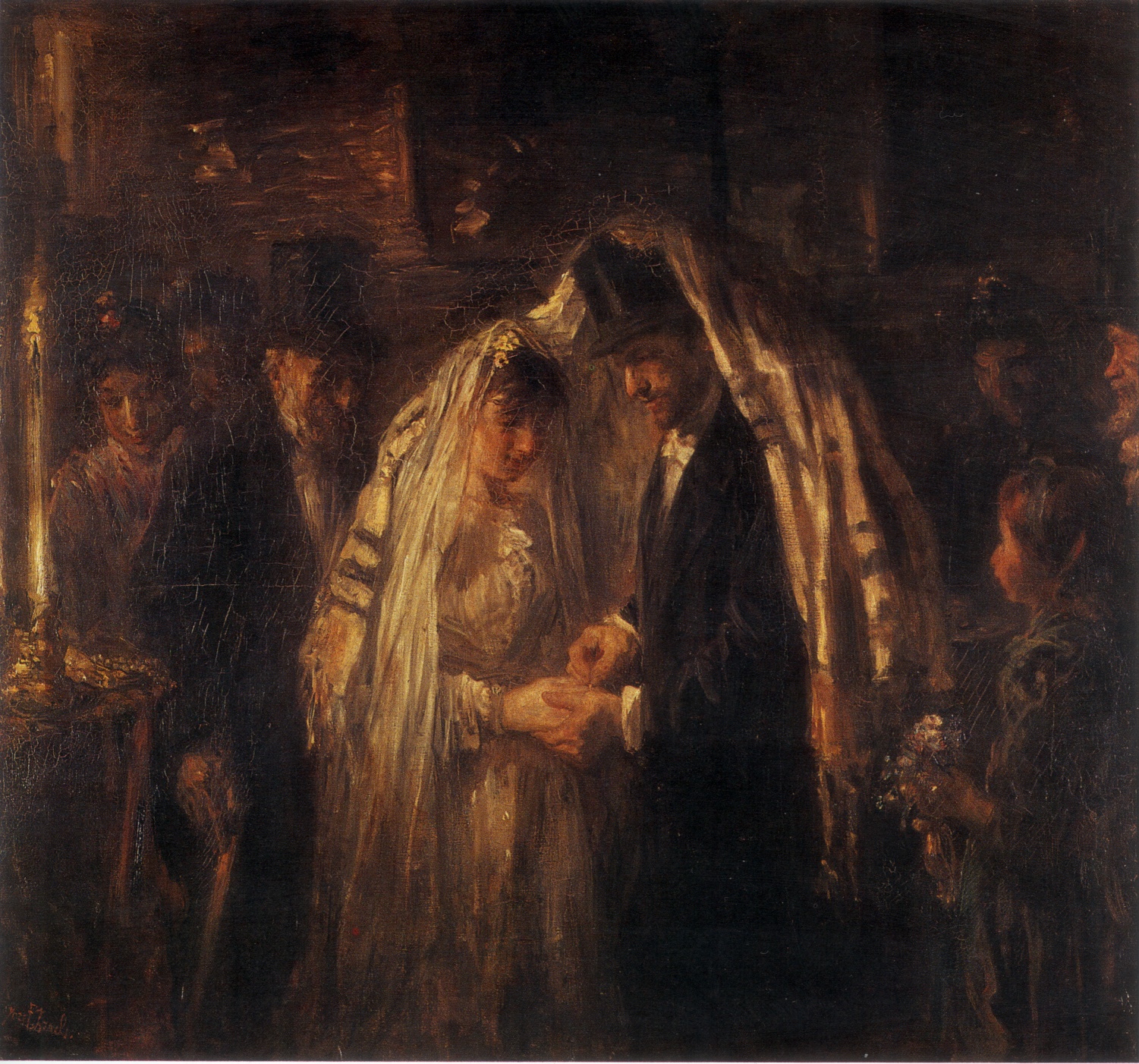
Here's a Jewish man admitting someone else into his tent, spreading his wings over her:


Of course they are getting married. The husband shows that his wife is, that's right, selected, separated, protected, and dedicated by covering her with his tallit. And she shows her acceptance by freely choosing to abide under his wing. By the way, the tallit may also be used to cover the wedding couple, as a tent once covered Abraham and Sarah. The tent covers the couple, the husband covers the wife; once again, a hierarchy of access:

 Yes, those are hockey sticks supporting the chuppah, the canopy.

Boaz understood that Ruth wanted him to marry her; and while spreading his wing over Ruth on a threshing floor would not make a marriage, it would most definitely indicate a commitment to wed. Did Boaz spread his wing over Ruth? Go find out on your own.

And likewise anyone who saw Elijah cover Elisha understood it was no ephemeral gesture.

Here's one more covering verse for you:

Acts 5:15 [T]hey brought forth the sick into the streets, and laid them on beds and couches, that at the least the shadow of Peter passing by might overshadow some of them.

We understand from context that Peter's shadow would heal those upon whom it fell. But after Peter had passed, and the afflicted were no longer overshadowed, would they become blind, lame, leprosy-ravaged again? Of course not: the consequences of Peter's overshadowing were permanent.

Suppose the Meeting Tent veils were pulled back; or the Shekhinah, the Glory Cloud, had shifted overhead; or the Tent wasn't pitched yet; or the cherubim weren't poised over the Ark; would any of that have allowed access to the Mercy Seat by anyone less than the High Priest? Of course not: access to the Ark was permanently exclusive, and the Ark itself was permanently reserved for God's Stuff, as we say in Catechism class.

And when Elijah put his mantle back on his own shoulders- was Elisha free to go back to his family and farm, get married, have kids? Again, of course not. The consequence of being covered by Elijah's mantle was permanent.

How about at a wedding? The husband must eventually put away his tallit, remove it from his wife's shoulders. Is his wife still selected, protected, separated, dedicated? Yes. Her status is permanent.

And the chuppah, the canopy- does God cease to cover the marriage when the tent comes down? Of course not.

Now back to the opening verse from Luke 1: "The Holy Spirit will come upon you, and the power of the Most High will overshadow you; therefore the child to be born will be called holy, the Son of God." That is, Mary was selected, protected, separated, and dedicated by God Himself, and Mary agreed to it. After the child was born, was Mary's overshadowed status canceled? Was Mary free to enjoy a life of marital intimacy with Joseph, having more children? The New Ark, once containing not merely God's Stuff, but God Himself, now suitable for holding...regular stuff?

Of course not: as a consequence of being overshadowed by God, Mary's virginal status was permanent.  More permanent than even a marriage vow, or the healings worked through Peter's passing shadow: ever-virgin.

My umbrella eventually has to close; God's doesn't.


Credit to the San Miguel News for the chuppah; and Henry Owassa Tanner for his Annunciation. 

Wednesday, January 2, 2013

Apple & Balloon


Our last class of the year covered December stuff: Immaculate Conception and Nativity scenes, mostly. We also talked about the transition from the Old Testament to the New, and got in a few minutes about John the Forerunner's miraculous conception.

For the last few years I've had a couple of girls portray this image, which I treat as the Great Hinge between the Testaments:

Yeah, I know, I show it in class every year around Christmas, and here at the blog. So what? It's a first-class catechetical tool, loaded with theological content like the work of Northern Renaissance artists such as van Eyck.

Anyway, the kids don't see the pic 'til we've discussed the content with our live models. This year, instead of saying, "Hey I need an Eve, get up here daughter...I need a Mary, yes, c'mon up," I did this:

"OK y'all I need two girl volunteers...two! not eight! And you aren't a girl! If you've already acted this year put ya hands down. Just one of you is left? OK daughter, you're it, come on up." I reach into my canvas bag. "Here, this apple's for you. Who is she? Eve! Yes, smarties! One more girl...NOT ALL OF YOU! Daughter, today's your birthday right? 12 years old on 12-12-12? Yes! OK, birthday girl gets the job!"

Now I pull out...a balloon?...and blow it up 'til it's about canteloupe size. "Here ya go, put this under your sweater like so. What's it for? Can y'all figure this out? She's pregnant! Ewww! Ewww! Ewww? Babies are great! Your mommas were pregnant with you! It's too weird! That's OK, you don't have to do it...who wants to be the pregnant woman? Me! Yes, c'mon up...there ya go. Who is she? Sarah! Good guess, but no. It's someone in the New Testament. Elizabeth! Ooh, great guess again, but no. Mary! Yes, and who's in the balloon? Jesus! Yes!" And from there we have the usual discussion followed by the image handout and more discussion. I like it better with the props, because then the kids can figure out, instead of being told, who the women are.

Couple of cartoons from class, similar to those in prior years:


Pressed for time during the Nativity discussion, I forgot this bit of Isaiah: A multitude of camels shall cover you, the dromedaries of Midian and Ephah; all those from Sheba shall come. They shall bring gold and frankincense, and shall proclaim the praise of the LORD; and thus left the camels out. But I remembered in 2010:


Tuesday, December 25, 2012

Hide in Plain Sight

 
 What's he think?

 Every year in Wednesday Night Sunday School we cover this bit of Isaiah:

"The ox knows its owner, and the ass its master's manger; but Israel does not know, my people does not understand."

And connect  it to these bits of Luke:

"And she gave birth to her first-born son and wrapped him in swaddling cloths, and laid him in a manger, because there was no place for them in the inn."

"And they went with haste, and found Mary and Joseph, and the babe lying in a manger."

See, Luke mentions the manger twice so we can understand the birth of Jesus in the context of chapter 1 of Isaiah: here's the Messiah right here in this manger, he's the master, nobody knows about it but dumb animals and the like. That is, Luke says manger to point out something from the past. I mean, what other reason would Luke have for bothering us with where Mary happened to plop Jesus? But he specifies manger to also say something about the future. I've been teaching Catechism of one sort or another since the late 90s, and don't think I've ever mentioned this other connection about mangers and Jesus:
 Miracle bread in Bethlehem*, get it? No? How about this:

Miracle bread and flesh, see? No? OK then, this:

You know: "the bread which I shall give for the life of the world is my flesh." Of course the dumb-yet-French-speaking ox and ass knew perfectly well all along that you put food in a manger**. But that would be Isaiah's point: sometimes the dumb and lowly know better than their betters.
  
*Bethlehem:  בֵּית  לֶחֶם Beyth Lechem, House [of] Bread.

**Manger: French, to eat.

Saturday, December 22, 2012

Greenville-Ephrathah 11

 
 Li'l 'phrathah

Recent news:

"A federal appeals court in Washington has reinstated the lawsuits for two religious colleges challenging a federal law that would compel them to cover contraception, abortifacients and sterilization in their employee health-insurance plans...During oral arguments Tuesday, HHS lawyers promised that the government would “never enforce” the mandate in its current form against Wheaton College, an evangelical liberal arts school in Illinois, or Belmont Abbey, a Catholic liberal arts college in North Carolina." (National Catholic Register)

But what makes the story Ephrathah-worthy?

Last week I was listening to one of the local Fundamentalist radio stations; their format is music, news, and gospel-preaching. When Catholicism comes up, it's in the context of its false teachings. In fact right now, the radio preacher is saying we've become our own priests and don't need a priest in a box. Straight to Jesus, amen! That's fine with me: I'm glad they just say what they mean. But when their newsman introduced the above ruling, he said it was in favor of "two Christian colleges," which he then proceeded to name. It would've been easy enough say a Christian college and a Catholic college, which is what I would've expected. It's a small thing; but not less significant to me for its smallness.

Kind of like the first Ephrathah.


Friday, December 21, 2012

Hommage au Chacal

This scope lets me see nearly 40 years into the future

Five or six nights a week, My Fabulous Wife and I will watch an episode of something on Roku or Netflix. Lately we've been watching Season 1 of Homeland, and I've noticed some homages to a few of my favorite movies. 

The first homage I recognized is based on this line from 1974's Chinatown: "When Mulvihill here was sheriff of Ventura County, the rum runners landed hundreds of tons of booze on the beach and never lost a drop. He oughta be able to hold on to your water for you." (Jake Gittes) In one of the first episodes of Homeland, Carrie (IIRC) makes a similar snide remark about a cop she thinks is corrupt, or at best, incompetent. She paraphrases the Chinatown line into a reference to illegal drugs.

Next is from 1972's The Godfather: 

"Hey, listen, I want somebody good - and I mean very good - to plant that gun. I don't want my brother coming out of that toilet with just his **** in his hands, alright?" (Sonny Corleone). In Homeland, Carrie and an FBI agent are arguing about a SWAT team fiasco. One of them uses the same vulgar imagery as Sonny to describe the hapless shooters.

After these two, I was primed for any other homages I might recognize. Then last night in Episode 9, "Crossfire," a scene opens with a sniper in the woods. I pause the show, and tell Janet, "This is going to be an homage to Day of the Jackal (1973). He's going to set up a target on a tree, then zero in his scope. He'll take two shots, adjusting his scope after each one; then take a third shot which will hit the bull's eye." I press Play, and- he does just as I expected. 

Near the end of the episode, the sniper fires another shot, this time with his rifle held steady by resting the barrel on a knife he has stuck into a tree. This is yet another Jackal homage based on the image at the top of the page, where the assassin steadies his rifle by tying the barrel against a tree.

Always fun to see that moviemakers and I like the same movies.


Tuesday, December 18, 2012

Book Review 2, Sort Of

Originally posted at New Evangelizers on Dec. 13
 

I read a Whole Lotta Books, but most of them aren't germane to my blog content. And if you want a review of Neptune's Inferno or Korsun Pocket, there are plenty out there that I can't improve on.

On the other hand, the New Evangelization Thing absorbs lots of my free time via 6th-grade Catechism class; and before that, teaching RCIA and Adult Ed with an explicitly Evangelical context. Although back in the late '90s when my wife and I were doing that, we didn't speak of, and I don't think we even had heard of, the New Evangelization. We were simply about helping old and new Catholics understand their faith in a way that enabled them to explain it to their decidedly un-Catholic friends and family.

It's only been in the last 10 years or so that I became aware of the phrase "New Evangelization;" JP2 first used the term about 30 years ago. I didn't know! Regardless, the Bible-Belt Catholic world I inhabit has had an Evangelical posture at least at the margins for what, 15 years or more? So it ain't all that New around here anyway.

About 8 years ago our parish had a 'Called and Gifted' workshop put on by the Siena Institute. It's 'designed to help Christians discern the presence of charisms in their lives.' I didn't attend, already having discovered that my charism was making 6th-graders suffer in Catechism class. But I thought the whole premise was intriguing, and later bumbled into Siena's website and blog. The blog was an eye-opener for me: Siena staff held Called and Gifted events all over the Anglosphere, and the blog was full of close-up observations of worldwide Catholicism: some encouraging, some pretty bleak. Now this was amazing to me because virtually all my friends in Upstate S.C. are gung-ho Catholics; time-treasure-talent Catholics; motivated, energized Catholics. And there are dozens and dozens of them: last Christmas/ New Year's we had two drop-in parties, invited about 100 of our "closest Catholic friends" and still couldn't invite everyone we wanted to.

One day at Siena's blog, founder Sherry Weddell posted about a lonely fired-up Catholic somewhere who didn't know a single other fired-up soul in his parish; and I commented how shocking that was, since my S.C. parish has more than you can shake a stick at. She asked if I belonged to St. Mary's parish in Greenville (she had done the Called and Gifted program here). I said yes, and Sherry remarked that it was not a typical parish.Well, yeah: but that atypical? And there are parishes that apathetic? 

In the meantime I was hearing more about the New Evangelization, which was an idea that harmonized well with my observations and goals in 6th grade Catechism class. I believe the Church is caught in a generational riptide where indifferently-catechized adults are indifferently-catechizing kids; who then grew up to be indifferently-catechized adults, etc. I'm not saying that Institutional Catechism is incompetent, but I am saying it's not very compelling by the time it goes into children's ears. At least I don't find it compelling. And my class goal is explicitly that the kids not just learn their faith, but learn it in a compelling way; and prepare now to evangelize later. I tell them in the first class that they have to pay attention and learn everything they can because I expect them to grow up to be catechists and evangelizers. And they start with their parents: their homework is to tell their parents what they learn. Breaking the riptide must start here and now, and will be a big part of the New Evangelization.

But I tell you what: I've read and heard hundreds of thousands of words about the New Evangelization on video, in print, and in person. And it all strikes me as 95% recycled generic Catholic information with a new name slapped on it. Or a lot of exhortation: like a football coach motivating his team in the locker room. Which is fine, but if the coach hasn't first trained his individual players in how to execute, they'll just get their asses whupped, exhortation or not.

So this brings me to the book, Forming Intentional Disciples by Sherry Weddell.

I first heard the term 'Intentional Disciple' at the Siena blog. It's the best one I know of to describe the sort of lay Catholic without whom there will be no New Evangelization, just a lot of talk about the New Evangelization. I like to say 'fired-up Catholic' or 'motivated Catholic;' but 'Intentional Disciple' is much better. Now Sherry could have defined that term on page 1, and then exhorted us to be intentional disciples and get out there and be New Evangelizers or whatever for another 249 pages, but she doesn't. She and her staff have been training, working with, and listening to, thousands of individual Catholics for more than a decade. So her book is based on that accumulated one-on-one, boots-on-the-ground experience.

Sometimes I tell My Fabulous Wife, "Bein' married t'you ain't like being married t'other women;" which is a compliment. Likewise, reading Forming Intentional Disciples isn't like reading other books on the New Evangelization. Which is also a compliment. The first few chapters describe the indifference and lassitude of the vast majority of the Catholic laity. Some info is statistical (not too much), but Sherry also includes lots of personal testimony from Catholics she has interviewed. Stuff I never heard of and would not have guessed at; and I expect most Catholics wouldn't guess at, either.

Then she describes real people and real parishes where things were turned around by small groups of...intentional disciples. At this point she could exhort you, the reader, to make a bunch of intentional disciples, turn around your parish and get busy with the New Evangelization! But she doesn't: the bulk of the rest of the book describes a step-by-step process of, you guessed it, actually Forming Intentional Disciples. Some of it is managerial and general, but there's lots of specific, interpersonal stuff in it as well, such as:

  • Talk explicitly about Jesus. 
  • Questions to ask people to draw them out about how their faith is lived (or not).
  • How to listen.
  • The stages people go through to become intentional disciples, and how to recognize where an individual is in that process. And again, these chapters are full of examples of real people in real parishes. 

The last chapter is titled 'Expect Conversion,' which would be a vacuous exhortation except that it is preceded by 11 substantial chapters containing concrete steps, specific advice, and real-life examples of what is already being accomplished by parishes using Siena's system. Particulars aside, the main reason I like this book is that it plops the responsibility for New Evangelizing right where it belongs: in the lap of the laity. And having done so, it then shows how the laity can get the job done. Not by talking about the New Evangelization, but by generating a critical mass of intentional disciples in one's parish. Based on my experience, if a parish has that, the rest happens of its own accord.

I'm not going into more detail. I'll close by saying that any Catholic who wants to see his or her parish become salt and light to the world would find Forming Intentional Disciples both an interesting read and a useful guide.